On My Radar: Year-End Market Summary and Outlook

December 19, 2025
By Steve Blumenthal
“There are two ways to enslave a country. One is by the sword. The other is by debt.”
- John Adams
Grab your coffee and find your favorite chair. This week, I share a few reflections on 2025 and present to you my high-level thoughts on 2026. We’ll take a look at the U.S. economy, the direction of interest rates, bonds, and stocks, all while keeping a close eye on the debt mess.
On My Radar: The Debt Backdrop
Year-End Market Summary: The U.S. Economy, Rates, Bonds, Stocks — and the Debt Mess
Personal Note: Happy Holidays!
OMR is for informational and educational purposes only. No consideration is given to your specific investment needs, objectives, or tolerances.
Please see the Important Disclosures at the bottom of this page. Reminder: This is not a recommendation to buy or sell any security. My views may change at any time. The information is for discussion and educational purposes only.
If you like what you are reading, you can subscribe for free.

Year-End Market Summary: The U.S. Economy, Rates, Bonds, Stocks — and the Debt Mess
The economy continued to move forward in 2025 - neither booming nor breaking, but advancing nonetheless. Inflation cooled, though it never entirely disappeared, and markets climbed a familiar wall of worry, with a few stumbles along the way.
The Federal Reserve has cut interest rates by 175 bps since September, and they have yet to declare victory. While short-term rates declined, long-term rates rose. Is this the beginning of the bond market revolt? A warning, yes, though I suspect not. I continue to think we are a few years away.
Can the Fed cut further without the bond market revolting? It is the key question for 2026, making the 10-year Treasury yield the most critical risk asset to monitor.
The most recent rate cut occurred on December 10, 2025, when the Federal Reserve reduced the federal funds target range by 25 basis points (bps), lowering it to 3.50%–3.75%.
Two details matter:
1. The post-meeting statement kept a cautious tone: Powell said cuts are now about “extent and timing.” Translation: They have no idea.
2. The Fed also said it will “initiate purchases of shorter-term Treasury securities as needed to maintain an ample supply of reserves”. This is plumbing language, yes, but it’s still “liquidity management” in plain sight. Some call it QE light.
The market hears “cuts” and thinks “easing.” The Fed hears “cuts” and thinks “risk management.” We hear “cuts” and see the cracks are widening in the system.
Interest rates: Three rate cuts, and the long end yields are higher, not lower.
The Federal Reserve began cutting the federal funds rate in September 2025, dropping from a peak of 4.00 %–4.25 % to where it sits now at 3.50%–3.75 % as of December 10, 2025. Wikipedia
Even after cuts began, long-term yields (10- and 30-year) didn’t immediately fall; in many cases, they held steady or rose. I believe the market is beginning to price in fiscal concerns (the government's high debt, high interest expense, and spending addiction) rather than relying solely on interest rate adjustments to stimulate the economy.
Before the first of three 2025 rate cuts, the 10-year was yielding 4.04% and the 30-year was 4.65% (Sep 16, 2025) U.S. Department of the Treasury.
This morning, the 10-year yield is 4.12% and the 30-year is 4.80%. Both are higher, not lower. The bond market is shifting its primary focus to debt, deficits, and new debt issuance.
Bottom line: The Fed controls the front end, and the bond market controls the back end.
The key question for 2026: “Can the Fed cut without the bond market revolting?” Stay laser-focused on the 10-year Treasury yield. Down is good, up is really bad.
Bonds
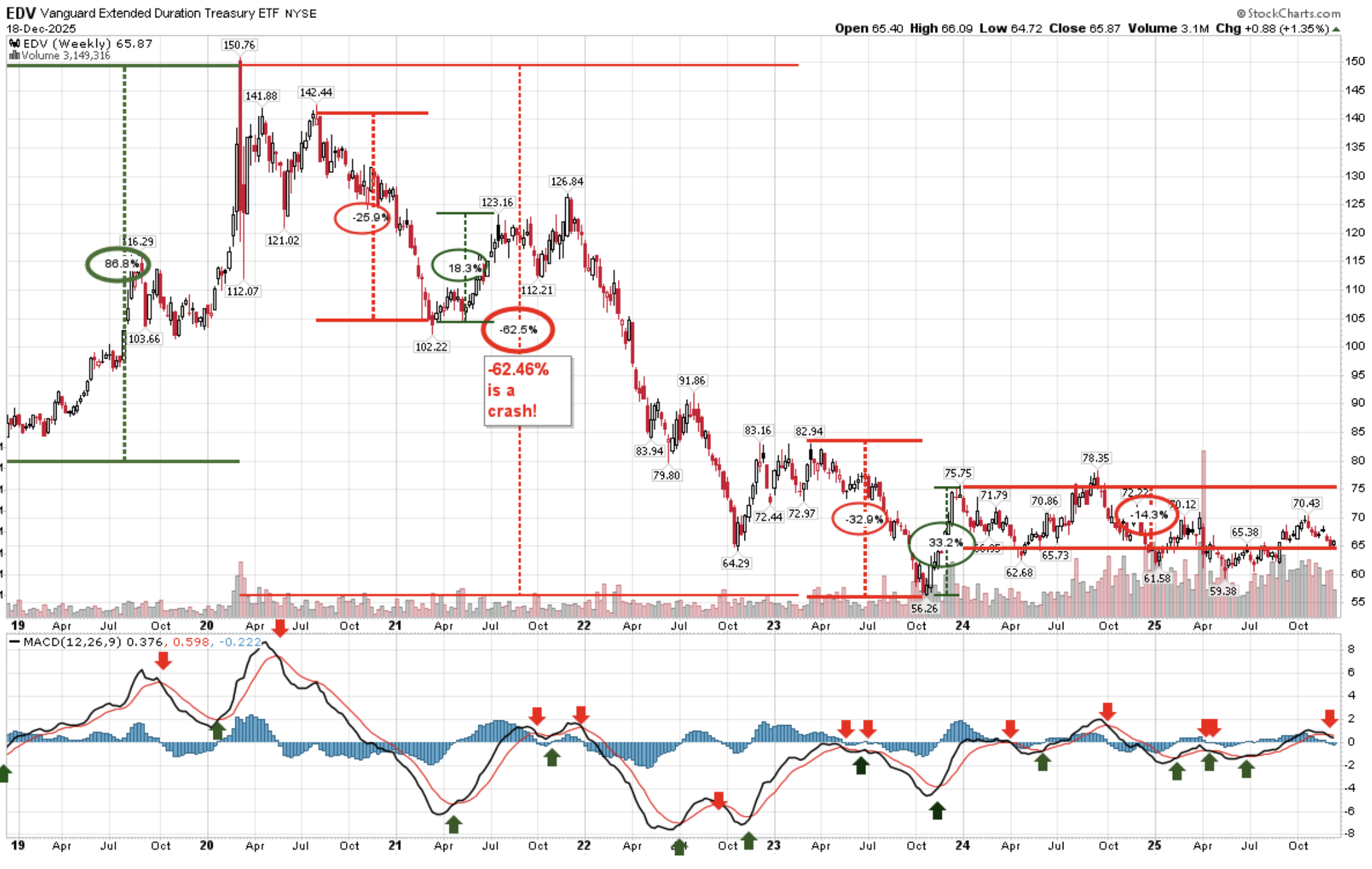
The following chart plots the price movement of the popular Vanguard Extended Duration Treasury ETF. (Note, you may want to expand your screen to view this better.)
Here are the key points:
When interest rates rise, bond prices decline.
In 2019, before COVID-19, interest rates declined, with the yield on the 10-year Treasury dropping below 0.50% in early 2020. That sent bond prices sharply higher. Note in the chart that the gain on EDV was approximately 86%.
Since then, returns have primarily been detrimental to bond investors. Note the -62.46% decline from the interest rate lows in 2020 to the interest rate highs at the end of 2023. That is what a crash looks like. I remain surprised that few have talked about this.
I know the chart looks busy, but stay with me. You’ll see other periods of ups and downs (red bars and green bars with corresponding color circles), making the point that with interest rates still low and the Fed and Treasury debasing our currency by printing money, for a savvy trader, the up and down trends in interest rates/bond prices may be appealing. Buying and holding bonds makes little sense in my view unless you invest in maturities of 3 years or less.
Lastly, I highlighted the approximate return for EDV for 2025. Currently down ~ 14.3%. (red circle, middle right in chart)
Source: Stockcharts.com, cmgprivatewealth.com
The Fed is stuck in a trap. The yield on the 10-year Treasury is the most critical asset to monitor in 2026.
Stocks
U.S. equities finished the year with good momentum. As of yesterday’s close (December 18), the S&P 500 was up ~16.63% total return YTD. The index itself sits near 6,775.
Here’s the nuance:
Returns were supported by falling short-term rates, resilient earnings expectations, and persistent liquidity from the Federal Reserve and Treasury.
The “AI trade” remained a psychological engine. Exciting or not, depending on your entry price.
The outlook for 2026? I favor high-quality, high-dividend-paying companies and select growth opportunities. Robotics, quantim, AI… companies with an edge in technology, good management, and a significant market opportunity to potentially capture. Avoid overvalued cap-weighted index funds due to near-record-high fundamental valuations. Active selection of passive cap-weighted index investing. Not a specific recommendation for you. Speak with your advisor. No guarantee I am correct. Views subject to change.
The big elephant in the room: Debt, deficits, and the dollar
This is where fiscal (the Fed) and monetary (government spending) policy meet “macro reality.”
Ray Dalio has been blunt: the U.S. is running a debt/issuance dynamic that eventually collides with buyer capacity, and the market won’t absorb unlimited supply at any price. LinkedIn
Howard Marks has framed it: America’s advantage has been its “golden credit card.” The ability to borrow cheaply because the world trusts us. He has warned that policy and geopolitics can erode that trust, raising funding costs over time. Business Insider
He has also cautioned against the notion that much lower rates are automatically “good,” arguing that they can push investors to take risks they wouldn’t otherwise need to take. Bloomberg
Key points:
The U.S. benefits from reserve-currency privilege.
But privilege is not a permanent entitlement.
The bond market is the referee, and it’s increasingly awake.
Key takeaways:
It’s not a politics problem first; it’s a math problem first. Excessive issuance, combined with insufficient natural buyers, eventually necessitates an adjustment. We remain on the path to “adjustment.” Or what Scott Bessent calls, a grand reordering.
Year-end Thoughts
The “Grand Reordering” is his shorthand for a structural reset of the global economic and financial system after decades of globalization, cheap money, and U.S.-led stability.
It is the messy transition from a world built on globalization and cheap capital to one defined by geopolitics, fiscal constraints, and higher cost of money (interest rates), where volatility is a feature, not a bug.
The core elements of the “Grand Reordering.”
From globalization to fragmentation: Supply chains shift from lowest cost to national security, resilience, and allies.
From free money to costly capital: Interest rates are structurally higher than in the post-GFC era; capital discipline matters again.
From U.S. unipolar dominance to multipolar tension: More geopolitical competition, less coordination.
From debt invisibility to debt consequences: Large deficits and balance sheets begin to matter for markets and currencies.
From financial engineering to real economics: Productivity, energy, labor, and industrial policy regain importance.
We are closer but have not yet arrived. The transition won’t be smooth. Expect:
More volatility
More inflation risk
More policy mistakes
And a wider set of winners vs. losers across assets, sectors, and countries
Conclusion:
The Federal Reserve is easing, but the long end of the bond market is not yielding. The long end is pricing in a world where debt and deficits matter more than the next 25 bps cut. I see more cuts in 2026 and a less compliant bond market. We are one year closer to a global grand reordering, as Scott Bessent calls it.
Positives: Liquidity remains a favorable tailwind. Every time the market hiccups, the Federal Reserve and the administration respond with support. I suspect that this will continue until legislators demonstrate fiscal discipline; otherwise, we will continue to receive more sugar (money printing). Sadly, I believe “discipline” will only come in crisis. We are not yet at that point.
Stocks can keep grinding higher, but “good” is not the same as “safe.” A +16% year in 2025 is terrific; however, it also raises the bar for what must go right next.
Debt and excess spending are the big elephant in the room. Not because tomorrow is a crisis, but because the direction is obvious, and markets eventually price obvious things. My best estimate of the crisis's timing is 2028, but there is no way to know for certain. Inflation and higher interest rates are the matches that light the fuse.
2026 signals I’m watching:
10-year yield trend: does it drift lower with growth slowing, or re-accelerate on fiscal pressure?
Credit spreads widening: are we being paid for risk?
Fed: any expansion of balance-sheet tools beyond “technical” language and QE lite. ie: QE (Fed buying longer duration bonds and mortgage bonds)
The deficit and Treasury issuance cadence
10-Year Outlook in Short: Lower Returns, Higher Selectivity
As we look out over the next decade, the dominant message isn’t collapse—it’s roller coaster. Perhaps similar to the 2000-2010 decade. The higher capital costs point toward more modest returns and greater dispersion across asset classes.
Valuations matter. With the Shiller P/E ratio above 40, historical evidence suggests that investors should temper expectations. At these levels, forward real returns for U.S. equities cluster around roughly –2% to +2% annualized over the next decade. That doesn’t preclude rallies or innovation; it simply suggests that buying and holding the S&P 500 cap-weighted index may not be optimal.
Equities
U.S. equities are likely to underperform relative to select global markets due to today’s rich valuations.
Fed rate cuts support the near-term outlook. Generally, rate cuts after long pauses have been bullish for stocks, and the expansion of reserves has been a bullish development for stocks—more liquidity juice from the juice givers.
As I update frequently for you in OMR, high valuations limit long-term return potential, even if earnings continue to grow. We’ll retake a look in early January.
AI remains a long-term positive. Certain businesses will prosper, others falter. We believe AI will help our lives in many areas (health care and longevity health, for example), but may cause meaningful disruption to employment.
Fixed Income
Our near-term target for the 10-year Treasury yield is 3.70%. A recession may get us there. Ultimately, we expect higher interest rates and inflation over the next 10 years due to the debt and spending trap that governments face.
We believe the developed countries will continue to print money / issue more debt. We wouldn’t be surprised to see $50 trillion (currently $38.5 trillion) in U.S. government debt outstanding. That is another nearly $12 trillion of liquidity pushed into the system.
Trade bonds, don’t buy-and-hold bonds. Money printing is inflationary and is generally bad for bond prices. Dust off your old technical analysis tools.
Alternatives
U.S. dollar: We are long-term bearish on the dollar due to ongoing money printing and fear of fiscal dominance and some form of interest rate control (as we wrote in OMR: Fiscal Dominance and the Not QE Question here last week).
Gold: We believe gold should continue to shine given the monetary and fiscal realities.
Commodities: We are bullish on commodities, with a focus on demand driven by AI infrastructure, power generation, and capital investment to support growth.
Real estate: My favorite real estate person on the planet is Barry Habib from MBS Highway. Barry projects 3% price growth in 2026 and a continued demand-supply mismatch that should support prices. Demand, driven by new household formation, exceeds the current supply by approximately 4 million homes. Higher interest rates / higher mortgage rates would be a headwind.
Bottom Line
This is not a forecast of a crisis; it’s a forecast of lower 10-year equity returns on cap-weighted index investments, with higher dispersion that favors more active vs passive portfolio exposure. A reminder that when valuations are stretched, and capital is no longer free, discipline becomes a strategy.
Not a recommendation to buy or sell any security. Please note that the information provided is not recommended for buying or selling any security and is provided for discussion purposes only. Current viewpoints are subject to change. Please note that the information provided is not recommended for buying or selling any security and is provided for discussion purposes only. See important CMG and NDR disclosures below.
West Palm Beach Event Highlights
Dinner began with my friend and master forecaster, Barry Habib, sharing his thoughts about the Fed, interest rates and the housing market. If you didn’t see last week’s short video “Surprise Shawty” I’m resharing it here.
This week, Barry shot me his summary of the CPI (Consumer Price Index) report. It was a good news softer inflation reading, with shelter (rent costs, etc.) as the primary driver. He and his team break it down like no other. This will give the Fed more breathing room to further cut rates. Click on the photo.
Source: MBS Highway
The following is a brief summary (highlights) of my notes from the event; there was much to digest beyond the steaks and excellent wine.
We began with a short introduction of our Virtual Family Office services. Essentially, it is a network of specialists across various fields who support needs beyond professional investment allocation. Think strategic tax mitigation planning, estate and tax consulting, family accounting services (bill pay to CFO), aggregated reporting services, investment due diligence, real estate strategy/acquisition/financing, next generation financial literacy and wellness, philanthropy consulting, and family governance.
Barry Habib shared his current views on Real Estate, Interest Rates, and the Fed. Barry was selected the #1 forecaster out of 150 Wall Street economists, is a four time Zillow Crystal Ball award winner, and is a Fannie Mae board member. Quick takes:
Barry shared his views about the Fed, interest rates, and employment. He predicts that the next Fed chair will be dovish (favoring economic stimulus). He believes the Fed Funds rate will be 75 bps cuts lower (three cuts in 2026), going from 3.65% (current level) to 2.90%. His target for the 10-year Treasury yield is 3.70%, and he expects mortgage rates to move down to 5.70%.
Essentially, a bullish backdrop for markets in general. In real estate, he is predicting a 3% gain in 2026 and said there is ample supply (inventory low) relative to demand (high number of new household formations - buyers).
There is no guarantee he is correct, but he presents a sound approach that resonates with me.
Tax mitigation - investment strategy:
Ryan Hanks presented on a tax/investment strategy around car washes and citrus farming.
Jack Grella of Metric-Financial presented on land donations.
Brandi Van loon, presented on oil and gas investing and IDC tax deductions (sponsored by Skyway Capital).
Niche Private Credit:
Rene Canezin, co-founder and managing member of Evolution Credit Partners, shared his views on the current state of the private credit space and his firm's unique approach to specialty lending. Rene was the former co-CIO of Harvard Management Company and oversaw the $52 billion endowment portfolio.
In short, liquidity in the system is abundant. There are problem spots but nothing that suggests the economy is in trouble.
One of the reasons I find getting together so important is you never know what new idea might present. Car washes for example. As the tax mitigation ideas were presented, Barry Habib turned and whispered, “you should investigate the tax advantages of investing in airplanes.” It got my attention. I have no idea where this might go, but I had him spend a few minutes with the Skyway Capital team (Mike Freeman, Adin Lowry, and Jack Grella). Will we onboard this idea? A long shot. But we'll do some research and consider it for the next tax year.
Not a recommendation to buy or sell any security. Please note that the information provided is not recommended for buying or selling any security and is provided for discussion purposes only. Current viewpoints are subject to change. Please note that the information provided is not recommended for buying or selling any security and is provided for discussion purposes only.
If you like what you are reading, click on the following link.
CLICK HERE TO SUBSCRIBE TO ON MY RADAR - IT’S FREE
Not a recommendation to buy or sell any security. Please note that the information provided is not recommended for buying or selling any security and is provided for discussion purposes only. Current viewpoints are subject to change. Please note that the information provided is not recommended for buying or selling any security and is provided for discussion purposes only.
Trade Signals: December 18, 2025 Update
Trade Signals is Organized in the Following Sections:
*Trade Signals basics: The Market Commentary section summarizes notable changes in the core key indicators: Investor sentiment, market breadth, stocks, treasury yields, the dollar, and gold. The Dashboard of Indicators provides a detailed view of all Trade Signals indicators.
Market Commentary
The equity trend remains bullish. Despite the Fed cut, interest rates are trending up. I’m paying attention to the weekly MACD trend signal and the Zweig Bond Model. Subscribers can click the link below to log in.
Key Macro Indicators - Investor Sentiment, Market Breadth, The S&P 500 Index (Stocks), The 10-year Treasury Yield (Bonds), and the Dollar
About Trade Signals
Trade Signals is a paid subscription service that posts the daily, weekly, and monthly trends in the markets (and more). Free for CMG clients. Not a recommendation to buy or sell any security. For discussion purposes only.
“Extreme patience combined with extreme decisiveness. You may call that our investment process.
Yes, it’s that simple.”
– Charlie Munger

TRADE SIGNALS SUBSCRIPTION ACKNOWLEDGEMENT / IMPORTANT DISCLOSURES
The views expressed herein are solely those of Steve Blumenthal as of the date of this report and are subject to change without notice. Not a recommendation to buy or sell any security.
Please note that the information provided is not recommended for buying or selling any security and is provided for discussion purposes only. Current viewpoints are subject to change. Please note that the information provided is not recommended for buying or selling any security and is provided for discussion purposes only.
Personal Note: Merry Christmas and Happy Holidays
I hope this note finds you happy and well.
In a year filled with challenges, noise, headlines, and forecasts, the holiday season invites us to step back, slow down, and spend time with the people we love most. Susan and my children (6) are coming home, along with two significant others: great food, wine, and time with family. We are checking in grateful.
As we close out the year, my hope is simple:
May you find a moment of stillness and peace
May your table be complete, with loved ones by your side
And may the holiday season put a smile on your face and joy in your heart.
At 9am every morning, a reminder pops up on my phone. It says, “Something amazing is going to happen today!” My wish this holiday season is that something amazing happens for you.
Thank you for the time you spend with me each week.
Merry Christmas, happy Hanukkah, and happy holidays with best wishes from my family to yours,
Steve
CLICK HERE TO SUBSCRIBE TO ON MY RADAR - IT’S FREE
You can share this letter on X by clicking here.
You can share this letter on LinkedIn by clicking here.
Subscribe to OMR for free by clicking the photo.
Stephen B. Blumenthal
Executive Chairman & CIO
CMG Capital Management Group, Inc.
75 Valley Stream Parkway, Suite 201,
Malvern, PA 19355
CMG Customer Relationship Summary (Form CRS)
Metric-Financial, LLC Customer Relationship Summary (Form CRS)

Stephen Blumenthal founded CMG Capital Management Group in 1992 and serves today as its Executive Chairman and CIO. Steve authors a free weekly e-letter entitled, “On My Radar.” Steve shares his views on macroeconomic research, valuations, portfolio construction, asset allocation and risk management. Author of Forbes Book: On My Radar, Navigating Stock Market Cycles.
Follow Steve on X @SBlumenthalCMG and LinkedIn.
IMPORTANT DISCLOSURE INFORMATION
This document is prepared by CMG Capital Management Group, Inc. (“CMG”) and is circulated for informational and educational purposes only. There is no consideration given to the specific investment needs, objectives, or tolerances of any of the recipients. Additionally, CMG’s actual investment positions may, and often will, vary from its conclusions discussed herein based on any number of factors, such as client investment restrictions, portfolio rebalancing, and transaction costs, among others. Recipients should consult their own advisors, including tax advisors, before making any investment decision. This material is for informational and educational purposes only and is not an offer to sell or the solicitation of an offer to buy the securities or other instruments mentioned. This material does not constitute a personal recommendation or take into account the particular investment objectives, financial situations, or needs of individual investors which are necessary considerations before making any investment decision. Investors should consider whether any advice or recommendation in this research is suitable for their particular circumstances and, where appropriate, seek professional advice, including legal, tax, accounting, investment, or other advice. The views expressed herein are solely those of Steve Blumenthal as of the date of this report and are subject to change without notice.
Investing involves risk.
This letter may contain forward-looking statements relating to the objectives, opportunities, and future performance of the various investment markets, indices, and investments. Forward-looking statements may be identified by the use of such words as; “believe,” anticipate,” “planned,” “potential,” and other similar terms. Examples of forward-looking statements include, but are not limited to, estimates with respect to financial condition, results of operations, and success or lack of success of any particular market, index, investment, or investment strategy. All are subject to various factors, including, but not limited to, general and local economic conditions, changing levels of competition within certain industries and markets, changes in legislation or regulation, Federal Reserve policy, and other economic, competitive, governmental, regulatory, and technological factors affecting markets, indices, investments, investment strategy and portfolio positioning that could cause actual results to differ materially from projected results. Such statements are forward-looking in nature and involve a number of known and unknown risks, uncertainties, and other factors, and accordingly, actual results may differ materially from those reflected or contemplated in such forward-looking statements. Investors are cautioned not to place undue reliance on any forward-looking statements or examples. All statements made herein speak only as of the date that they were made. Investing is inherently risky and all investing involves the potential risk of loss.
Past performance does not guarantee or indicate future results. Different types of investments involve varying degrees of risk, and there can be no assurance that the future performance of any specific investment, investment strategy, or product (including the investments and/or investment strategies recommended or undertaken by CMG), or any non-investment related content, made reference to directly or indirectly in this commentary will be profitable, equal any corresponding indicated historical performance level(s), be suitable for your portfolio or individual situation or prove successful. Due to various factors, including changing market conditions and/or applicable laws, the content may no longer be reflective of current opinions or positions. Moreover, you should not assume that any discussion or information contained in this commentary serves as the receipt of, or as a substitute for, personalized investment advice from CMG. Please remember to contact CMG, in writing, if there are any changes in your personal/financial situation or investment objectives for the purpose of reviewing/evaluating/revising our previous recommendations and/or services, or if you would like to impose, add, or to modify any reasonable restrictions to our investment advisory services. Unless, and until, you notify us, in writing, to the contrary, we shall continue to provide services as we do currently. CMG is neither a law firm, nor a certified public accounting firm, and no portion of the commentary content should be construed as legal or accounting advice.
No portion of the content should be construed as an offer or solicitation for the purchase or sale of any security. References to specific securities, investment programs or funds are for illustrative purposes only and are not intended to be, and should not be interpreted as recommendations to purchase or sell such securities.
This presentation does not discuss, directly or indirectly, the amount of the profits or losses realized or unrealized, by any CMG client from any specific funds or securities. Please note: In the event that CMG references performance results for an actual CMG portfolio, the results are reported net of advisory fees and inclusive of dividends. The performance referenced is that as determined and/or provided directly by the referenced funds and/or publishers, has not been independently verified, and does not reflect the performance of any specific CMG client. CMG clients may have experienced materially different performance based upon various factors during the corresponding time periods. See in links provided citing limitations of hypothetical back-tested information. Past performance cannot predict or guarantee future performance. Not a recommendation to buy or sell. Please talk to your advisor.
Information herein has been obtained from sources believed to be reliable, but we do not warrant its accuracy. This document is general communication and is provided for informational and/or educational purposes only. None of the content should be viewed as a suggestion that you take or refrain from taking any action nor as a recommendation for any specific investment product, strategy, or other such purposes.
In a rising interest rate environment, the value of fixed-income securities generally declines, and conversely, in a falling interest rate environment, the value of fixed-income securities generally increases. High-yield securities may be subject to heightened market, interest rate, or credit risk and should not be purchased solely because of the stated yield. Ratings are measured on a scale that ranges from AAA or Aaa (highest) to D or C (lowest). Investment-grade investments are those rated from highest down to BBB- or Baa3.
NOT FDIC INSURED. MAY LOSE VALUE. NO BANK GUARANTEE.
Certain information contained herein has been obtained from third-party sources believed to be reliable, but we cannot guarantee its accuracy or completeness.
In the event that there has been a change in an individual’s investment objective or financial situation, he/she is encouraged to consult with his/her investment professional.
Written Disclosure Statement. CMG is an SEC-registered investment adviser located in Malvern, Pennsylvania. Stephen B. Blumenthal is CMG’s founder and CEO. Please note: The above views are those of CMG and its CEO, Stephen Blumenthal, and do not reflect those of any sub-advisor that CMG may engage to manage any CMG strategy, or exclusively determines any internal strategy employed by CMG. A copy of CMG’s current written disclosure statement discussing advisory services and fees is available upon request or via CMG’s internet web site at www.cmgwealth.com/disclosures. CMG is committed to protecting your personal information. Click here to review CMG’s privacy policies.
See CMG Disclosures at the bottom of this page.
For more information about NDR, please visit at www.ndr.com.
NDR, Inc. (NDR), d.b.a. Ned Davis Research Group (NDRG), any NDRG affiliates or employees, or any third-party data provider, shall not have any liability for any loss sustained by anyone who has relied on the information contained in any NDRG publication. The data and analysis contained herein are provided "as is." NDRG disclaims any and all express or implied warranties, including, but not limited to, any warranties of merchantability, suitability or fitness for a particular purpose or use. NDRG's past recommendations and model results are not a guarantee of future results. This communication reflects our analysts' opinions as of the date of this communication and will not necessarily be updated as views or information change. All opinions expressed herein are subject to change without notice. NDRG or its affiliated companies or their respective shareholders, directors, officers and/or employees, may have long or short positions in the securities discussed herein and may purchase or sell such securities without notice. For NDRG's important additional disclaimers, refer to www.ndr.com/invest/public/copyright.html. Further distribution prohibited without prior permission. Copyright 2025 © NDR, Inc. All rights reserved.