On My Radar: Global Macro Game Theory

December 26, 2025
By Steve Blumenthal
“I’ve always loved to play games, and face it: investing is one big game. You need to be decisive, open-minded, flexible, and competitive.”
- Stanley Druckenmiller
Grab that coffee and find a quiet place. Today I’m going to highlight a few key takeaways from Treasury Secretary Scott Bessent’s recent All In Podcast interview and some technical advice from Stanley Druckenmiller. Given their close personal and business friendship, I thought I’d pair them together in this week’s OMR.
I kindly request that you review the Bessent section with your global macro hat on. If you can, set politics aside and view it as a chess match, focusing on the likely moves and their economic and investment implications. Bessent plays a critical role. Like him or not, he is a grand master, and what the Treasury does matters. Thanks for reading. I hope you find this week’s post helpful.
On My Radar: Global Macro Game Theory
Personal Note: The Daily Coach’s 10 Most-Loved Pieces of 2025
OMR is for informational and educational purposes only. No consideration is given to your specific investment needs, objectives, or tolerances.
Please see the Important Disclosures at the bottom of this page. Reminder: This is not a recommendation to buy or sell any security. My views may change at any time. The information is for discussion and educational purposes only.
If you like what you are reading, you can subscribe for free.

Treasury Secretary Scott Bessent
All In Podcast: Scott Bessent: Fixing the Fed, Tariffs for National Security, Solving Affordability in 2026
Scott Bessent is a veteran global macro investor, former CIO at Soros Fund Management, and founder of Key Square Capital. He holds a B.A. from Yale and has taught economic history, an uncommon but valuable mix of markets and context.
Early in his career, Bessent worked closely with legendary investor Stanley Druckenmiller, who was both a senior partner at Soros and a long-time mentor. Druckenmiller has spoken highly of Bessent’s judgment and temperament over the years. As a big Druckenmiller fan, I find that endorsement carries weight and offers a measure of comfort.
As I wrote in last week’s On My Radar: “The Federal Reserve is easing, but the long end of the bond market is not yielding. The long end is pricing in a world where debt and deficits matter more than the next 25 bps cut. I see more cuts in 2026 and a less compliant bond market. We are one year closer to a global grand reordering, as Scott Bessent calls it.”
I listen regularly to the All‑In Podcast (hat tip to Tom T.), so I was genuinely pleased to see that their most recent episode featured Bessent. Whether or not you’re an All-In fan, and regardless of politics, the conversation was informative from a macro game theory perspective. The back-and-forth with David Friedberg, Chamath Palihapitiya, and Jason Calacanis was thoughtful, candid, and substantive.
As investors, our job is to understand how the economic machine works and to watch which levers the key players are pulling. Bessent is one of those grandmaster figures moving pieces across the chessboard. It’s worth spending time inside his framework.
The following links provide discussion points/minute marks. Click on the picture below to watch/listen to the full interview. My short conclusion then follows.
(0:00) Treasury Secretary Scott Bessent joins the show
(0:55) Recapping 2025 and the state of the economy
(3:13) Tariffs: Leverage, legal challenges, implementation
(15:20) Affordability: inflation, BLS data, interest rates
(23:00) The Fed: biggest mistakes, how we got a 15-year asset bubble, rate cycle, appetite for US debt, Fed Chair candidates
(42:44) Focus on Main Street, taking equity stakes in American companies
(50:40) Tax cuts, Trump accounts, economic legacy
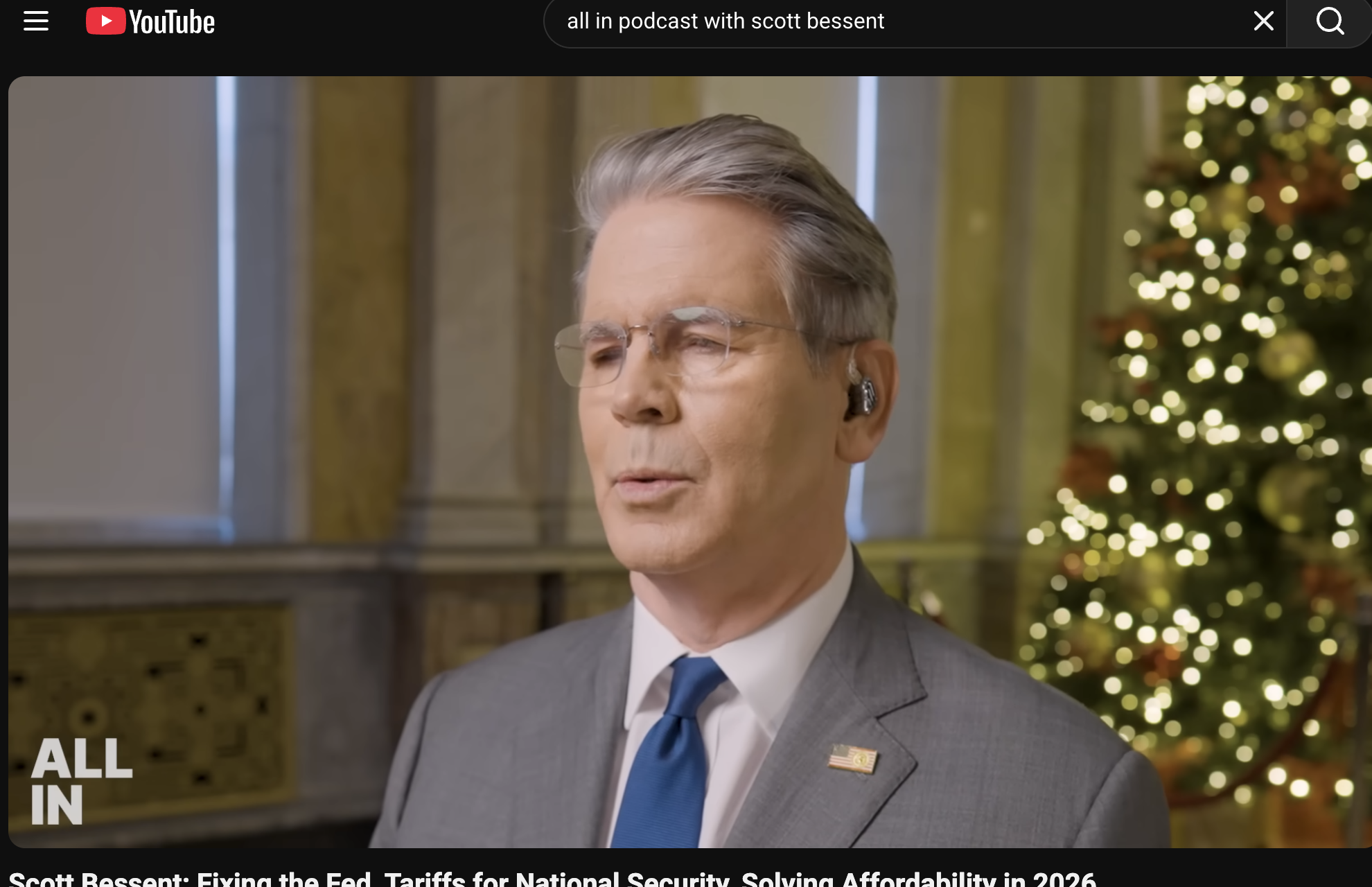
Source: YouTube, All In
SB Bullet Point Notes:
Tariffs have become an important national security tool
Bessent views the ultimate goal of tariffs as a payback for the imbalances that have persisted for many years. But over time, the real goal is to rebalance trade, reshore manufacturing, and bring our economy into balance with our trading partners.
Over time, tariff revenue will decline, while US tax receipts will rise, driven by factory jobs, increased manufacturing, and higher payroll taxes. We start at a high tariff level and rebalance as tax revenues increase.
We know the destination; determining the exact timing is difficult.
Regarding the Supreme Court's potential reversal of the tariffs, Bessent said the issue is a national security matter. Revenues can be replaced. A reversal would be a massive hit to our national security. Ruling expected in January or February.
Around the 13-minute mark, he shares his positive thoughts about the Supreme Court as an institution. Mentioning how close it is, above all other government institutions, to our founders' intentions. Adding, we should all attend a session.
Bessent said the team understands that people are hurting and seething over high prices. This is a significant focus of the administration.
Inflation numbers are starting to roll down. He mentioned rent and the impact migrants had on higher rents. They are coming down now and were evident in last week’s CPI index. Side note: See Barry Habib’s review on CPI here.
On Inflation, MIT conducted a study titled “Deficits and Inflation,” indicating that 42% of inflation was due to the government's deficit spending, with another 17% tied to individuals’ reactions to inflation (see below).
Bessent was highly critical of the Fed. “Overuse of nonstandard policies, mission creep, and institutional bloat are threatening the central bank’s monetary independence.” Read Bessent’s article here.
I do hope you listen to the full podcast. Take it in to better understand what is most important for us to keep our focus on as time moves forward.
Again, please try to keep politics aside. This is the water in which we find ourselves swimming. This post is about global macro game theory, probable outcomes, and investment positioning.
Several links mentioned in the podcast:
The Economic Effects of Tariffs, San Fransisco Fed
“Deficits and Inflation: HANK meets FTPL” (2025, Angeletos, Lian & Wolf — MIT affiliations)
This working paper, co-authored by MIT economist Christian Wolf (with Angeletos and Lian), examines the transmission of fiscal deficits to inflation in a modern macroeconomic model.
It compares two frameworks:
Fiscal Theory of the Price Level (FTPL), in which deficits can directly influence the price level if monetary and fiscal authorities lack a credible commitment, and
Heterogeneous Agent New Keynesian (HANK) models, where deficits drive inflation through aggregate demand because households are non-Ricardian.
The authors find that under realistic assumptions, government deficits can cause inflationary pressure, but the magnitude and dynamics depend on the model structure (e.g., how fiscal policy interacts with monetary policy and the nature of household behavior).
In case you missed it last week, I’m re-sharing what I believe we need to consider as we assess the Treasury Secretary’s agenda. I wrote the following in last week’s On My Radar: Year End Market Summary and Outlook:
The elephant in the room: Debt, deficits, and the dollar
This is where fiscal (the Fed) and monetary (government spending) policy meet “macro reality.”
Ray Dalio has been blunt: the U.S. is running a debt-issuance dynamic that will eventually collide with buyers' capacity, and the market won’t absorb unlimited supply at any price. LinkedIn
Howard Marks framed it: America’s advantage has been its “golden credit card.” The ability to borrow cheaply because the world trusts us. He has warned that policy and geopolitics can erode that trust, raising funding costs over time. Business Insider
He has also cautioned against the notion that much lower rates are automatically “good,” arguing that they can push investors to take risks they wouldn’t otherwise need to take. Bloomberg
Key points:
The U.S. benefits from reserve-currency privilege.
But privilege is not a permanent entitlement.
The bond market is the referee, and it’s increasingly awake.
Key takeaways:
It’s not a politics problem first; it’s a math problem first. Excessive issuance, combined with insufficient natural buyers, eventually necessitates an adjustment. We remain on the path to “adjustment.” Or what Scott Bessent calls, a grand reordering.
Year-end Thoughts
The “Grand Reordering” is his shorthand for a structural reset of the global economic and financial system after decades of globalization, cheap money, and U.S.-led stability.
It is the messy transition from a world built on globalization and cheap capital to one defined by geopolitics, fiscal constraints, and higher cost of money (interest rates), where volatility is a feature, not a bug.
The core elements of the “Grand Reordering.”
From globalization to fragmentation: Supply chains shift from lowest cost to national security, resilience, and allies.
From free money to costly capital: Interest rates are structurally higher than in the post-GFC era; capital discipline matters again.
From U.S. unipolar dominance to multipolar tension: More geopolitical competition, less coordination.
From debt invisibility to debt consequences: Large deficits and balance sheets begin to matter for markets and currencies.
From financial engineering to real economics: Productivity, energy, labor, and industrial policy regain importance.
We are closer but have not yet arrived. The transition won’t be smooth.
Expect:
More volatility
More inflation risk
More policy mistakes
And a wider set of winners vs. losers across assets, sectors, and countries
Conclusion:
Liquidity remains a favorable tailwind. Every time the market hiccups, the Federal Reserve and the administration respond with support. I suspect that this will continue until legislators demonstrate fiscal discipline; otherwise, we will continue to receive more sugar (money printing). Sadly, I believe “discipline” will only come in crisis. We are not yet at that point.
Stocks can keep grinding higher, but “good” is not the same as “safe.” A +16% year in 2025 is terrific; however, it also raises the bar for what must go right next.
Debt and excess spending are the big elephant in the room. Not because tomorrow is a crisis, but because the direction is obvious, and markets eventually price obvious things. My best estimate of the crisis's timing is 2028, but there is no way to know for certain. Inflation and higher interest rates are the matches that light the fuse.
2026 signals I’m watching:
10-year yield trend: does it drift lower with growth slowing, or re-accelerate on fiscal pressure?
Credit spreads widening: are we being paid for risk?
Fed: any expansion of balance-sheet tools beyond “technical” language and QE lite. ie: QE (Fed buying longer duration bonds and mortgage bonds)
The deficit and Treasury issuance cadence
10-Year Outlook in Short: Lower Returns, Higher Selectivity
As we look out over the next decade, the dominant message isn’t collapse—it’s a roller coaster. Perhaps similar to the 2000-2010 decade. The higher capital costs indicate lower returns and greater dispersion across asset classes.
Valuations matter. With the Shiller P/E ratio above 40, historical evidence suggests that investors should temper expectations. At these levels, forward real returns for U.S. equities cluster around roughly –2% to +2% annualized over the next decade. That doesn’t preclude rallies or innovation; it simply suggests that buying and holding the S&P 500 cap-weighted index may not be optimal.
Equities:
U.S. equities are likely to underperform relative to select global markets due to today’s rich valuations.
Fed rate cuts support the near-term outlook. Generally, rate cuts after long pauses have been bullish for stocks, and the expansion of reserves has been a bullish development for stocks—more liquidity juice from the juice givers.
As I update frequently for you in OMR, high valuations limit long-term return potential, even if earnings continue to grow. We’ll retake a look in early January.
AI remains a long-term positive. Certain businesses will prosper, others falter. We believe AI will help our lives in many areas (health care and longevity health, for example), but may cause meaningful disruption to employment.
Fixed Income
Our near-term target for the 10-year Treasury yield is 3.70%. A recession may get us there. Ultimately, we expect higher interest rates and inflation over the next 10 years due to the debt and spending trap that governments face.
We believe the developed countries will continue to print money / issue more debt. We wouldn’t be surprised to see $50 trillion (currently $38.5 trillion) in U.S. government debt outstanding. That is another nearly $12 trillion of liquidity pushed into the system.
Trade bonds, don’t buy-and-hold bonds. Money printing is inflationary and is generally bad for bond prices. Dust off your old technical analysis tools.
Alternatives
U.S. dollar: We are long-term bearish on the dollar due to ongoing money printing and fear of fiscal dominance and some form of interest rate control (as we wrote in OMR: Fiscal Dominance and the Not QE Question here last week).
Gold: We believe gold should continue to shine given the monetary and fiscal realities.
Commodities: We are bullish on commodities, with a focus on demand driven by AI infrastructure, power generation, and capital investment to support growth.
Real estate: My favorite real estate person on the planet is Barry Habib from MBS Highway. Barry projects 3% price growth in 2026 and a continued demand-supply mismatch that should support prices. Demand, driven by new household formation, exceeds the current supply by approximately 4 million homes. Higher interest rates / higher mortgage rates would be a headwind.
Bottom Line
This is not a forecast of a crisis; it’s a forecast of lower 10-year equity returns on cap-weighted index investments, with higher dispersion that favors more active vs passive portfolio exposure. A reminder that when valuations are stretched, and capital is no longer free, discipline becomes a strategy.
Not a recommendation to buy or sell any security. Please note that the information provided is not recommended for buying or selling any security and is provided for discussion purposes only. Current viewpoints are subject to change. Please note that the information provided is not recommended for buying or selling any security and is provided for discussion purposes only. See important CMG and NDR disclosures below.
Stan Druckenmiller - Technical Advice
Ted Zhang, @TedHZhang shared a nice post about Stanley Druckenmiller, @standuquesne, sharing his views on technical vs fundamental analysis:
“Every night at about 4:30, I get 272 charts, and they cover just about every group in the stock market, every commodity, every currency cross I am interested in, every fixed income market around the world, and they’re daily, weekly, and monthly (ie, technical trend/direction).
Short term (8 days to 20 weeks)
Price action and technicals dominate
He focuses on charts, momentum, trends, and positioning
The goal is confirmation: is the market agreeing with (or rejecting) the idea right now?
If the price disagrees, he steps aside or cuts risk quickly
Price is the arbiter in the short run.
Medium term (8 weeks to 20 weeks)
Blend of fundamentals and technicals
Macro data, policy shifts, earnings, liquidity trends- validated by charts
This is where he puts on his largest, most meaningful trades
If fundamentals are correct and the charts confirm, he presses. This is his sweet spot.
Long term (8 to 20 months)
Fundamentals dominate
Big macro forces: growth, inflation, debt cycles, policy regime changes
Valuation, while not a timing tool, matters more over long horizons
Technicals matter far less here; structural forces do the heavy lifting
The big money is made by being right about the regime.
The through-line
Druckenmiller’s key insight isn’t that charts replace fundamentals; it’s that charts keep you honest.
Fundamentals generate the idea. Technicals decide whether you should act on it.
He said, “When I make an investment decision, sometimes believe it or not, the idea comes from the charts, but I will never invest just on a chart. But if I really like the fundamental thesis and the chart stinks, I won’t do it. “You can always find, at least, in terms of equities, 20 to 30 great fundamental stories that the chart looks good. I always assume that the market knows something, and I’ve always had a great deal of respect for the market.”
“I’d say 75-85% of ideas come from fundamental and verified by the chart, but I‘ve also found ideas from the charts and then discovered the fundamentals. “My discipline requires that I’m not just a value guy. I need charts, I need catalysts, and I think they are a one-way bet except carry. I am salivating to short the bond market in major size.” Source: @TedHZhang
Not a recommendation to buy or sell any security. Please note that the information provided is not recommended for buying or selling any security and is provided for discussion purposes only. Current viewpoints are subject to change. Please note that the information provided is not recommended for buying or selling any security and is provided for discussion purposes only.
If you like what you are reading, click on the following link.
CLICK HERE TO SUBSCRIBE TO ON MY RADAR - IT’S FREE
Not a recommendation to buy or sell any security. Please note that the information provided is not recommended for buying or selling any security and is provided for discussion purposes only. Current viewpoints are subject to change. Please note that the information provided is not recommended for buying or selling any security and is provided for discussion purposes only.
Trade Signals: December 26, 2025 Update
Trade Signals is Organized in the Following Sections:
*Trade Signals basics: The Market Commentary section summarizes notable changes in the core key indicators: Investor sentiment, market breadth, stocks, treasury yields, the dollar, and gold. The Dashboard of Indicators provides a detailed view of all Trade Signals indicators.
Market Commentary
My quick take is that the S&P 500 remains highly overvalued, investor sentiment is Extremely Optimistic (short-term bearish), and the Weekly MACD is signaling a bear trend over the next 8 to 20 weeks (channeling my inner Stan Druckenmiller's definition of weekly trend signals).
And it’s been another fantastic week for gold! Wow…
You’ll notice in the “Market Summary” section that I changed the short-term trend to 8 to 20 days, the medium-term to 8 to 20 weeks, and the long-term to 8 to 20 months. I like how Stan Druckenmiller reviews hundreds of charts. We, of course, review the key market charts each week through the same lens.
Please let me know if you have any questions. Please email Amy@cmgwealth.com if you would like a free sample of Trade Signals.
Key Macro Indicators - Investor Sentiment, Market Breadth, The S&P 500 Index (Stocks), The 10-year Treasury Yield (Bonds), and the Dollar
About Trade Signals
Trade Signals is a paid subscription service that posts the daily, weekly, and monthly trends in the markets (and more). Free for CMG clients. Not a recommendation to buy or sell any security. For discussion purposes only.
“Extreme patience combined with extreme decisiveness. You may call that our investment process.
Yes, it’s that simple.”
– Charlie Munger

TRADE SIGNALS SUBSCRIPTION ACKNOWLEDGEMENT / IMPORTANT DISCLOSURES
The views expressed herein are solely those of Steve Blumenthal as of the date of this report and are subject to change without notice. Not a recommendation to buy or sell any security.
Please note that the information provided is not recommended for buying or selling any security and is provided for discussion purposes only. Current viewpoints are subject to change. Please note that the information provided is not recommended for buying or selling any security and is provided for discussion purposes only.
Personal Note: The Daily Coach’s 10 Most-Loved Pieces of 2025
Michael Lombardi co-founded The Daily Coach with the late, great Coach George Raveling. Michael has been awarded three Super Bowl rings in an NFL career spanning more than thirty years, which included stints with Bill Walsh, Al Davis, and Bill Belichick’s organizations. He is the author of “Gridiron Genius” (2018) and “Football Done Right” (2023).
I’m so blessed to have my wife, Susan (Coach Sue), in my life. You should see the books she has in our den. Most are about teaching. In the end, we are all in the game of life, humans learning and finding our way. I hope you find a nugget or two of wisdom from the following.
You can find the full post on The Daily Coach website here.
Here are the top ten of 2025:
Winning Without Being Defined by the Win
We should strive for greatness and mastery in our pursuits, but our identity and worth don’t have to be tethered to the outcome.
We don’t have to lead today. We get to lead today—ourselves and individuals who, just like us, are carrying invisible loads and battles that another person knows absolutely nothing about.
Be Disciplined to Be Disciplined
The habits we repeat when no one’s watching are what define us when everyone is.
Stepping Into the Arena: The Words That Changed Brené Brown’s Life
In the end, history remembers the ones who dared greatly.
Wins and Losses Come and Go—Your Work Ethic Shouldn’t
Results come and go. Conditions change. Emotions fluctuate. But discipline? That’s the foundation of sustained excellence and high performance.
How often do we write ourselves off before life has finished writing our story?
The Hard Hat Way: How George Boiardi Still Leads Cornell Lacrosse
Standards, when held over time, become identity.
The Leaders Who Say the Least: No Speech Needed
You don’t need a fiery speech or a spotlight to be a great leader.
The measure of leadership is not how someone treats the superstar. That is easy. True leadership shows up in how you treat the people no one else notices.
Culture Is How It Feels. Standards Are What You Uphold.
Greatness doesn’t live in one or the other. It lives in the tension between both the culture and the standards.
I hope you had a wonderful holiday. I can say I’m going to be looking good in a pair of new shoes and excellent high-tech sunglasses.
Warm regards,
Steve
CLICK HERE TO SUBSCRIBE TO ON MY RADAR - IT’S FREE
You can share this letter on X by clicking here.
You can share this letter on LinkedIn by clicking here.
Subscribe to OMR for free by clicking the photo.
Stephen B. Blumenthal
Executive Chairman & CIO
CMG Capital Management Group, Inc.
75 Valley Stream Parkway, Suite 201,
Malvern, PA 19355
CMG Customer Relationship Summary (Form CRS)
Metric-Financial, LLC Customer Relationship Summary (Form CRS)

Stephen Blumenthal founded CMG Capital Management Group in 1992 and serves today as its Executive Chairman and CIO. Steve authors a free weekly e-letter entitled, “On My Radar.” Steve shares his views on macroeconomic research, valuations, portfolio construction, asset allocation and risk management. Author of Forbes Book: On My Radar, Navigating Stock Market Cycles.
Follow Steve on X @SBlumenthalCMG and LinkedIn.
IMPORTANT DISCLOSURE INFORMATION
This document is prepared by CMG Capital Management Group, Inc. (“CMG”) and is circulated for informational and educational purposes only. There is no consideration given to the specific investment needs, objectives, or tolerances of any of the recipients. Additionally, CMG’s actual investment positions may, and often will, vary from its conclusions discussed herein based on any number of factors, such as client investment restrictions, portfolio rebalancing, and transaction costs, among others. Recipients should consult their own advisors, including tax advisors, before making any investment decision. This material is for informational and educational purposes only and is not an offer to sell or the solicitation of an offer to buy the securities or other instruments mentioned. This material does not constitute a personal recommendation or take into account the particular investment objectives, financial situations, or needs of individual investors which are necessary considerations before making any investment decision. Investors should consider whether any advice or recommendation in this research is suitable for their particular circumstances and, where appropriate, seek professional advice, including legal, tax, accounting, investment, or other advice. The views expressed herein are solely those of Steve Blumenthal as of the date of this report and are subject to change without notice.
Investing involves risk.
This letter may contain forward-looking statements relating to the objectives, opportunities, and future performance of the various investment markets, indices, and investments. Forward-looking statements may be identified by the use of such words as; “believe,” anticipate,” “planned,” “potential,” and other similar terms. Examples of forward-looking statements include, but are not limited to, estimates with respect to financial condition, results of operations, and success or lack of success of any particular market, index, investment, or investment strategy. All are subject to various factors, including, but not limited to, general and local economic conditions, changing levels of competition within certain industries and markets, changes in legislation or regulation, Federal Reserve policy, and other economic, competitive, governmental, regulatory, and technological factors affecting markets, indices, investments, investment strategy and portfolio positioning that could cause actual results to differ materially from projected results. Such statements are forward-looking in nature and involve a number of known and unknown risks, uncertainties, and other factors, and accordingly, actual results may differ materially from those reflected or contemplated in such forward-looking statements. Investors are cautioned not to place undue reliance on any forward-looking statements or examples. All statements made herein speak only as of the date that they were made. Investing is inherently risky and all investing involves the potential risk of loss.
Past performance does not guarantee or indicate future results. Different types of investments involve varying degrees of risk, and there can be no assurance that the future performance of any specific investment, investment strategy, or product (including the investments and/or investment strategies recommended or undertaken by CMG), or any non-investment related content, made reference to directly or indirectly in this commentary will be profitable, equal any corresponding indicated historical performance level(s), be suitable for your portfolio or individual situation or prove successful. Due to various factors, including changing market conditions and/or applicable laws, the content may no longer be reflective of current opinions or positions. Moreover, you should not assume that any discussion or information contained in this commentary serves as the receipt of, or as a substitute for, personalized investment advice from CMG. Please remember to contact CMG, in writing, if there are any changes in your personal/financial situation or investment objectives for the purpose of reviewing/evaluating/revising our previous recommendations and/or services, or if you would like to impose, add, or to modify any reasonable restrictions to our investment advisory services. Unless, and until, you notify us, in writing, to the contrary, we shall continue to provide services as we do currently. CMG is neither a law firm, nor a certified public accounting firm, and no portion of the commentary content should be construed as legal or accounting advice.
No portion of the content should be construed as an offer or solicitation for the purchase or sale of any security. References to specific securities, investment programs or funds are for illustrative purposes only and are not intended to be, and should not be interpreted as recommendations to purchase or sell such securities.
This presentation does not discuss, directly or indirectly, the amount of the profits or losses realized or unrealized, by any CMG client from any specific funds or securities. Please note: In the event that CMG references performance results for an actual CMG portfolio, the results are reported net of advisory fees and inclusive of dividends. The performance referenced is that as determined and/or provided directly by the referenced funds and/or publishers, has not been independently verified, and does not reflect the performance of any specific CMG client. CMG clients may have experienced materially different performance based upon various factors during the corresponding time periods. See in links provided citing limitations of hypothetical back-tested information. Past performance cannot predict or guarantee future performance. Not a recommendation to buy or sell. Please talk to your advisor.
Information herein has been obtained from sources believed to be reliable, but we do not warrant its accuracy. This document is general communication and is provided for informational and/or educational purposes only. None of the content should be viewed as a suggestion that you take or refrain from taking any action nor as a recommendation for any specific investment product, strategy, or other such purposes.
In a rising interest rate environment, the value of fixed-income securities generally declines, and conversely, in a falling interest rate environment, the value of fixed-income securities generally increases. High-yield securities may be subject to heightened market, interest rate, or credit risk and should not be purchased solely because of the stated yield. Ratings are measured on a scale that ranges from AAA or Aaa (highest) to D or C (lowest). Investment-grade investments are those rated from highest down to BBB- or Baa3.
NOT FDIC INSURED. MAY LOSE VALUE. NO BANK GUARANTEE.
Certain information contained herein has been obtained from third-party sources believed to be reliable, but we cannot guarantee its accuracy or completeness.
In the event that there has been a change in an individual’s investment objective or financial situation, he/she is encouraged to consult with his/her investment professional.
Written Disclosure Statement. CMG is an SEC-registered investment adviser located in Malvern, Pennsylvania. Stephen B. Blumenthal is CMG’s founder and CEO. Please note: The above views are those of CMG and its CEO, Stephen Blumenthal, and do not reflect those of any sub-advisor that CMG may engage to manage any CMG strategy, or exclusively determines any internal strategy employed by CMG. A copy of CMG’s current written disclosure statement discussing advisory services and fees is available upon request or via CMG’s internet web site at www.cmgwealth.com/disclosures. CMG is committed to protecting your personal information. Click here to review CMG’s privacy policies.
See CMG Disclosures at the bottom of this page.
For more information about NDR, please visit at www.ndr.com.
NDR, Inc. (NDR), d.b.a. Ned Davis Research Group (NDRG), any NDRG affiliates or employees, or any third-party data provider, shall not have any liability for any loss sustained by anyone who has relied on the information contained in any NDRG publication. The data and analysis contained herein are provided "as is." NDRG disclaims any and all express or implied warranties, including, but not limited to, any warranties of merchantability, suitability or fitness for a particular purpose or use. NDRG's past recommendations and model results are not a guarantee of future results. This communication reflects our analysts' opinions as of the date of this communication and will not necessarily be updated as views or information change. All opinions expressed herein are subject to change without notice. NDRG or its affiliated companies or their respective shareholders, directors, officers and/or employees, may have long or short positions in the securities discussed herein and may purchase or sell such securities without notice. For NDRG's important additional disclaimers, refer to www.ndr.com/invest/public/copyright.html. Further distribution prohibited without prior permission. Copyright 2025 © NDR, Inc. All rights reserved.