On My Radar: Gravity Returns

September 25, 2026
By Steve Blumenthal
“Interest rates are to asset prices what gravity is to the apple.”
— Warren Buffett
“In investing, the greatest puzzle for me is risk, how we should think about it, and how we can work with it.”
— Howard Marks
In 1720, the most brilliant mind in England bought shares in the South Sea Company. Isaac Newton, the man who explained gravity, made a tidy profit early and sold. Then he watched his friends keep getting richer. He bought back in near the top, with far more money. When the bubble burst, Newton lost a fortune, roughly £20,000, or millions in today's dollars.
Legend has it he later said he could calculate the motions of the heavenly bodies, but not the madness of people.
The South Sea Company wasn't Newton's mistake. He paid too much, bet too big, and got back in because everyone around him was getting rich. The man who discovered gravity forgot that it applies to markets too.
This week, gravity showed up.
Grab your coffee and find your favorite chair. What a week! The long bond hit its highest yield since 2004. A weak Treasury auction sent the 5-year above 5%. The Fed is hiking again, with more penciled in. Stocks wobbled under two-decade highs in yields. Thin tanker traffic through Hormuz kept Brent oil above $100. The dollar is rising, and the yen is falling again.
Lower rates reduce the gravitational pull on asset prices; higher rates increase it. In a world flooded with debt, higher rates are the match that lights the fuse.
This week, we look at both sides of the ledger. First, the opportunity: AI's productivity boom and what Brad Gerstner says it will take to keep the AI trade intact. Then, the risk: Howard Marks on what risk really is, and why it matters now. Finally, we take a look at the signals flashing yellow: the 10-year, the yen, high yield and a "minus 2" signal I've been waiting to write about.
Bottom line: Brace for opportunity.
On My Radar: Gravity Returns
Brace for Opportunity
Risk Revisited — Howard Marks Meets the AI Trade
The 10-year - The Yen - And Watch Out For -2
Trade Signals: September 24, 2026
Personal Note: 5-0-1
OMR is for informational and educational purposes only. No consideration is given to your specific investment needs, objectives, or tolerances.
Please see the Important Disclosures at the bottom of this page. Reminder: This is not a recommendation to buy or sell any security. My views may change at any time. The information is for discussion and educational purposes only.
If you like what you are reading, you can subscribe for free.

Brace For Opportunity
One bullish area is the productivity coming from AI. We've been teaching AI to think, and are now teaching it to move, see and build. Think: robots, factories, power plants and power grids.
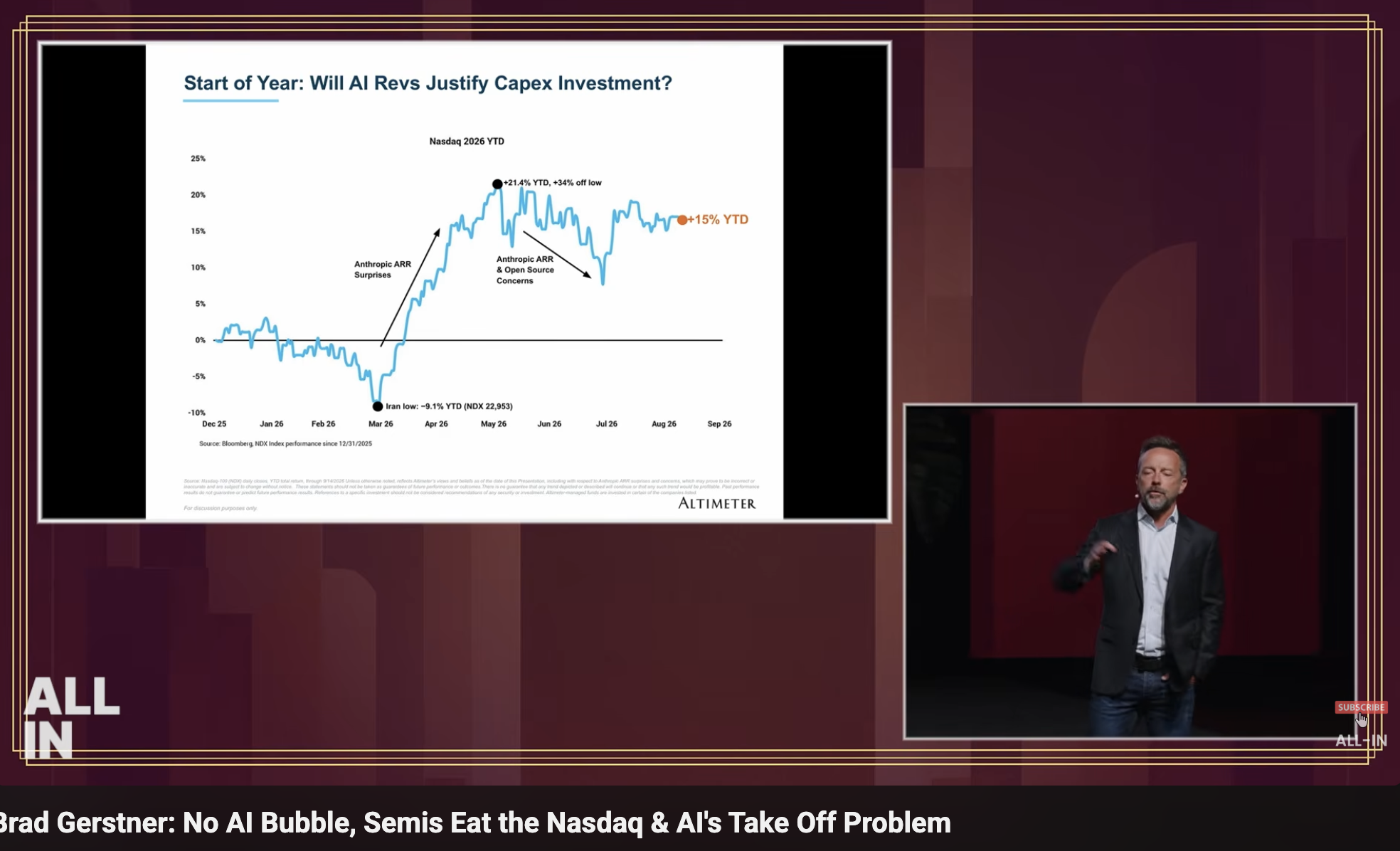
In this regard, I found Brad Gerstner's All In Summit presentation to be concise, balanced and insightful. It helps to frame risk and reward.
Gerstner's point comes down to this: AI's economic payoff is real, but it's now priced in. The easy money has been made, and from here the market will reward facts, not faith.
The revenue showed up. Last fall, the big question was how AI labs could commit to $1 trillion of spending with only about $13 billion in revenue. Then Anthropic answered it. Its monthly revenue went from $2 billion in January to $4 billion in February to $11 billion in March. That set off the April–May rally.
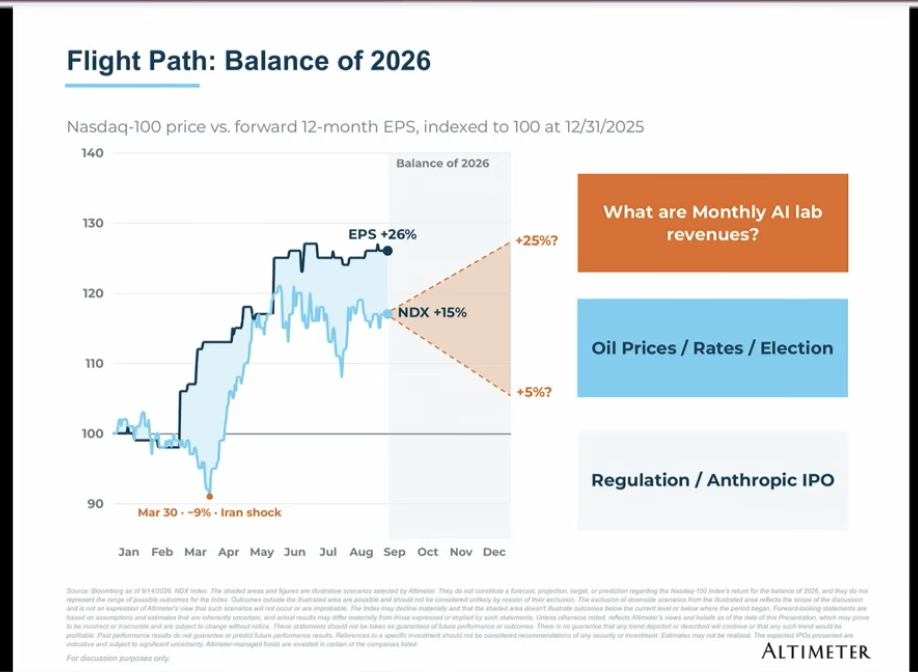
The math that matters. Microsoft, Google, Amazon and the rest of the Mag 5 are building about $1.5 trillion a year in data centers. They aren't the end users; they're building to rent. Someone has to pay the rent. The top three labs (Anthropic, OpenAI and SpaceX) were running at about $100 billion a year this summer. Gerstner thinks that needs to reach roughly $200 billion by year-end, then $450 billion, and eventually $1 trillion, to justify the buildout. His key number to watch is whether each leading lab is bringing in closer to $4 billion or $8 billion a month.
Demand isn't the problem. Knowledge work may be the largest market in history, and AI needs only about 4% of it ($1.2 trillion) to fund its spending. Enterprise AI spending is up 17x in 18 months. His firm, like many others, he said, "can't operate our business without buying AI."
The productivity dividend. From 2015 to 2025, Nasdaq earnings grew about 10% a year: 6% from revenue growth and about 0.38% from wider profit margins. Gerstner thinks AI can push that margin gain to 1% a year. Uber and Snowflake plan to grow 20–30% without adding headcount. Companies aren't firing people; they're just hiring far fewer. That's where the productivity gain shows up.
Three risks:
Regulation. He points to the U.S. shutting down 67 nuclear reactors after activists pushed back. Fear-driven rules could do the same to AI.
Power. The forecast calls for adding 43 gigawatts of compute next year. The whole country has only about 40 gigawatts today. Think about that: we'd more than double our total compute in a single year. Permits, grid hookups, labor and equipment are all bottlenecks. He expects closer to 25 gigawatts, which he thinks is still enough to hit the revenue targets.
Rates. Gerstner spoke the day before the Fed's September 16 meeting and put the odds of a hike above 90%. The Fed raised rates the next day. Data centers are built with borrowed money, so higher rates raise the bar every project has to clear. Remember Buffett's gravity: a 10-year Treasury at 5.5% would weigh heavily on stocks.
How he's positioned: medium. He'll add if AI lab revenues come in strong and oil prices fall, and cut back if they don't. From 2023 to 2025, you only had to get one thing right: own AI. In 2026, his advice is: "Stay mentally flexible. Follow the facts. Don't YOLO." (You Only Live Once.)
Why it matters now: This week the 10-year hit 5.22%, and the 30-year neared 5.5%. We're already close to the level Gerstner calls a burden for stocks. The opportunity is real, and so is the gravity. That tension is exactly why it pays to brace for opportunity with a plan.
What's a gigawatt, and why 43 is a big number
A quick sidebar to help you understand just how big the need is:"
A gigawatt (GW) is a billion watts. A large nuclear reactor produces about 1 GW, which is enough to power roughly 750,000 American homes.
Here's how fast data centers are growing:
2024: about 25 GW of data centers were running across the U.S.
2025: the total rose to about 31 GW, after roughly 8.5 GW was added.
2026: it's expected to reach about 41 GW. That's Gerstner's "less than 40," give or take.
Next year (the forecast): 43 GW added in one year, alone!
So in two years, the country went from about 25 GW to about 40 GW, a jump of more than 50%. The forecast now calls for adding more than our entire current total in a single year.
To picture it, 43 GW is roughly:
43 new nuclear reactors. The U.S. has about 94 today, and each new one takes many years to build.
Power for about 32 million homes, roughly one in four U.S. households.
That's why Gerstner thinks 43 is too aggressive and expects closer to 25. Even 25 GW would be a record year. The chips can be built. The hard part is the power plants, transmission lines, transformers, permits, and electricians.
Sources: BloombergNEF – US data center capacity outlook · Goldman Sachs – US data center power demand · Utility Dive – BNEF 106 GW by 2035 · John D. Cook – How much is a gigawatt?
For the replay, start at the 5:07 mark:
Source: All In Podcast, YouTube
Source: Altimeter
Opinions are subject to change. Not a recommendation to buy or sell any security. Provided for discussion and educational purposes only.
Risk Revisited — Howard Marks Meets the AI Trade
Howard Marks has written about risk for more than 35 years. His 2015 memo Risk Revisited Again is one I come back to often, and he revisited it at Wharton this spring. Read next to Gerstner's talk; it gives us a simple framework for today's AI trade.
Marks' core ideas:
Risk isn't volatility. It's permanent loss. You can ride out a drawdown. You can't undo a permanent loss. Those usually come from selling in a panic, overpaying, or using leverage that forces you to sell at the bottom.
The future is a range of outcomes, not a forecast. Nobody knows what will happen. The edge goes to investors who understand the range of possibilities, weigh the odds and look for lopsided bets.
Risk is counterintuitive. When prices rise and everyone feels safe, risk is highest. When prices fall and everyone is scared, risk is lowest.
Two ways to lose. Either the business disappoints (fundamental risk), or you paid too much for it (valuation risk). A great company bought at the wrong price can still be a bad investment.
Leverage and funding risk. Borrowed money makes good outcomes better and bad ones fatal. If funding dries up before the payoff arrives, you can be right and still lose.
Avoiding risk means avoiding returns. The risk of missing out is real too. The goal is to control risk, not escape it. For that, Marks says, you need "humility, lack of hubris, and knowing what you don't know."
How it connects to Gerstner's view of AI:
Real fundamentals, rising valuation risk. Gerstner sees no shortage of demand for AI. Revenues are surging, enterprise spending is up 17x, and he expects margins to widen. That's the fundamental side. He also says "it's all priced now," and that's Marks' valuation risk. Today's question is less "is AI real?" and more "what's already in the price?"
Thinking in ranges. Gerstner's "flight path" is the probability thinking Marks describes. If lab revenues run near $8 billion a month and oil falls, the AI trade takes off. If revenues are closer to $4 billion and the 10-year heads to 5.5%, stocks face gravity. He's watching the data rather than betting on one outcome.
Leverage is the permanent-loss risk. "Don't YOLO" is Gerstner's version of Marks' warning. And the $1.5 trillion AI buildout runs largely on borrowed money. With the 10-year at 5.22%, the bar every data-center project has to clear keeps rising. That's funding risk at the scale of a whole economy.
Forecasts can overshoot. Gerstner thinks the forecast of 43 gigawatts of new compute next year is too aggressive and expects closer to 25. That's Marks' point about models built on assumptions: permits, power equipment and labor don't scale on a spreadsheet's schedule.
Medium, not all-in or all-out. Neither man says to get out. Gerstner is running a "medium" position, ready to add or trim as the facts change. That's Marks' balance: control risk without avoiding return, and keep adjusting rather than reacting once the damage is done.
The takeaway: AI may be the biggest productivity story of our lifetimes. That's the opportunity. The risk isn't that AI fails. The risk is paying too much, borrowing too much, or holding a position so large that a normal pullback turns into a permanent loss. Newton learned that the hard way. Brace for opportunity, size it with humility, and know what you want to buy when a leveraged, forced market unwind presents itself.
Sources: Risk Revisited Again (Oaktree PDF, June 2015) · StreetFins memo breakdown · Oaktree memo video · Wharton Howard Marks Investor Series
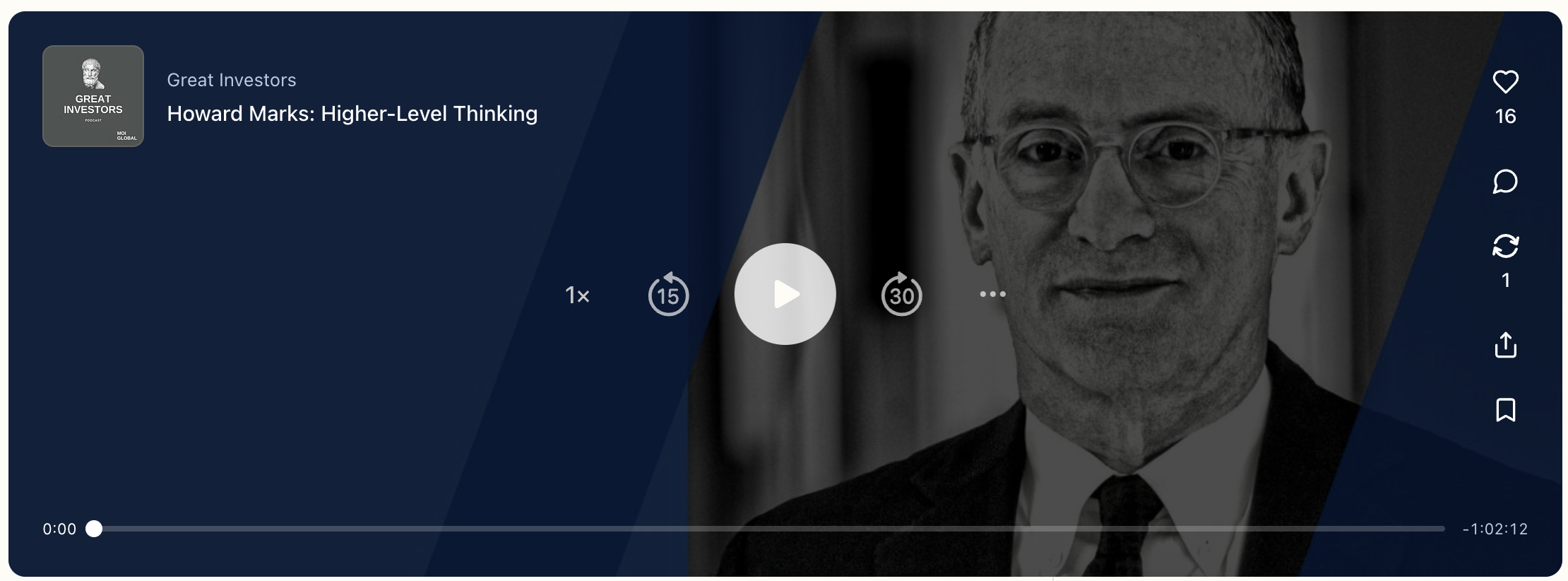
If you have time, plug in your earbuds and go for a nice walk. Click on the photo - totally worth the listen:
Opinions are subject to change. Not a recommendation to buy or sell any security. Provided for discussion and educational purposes only.
The 10-year - The Yen - And Watch Out For -2
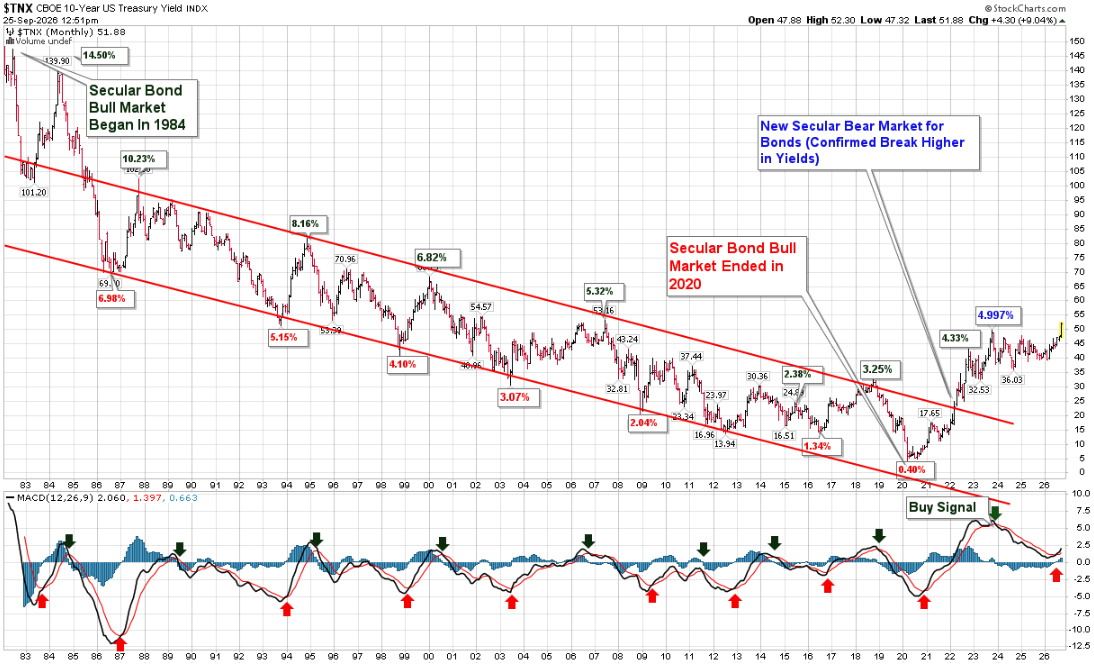
This may be the best call we’ve made, helping us avoid losses in the fixed-income bond market since early 2020. Yields spiked higher, breaching the 5% level that proved resistance since 2023. Note the spike higher to 5.23% this week.
Source: StockCharts.com, CMG annotations (arrows)
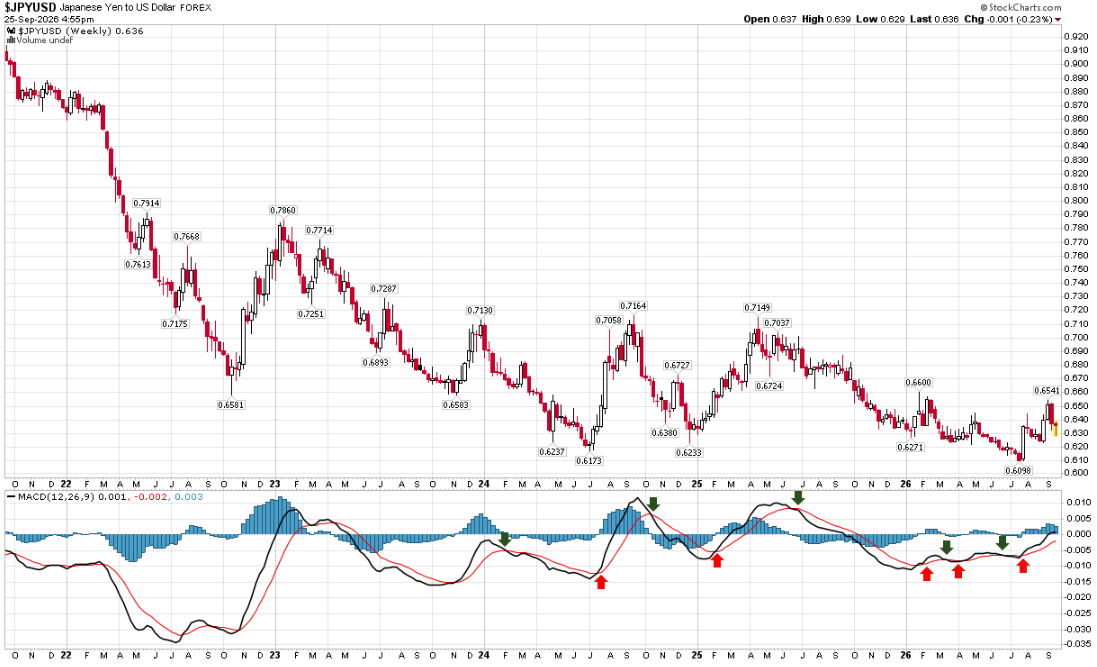
The Bank of Japan is having difficulty pushing the yen higher. Red bars reflect the weekly price movement over the last two weeks. The yen is lower, testing the late-July coordinated intervention (Japan and Bessent), and has given up nearly all of the gains from the second intervention that began three weeks ago. Each bar equals the price activity for one week. A lower yen means higher inflation for Japanese citizens. The risk to US interest rates is that they sell their large US Treasury holdings and repatriate the proceeds (sell US bonds, sell dollars, buy yen). That may be what we are seeing in the higher 5-year, 10-year, and 30-year US Treasury yields this week.
Source: StockCharts.com, CMG annotations
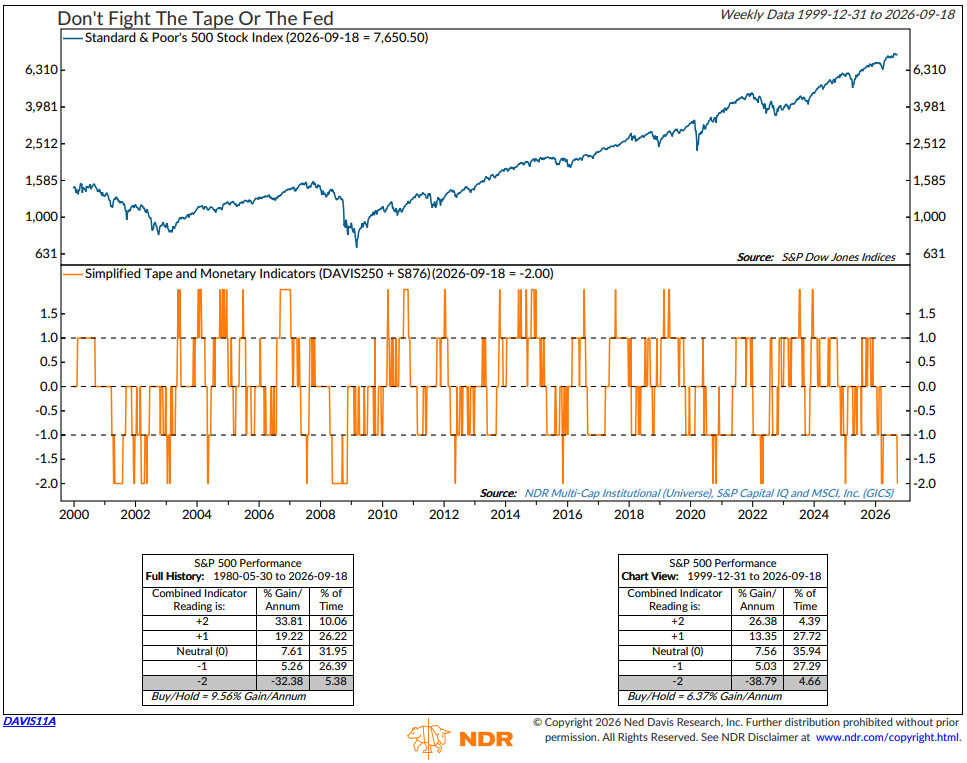
Don’t Fight the Tape or the Fed - “Watch Out for -2”
This indicator combines two simple ideas: follow the market's trend, and follow interest rates.
The Tape: NDR's Big Mo Multi-Cap Tape Composite rolls more than 100 trend and momentum indicators into a single reading of the stock market's health.
The Fed: an interest-rate trend. When the 10-year Treasury yield is below its longer-term trend (10-week vs. 70-week), stocks have historically done better.
The score: each signal counts as +1 (bullish) or -1 (bearish), so the combined score runs from +2 to -2. Historically, the S&P 500's best gains came at +2 and its worst stretches at -2.
Today: -2. Both the trend and rates are working against stocks.
Source: The great NDR
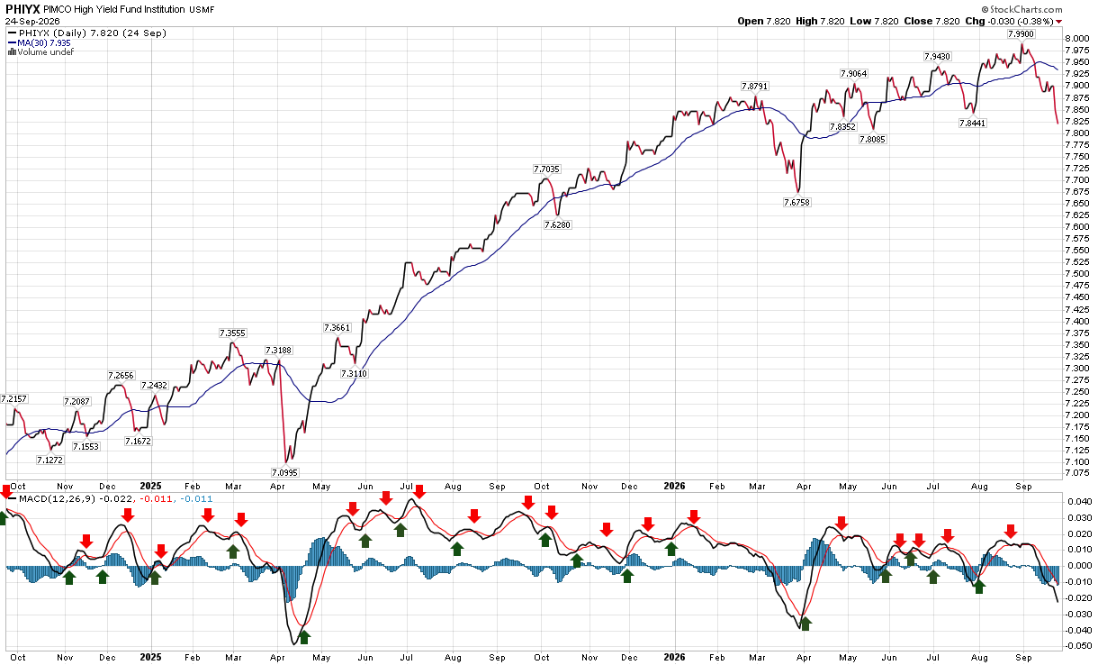
High-yield is an early “canary in the coal mine” like indicator. I’ve been using it since 1992.
Source: StockCharts.com, CMG arrows
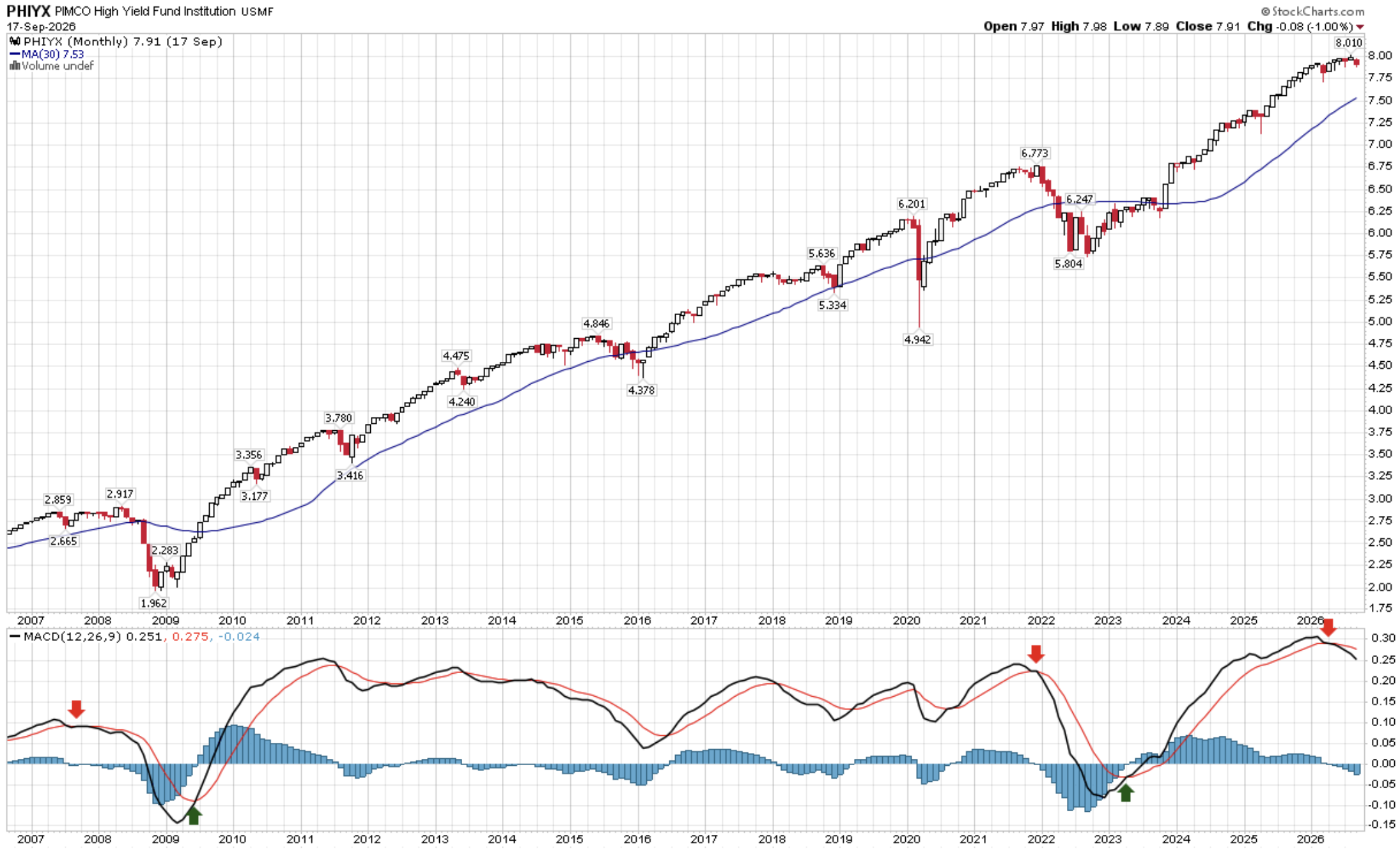
Here is another HY trend chart I keep my eye on. Note that the monthly MACD is signaling a downtrend. No major deterioration yet. Watch for acceleration in price decline.
Source: StockCharts.com w CMG trend arrows
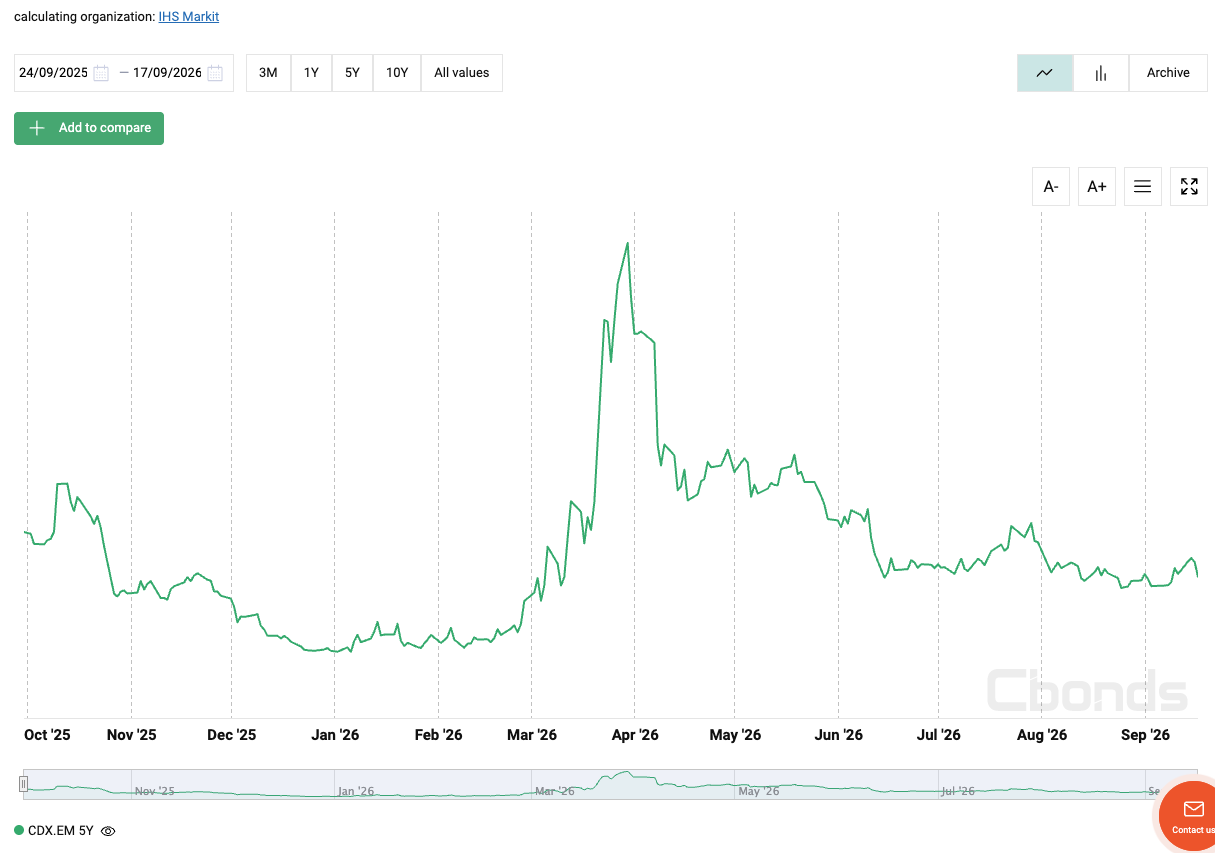
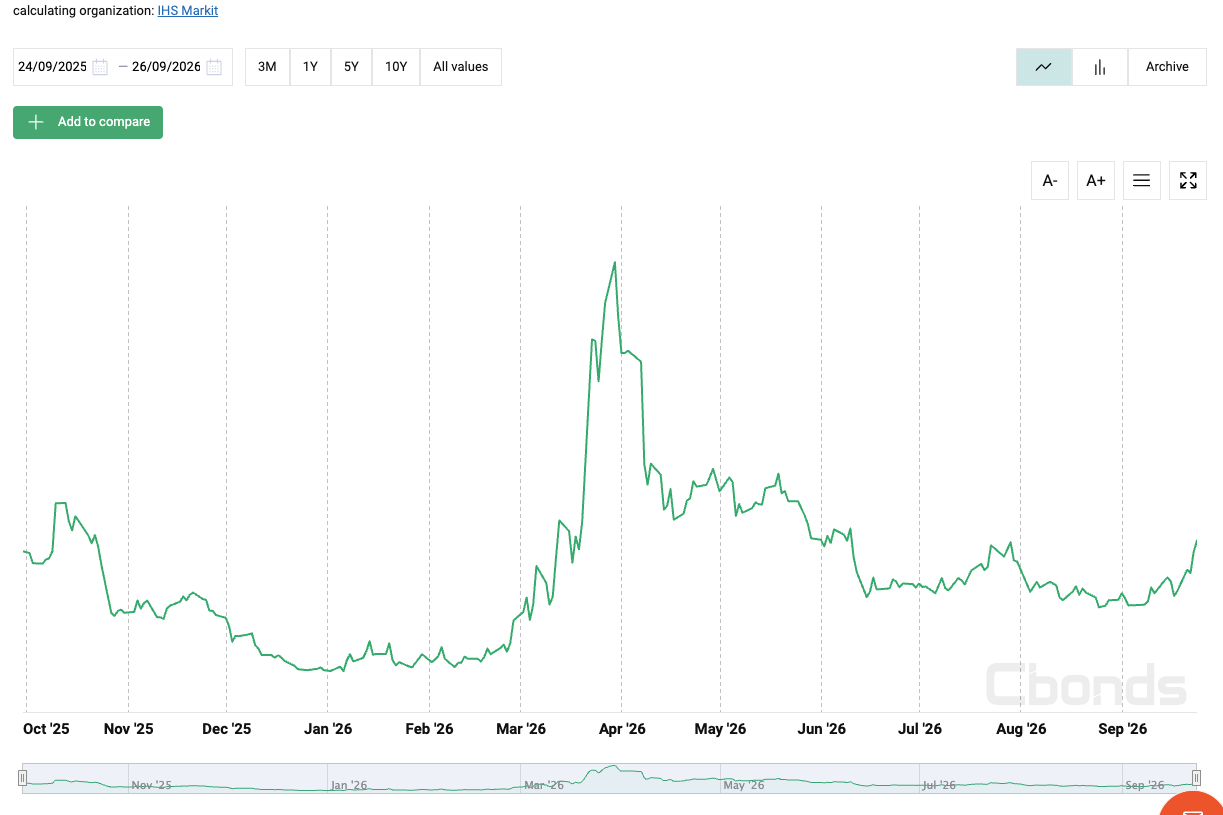
Another risk signal to watch for the Yen Carry Trade unwinding: Emerging market CDX (CDX EM Diversified Debt)
This is S&P Global’s official page for the CDX.EM 5-year index. The 5-year contract is generally the one people refer to when discussing EM sovereign credit conditions. Source: S&PGlobal
The following chart is what I shared with you last week. Pay attention to the second chart, updated today. Calm and steady is good; a sharp rise is a warning.
Last week:
Source: CBonds, https://cbonds.com/indexes/379/?utm_source=chatgpt.com
This week’s chart:
Source: StockCharts.com, CMG arrows
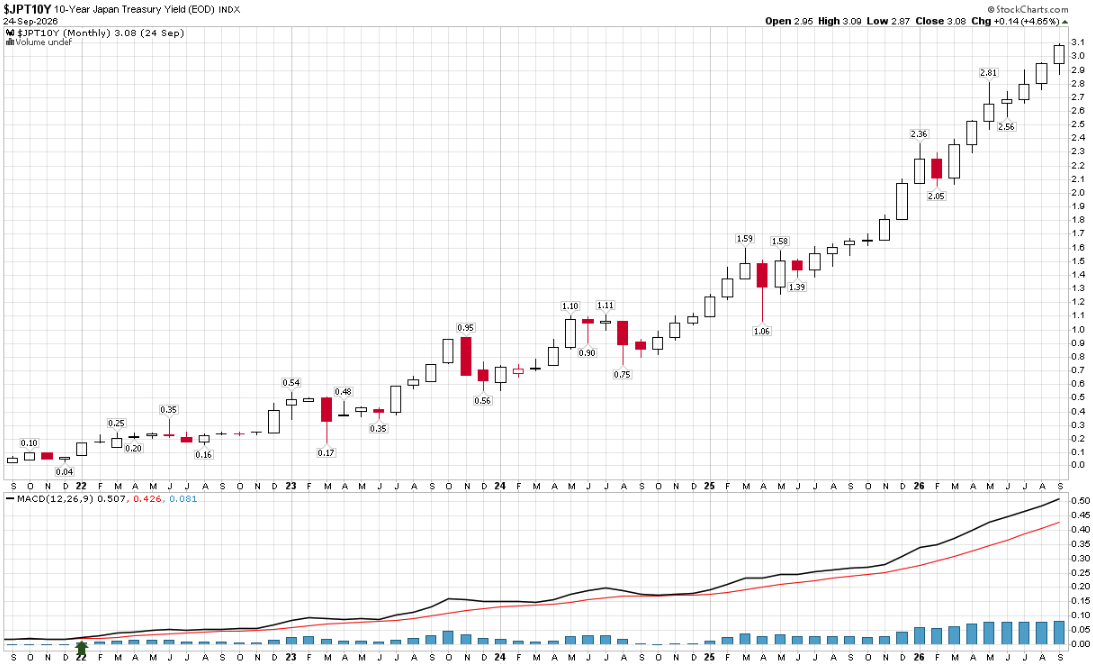
Other important signals: The Japan 10-year JGB yield is at 3.08% today, the highest level since September 1996. What is important about this is that high JGB yields choke off the carry trade at the source.
Bottom line: Flashing yellow.
Source: StockCharts.com
Opinions are subject to change. Not a recommendation to buy or sell any security. Provided for discussion and educational purposes only.
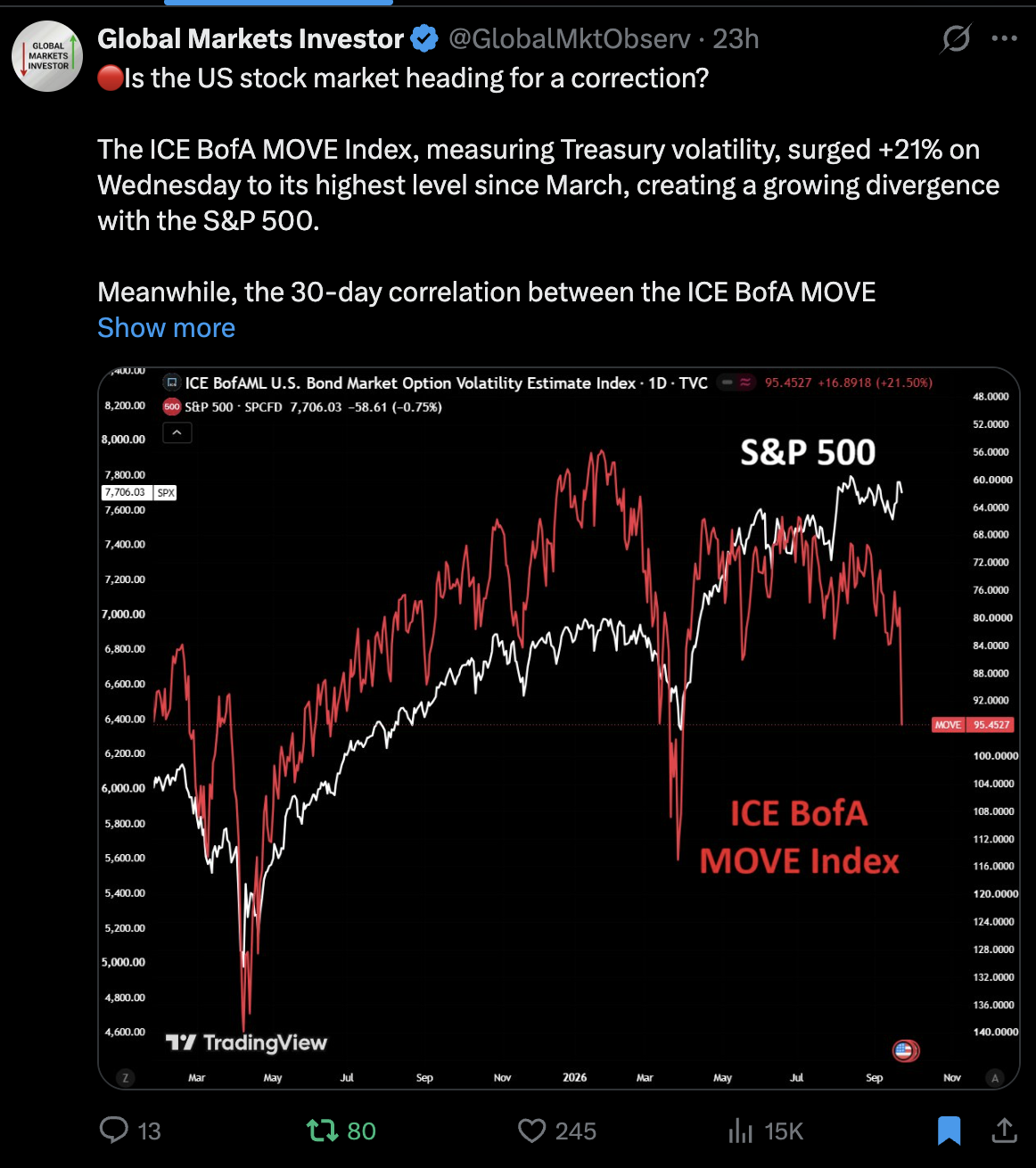
Other Interesting Charts
Source: @GlobalMktObserv
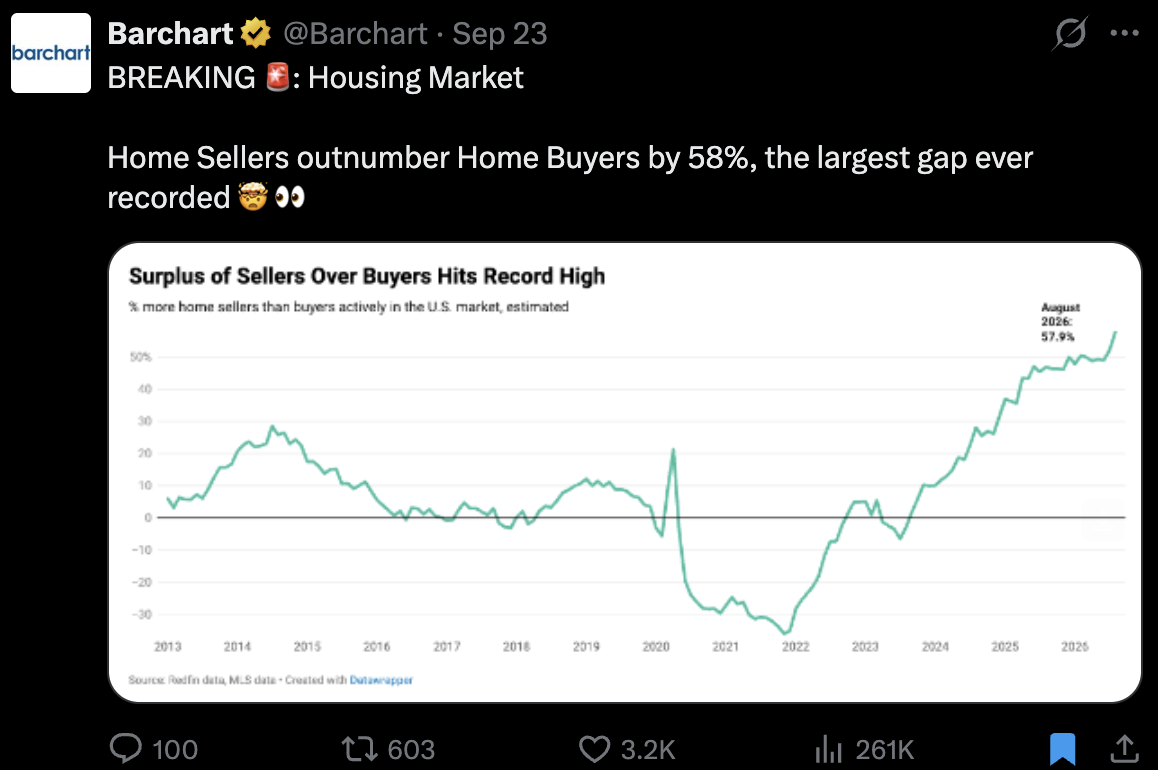
Source: @Barchart, Redfin
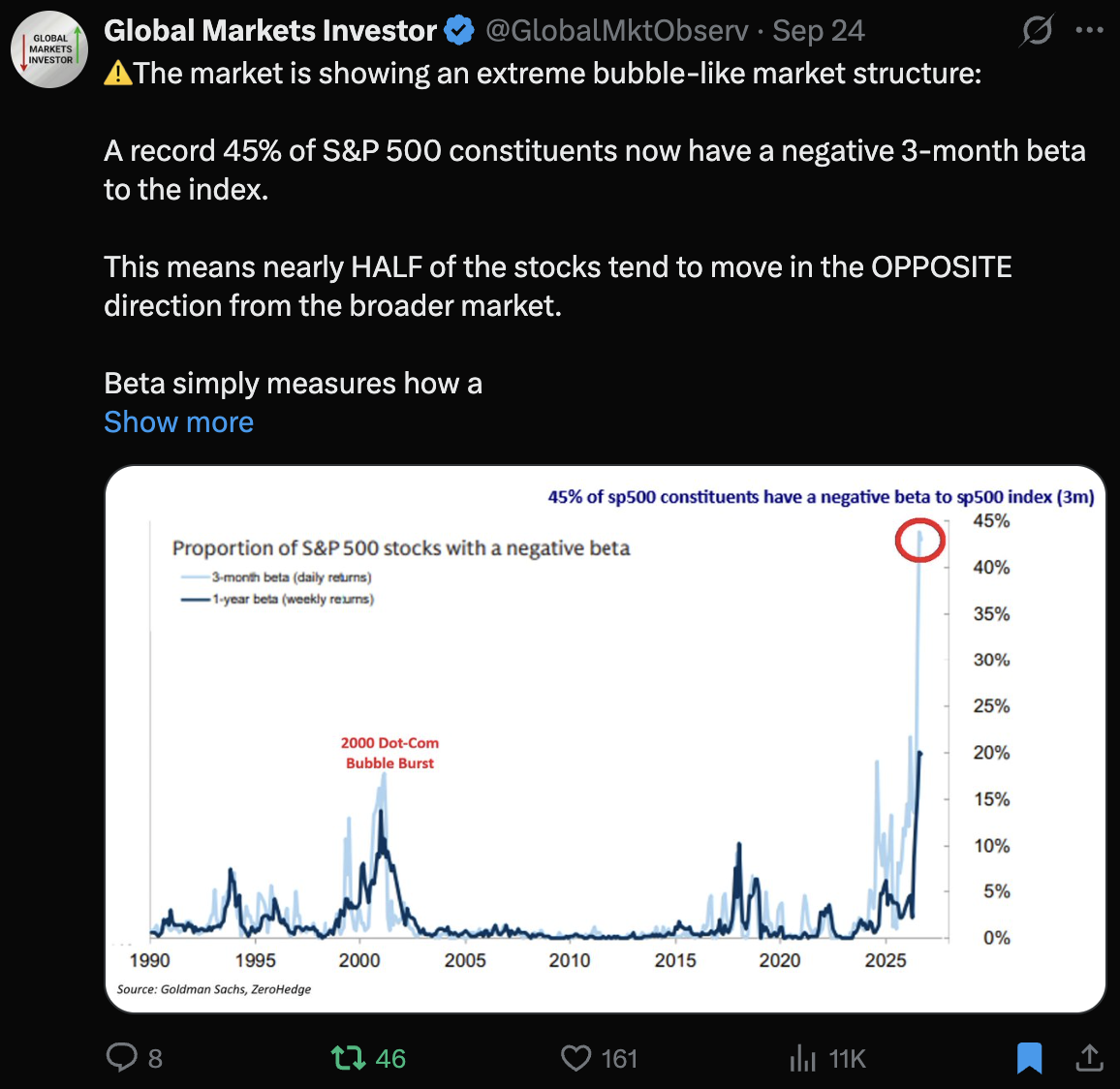
Source: Goldman Sachs, @GlobalMktObserv
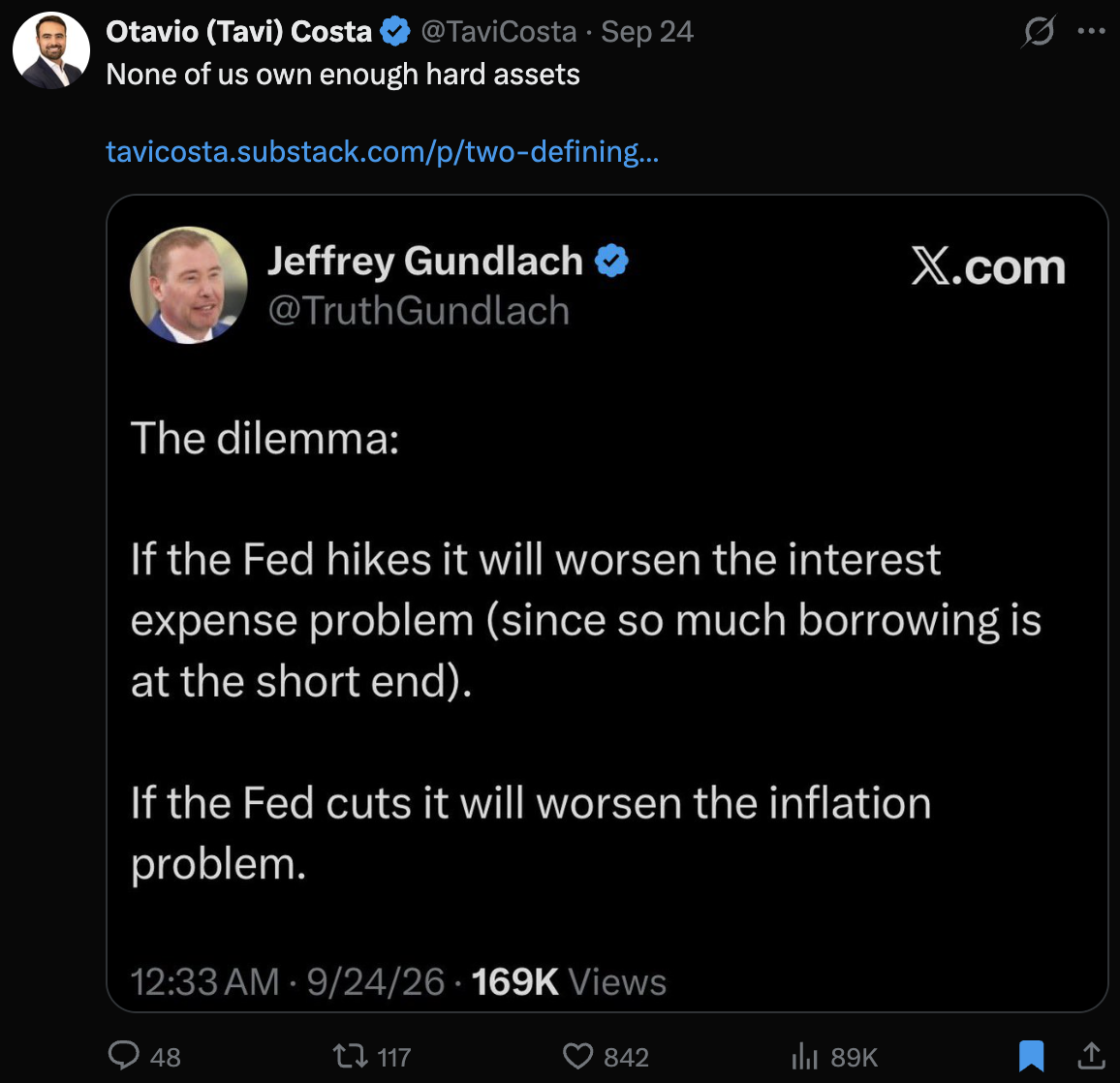
Source: @TruthGundlach, @TaviCosta
That should be enough to make your head spin. Let’s call it a day and enjoy the weekend.
Opinions are subject to change. Not a recommendation to buy or sell any security. Provided for discussion and educational purposes only.
If you like what you are reading, click on the link and share it with a friend (it’s free).
CLICK HERE TO SUBSCRIBE TO ON MY RADAR
Trade Signals: September 24, 2026 Update
Trade Signals
The Indicators Dashboard - Stocks, Investor Sentiment, Bonds, Commodities, Currencies, and Gold
Valuations and Subsequent 10-year Returns
Supporting Charts with Explanations

TRADE SIGNALS SUBSCRIPTION ACKNOWLEDGEMENT / IMPORTANT DISCLOSURES
About Trade Signals - Trade Signals is a paid subscription service that posts daily, weekly, and monthly market trends (and more). Free for CMG clients. Not a recommendation to buy or sell any security. For discussion purposes only.
The views expressed herein are solely those of Steve Blumenthal as of the date of this report and are subject to change without notice. Please note that the information provided is not recommended for buying or selling any security and is provided for discussion purposes only.
Personal Note: 5-0-1
The travel schedule is picking up. Next Friday, I head to Penn State to catch up with some of my former teammates and watch our Nittany Lions men's soccer team take on Ohio State. After the game, we'll likely head to The Phyrst for a few beers and throw a jab or two at each other. We were a close-knit team from 1979 to 1983, and I think that chemistry was a big reason for our success. It will be good to be with old friends.
Speaking of chemistry, Coach Sue's MP Friars played a close one last Monday. The game was tied 1–1 at the end of regulation and went to overtime. In the huddle before extra time, one of the boys said, "Get the ball to Dom." Dom is a tremendous goal scorer. Then our left-footed star, Chase O, made a quick move just outside the 18-yard box and drilled home the game-winner.
I smiled, thinking back to our 1979 NCAA Final Four run. Everyone knew the job: hold the line on defense, don't break, and get the ball to Jimmy Stamatis. Jimmy won the Hermann Trophy that year as the nation's most outstanding college player. He was the key to our success, but it takes a team, especially one with great chemistry. On Monday night, the plan was Dom, and the finish was Chase. The celebration was fun to watch.
The Friars sit at 5–0–1, and the season's challenging Inter-Ac league play begins next week. I'm loving being on the sidelines with Susan and getting to know the young men. This group is special. What a wonderful, fun distraction from investment risk management.
I'll be in NYC in early October and then in Boston at the end of the month for the annual Schwab conference. One of our private equity investments just signed a major technology deal with Schwab, and the partnership kicks off at the conference.
Lastly, the Northeast is in for a rough weekend. A slow-moving nor'easter is bringing the risk of coastal flooding, beach erosion, high surf, and locally heavy rain. If it affects your area, stay safe!
Hope your young sports stars are enjoying their teams.
Have a great weekend!
Kind regards,
Steve
CLICK HERE TO SUBSCRIBE TO ON MY RADAR - IT’S FREE
You can share this letter on X by clicking here.
You can share this letter on LinkedIn by clicking here.
Subscribe to OMR for free by clicking the photo.
Stephen B. Blumenthal
Executive Chairman & CIO
CMG Capital Management Group, Inc.
75 Valley Stream Parkway, Suite 201,
Malvern, PA 19355
CMG Customer Relationship Summary (Form CRS)
Metric-Financial, LLC Customer Relationship Summary (Form CRS)

Stephen Blumenthal founded CMG Capital Management Group in 1992 and serves today as its Executive Chairman and CIO. Steve authors a free weekly e-letter entitled, “On My Radar.” Steve shares his views on macroeconomic research, valuations, portfolio construction, asset allocation and risk management. Author of Forbes Book: On My Radar, Navigating Stock Market Cycles.
Follow Steve on X @SBlumenthalCMG and LinkedIn.
IMPORTANT DISCLOSURE INFORMATION
This document is prepared by CMG Capital Management Group, Inc. (“CMG”) and is circulated for informational and educational purposes only. There is no consideration given to the specific investment needs, objectives, or tolerances of any of the recipients. Additionally, CMG’s actual investment positions may, and often will, vary from its conclusions discussed herein based on any number of factors, such as client investment restrictions, portfolio rebalancing, and transaction costs, among others. Recipients should consult their own advisors, including tax advisors, before making any investment decision. This material is for informational and educational purposes only and is not an offer to sell or the solicitation of an offer to buy the securities or other instruments mentioned. This material does not constitute a personal recommendation or take into account the particular investment objectives, financial situations, or needs of individual investors which are necessary considerations before making any investment decision. Investors should consider whether any advice or recommendation in this research is suitable for their particular circumstances and, where appropriate, seek professional advice, including legal, tax, accounting, investment, or other advice. The views expressed herein are solely those of Steve Blumenthal as of the date of this report and are subject to change without notice.
Investing involves risk.
This letter may contain forward-looking statements relating to the objectives, opportunities, and future performance of the various investment markets, indices, and investments. Forward-looking statements may be identified by the use of such words as; “believe,” anticipate,” “planned,” “potential,” and other similar terms. Examples of forward-looking statements include, but are not limited to, estimates with respect to financial condition, results of operations, and success or lack of success of any particular market, index, investment, or investment strategy. All are subject to various factors, including, but not limited to, general and local economic conditions, changing levels of competition within certain industries and markets, changes in legislation or regulation, Federal Reserve policy, and other economic, competitive, governmental, regulatory, and technological factors affecting markets, indices, investments, investment strategy and portfolio positioning that could cause actual results to differ materially from projected results. Such statements are forward-looking in nature and involve a number of known and unknown risks, uncertainties, and other factors, and accordingly, actual results may differ materially from those reflected or contemplated in such forward-looking statements. Investors are cautioned not to place undue reliance on any forward-looking statements or examples. All statements made herein speak only as of the date that they were made. Investing is inherently risky and all investing involves the potential risk of loss.
Past performance does not guarantee or indicate future results. Different types of investments involve varying degrees of risk, and there can be no assurance that the future performance of any specific investment, investment strategy, or product (including the investments and/or investment strategies recommended or undertaken by CMG), or any non-investment related content, made reference to directly or indirectly in this commentary will be profitable, equal any corresponding indicated historical performance level(s), be suitable for your portfolio or individual situation or prove successful. Due to various factors, including changing market conditions and/or applicable laws, the content may no longer be reflective of current opinions or positions. Moreover, you should not assume that any discussion or information contained in this commentary serves as the receipt of, or as a substitute for, personalized investment advice from CMG. Please remember to contact CMG, in writing, if there are any changes in your personal/financial situation or investment objectives for the purpose of reviewing/evaluating/revising our previous recommendations and/or services, or if you would like to impose, add, or to modify any reasonable restrictions to our investment advisory services. Unless, and until, you notify us, in writing, to the contrary, we shall continue to provide services as we do currently. CMG is neither a law firm, nor a certified public accounting firm, and no portion of the commentary content should be construed as legal or accounting advice.
No portion of the content should be construed as an offer or solicitation for the purchase or sale of any security. References to specific securities, investment programs or funds are for illustrative purposes only and are not intended to be, and should not be interpreted as recommendations to purchase or sell such securities.
This presentation does not discuss, directly or indirectly, the amount of the profits or losses realized or unrealized, by any CMG client from any specific funds or securities. Please note: In the event that CMG references performance results for an actual CMG portfolio, the results are reported net of advisory fees and inclusive of dividends. The performance referenced is that as determined and/or provided directly by the referenced funds and/or publishers, has not been independently verified, and does not reflect the performance of any specific CMG client. CMG clients may have experienced materially different performance based upon various factors during the corresponding time periods. See in links provided citing limitations of hypothetical back-tested information. Past performance cannot predict or guarantee future performance. Not a recommendation to buy or sell. Please talk to your advisor.
Information herein has been obtained from sources believed to be reliable, but we do not warrant its accuracy. This document is general communication and is provided for informational and/or educational purposes only. None of the content should be viewed as a suggestion that you take or refrain from taking any action nor as a recommendation for any specific investment product, strategy, or other such purposes.
In a rising interest rate environment, the value of fixed-income securities generally declines, and conversely, in a falling interest rate environment, the value of fixed-income securities generally increases. High-yield securities may be subject to heightened market, interest rate, or credit risk and should not be purchased solely because of the stated yield. Ratings are measured on a scale that ranges from AAA or Aaa (highest) to D or C (lowest). Investment-grade investments are those rated from highest down to BBB- or Baa3.
NOT FDIC INSURED. MAY LOSE VALUE. NO BANK GUARANTEE.
Certain information contained herein has been obtained from third-party sources believed to be reliable, but we cannot guarantee its accuracy or completeness.
In the event that there has been a change in an individual’s investment objective or financial situation, he/she is encouraged to consult with his/her investment professional.
Written Disclosure Statement. CMG is an SEC-registered investment adviser located in Malvern, Pennsylvania. Stephen B. Blumenthal is CMG’s founder and CEO. Please note: The above views are those of CMG and its CEO, Stephen Blumenthal, and do not reflect those of any sub-advisor that CMG may engage to manage any CMG strategy, or exclusively determines any internal strategy employed by CMG. A copy of CMG’s current written disclosure statement discussing advisory services and fees is available upon request or via CMG’s internet web site at www.cmgwealth.com/disclosures. CMG is committed to protecting your personal information. Click here to review CMG’s privacy policies.
See CMG Disclosures at the bottom of this page.
For more information about NDR, please visit at www.ndr.com.
NDR, Inc. (NDR), d.b.a. Ned Davis Research Group (NDRG), any NDRG affiliates or employees, or any third-party data provider, shall not have any liability for any loss sustained by anyone who has relied on the information contained in any NDRG publication. The data and analysis contained herein are provided "as is." NDRG disclaims any and all express or implied warranties, including, but not limited to, any warranties of merchantability, suitability or fitness for a particular purpose or use. NDRG's past recommendations and model results are not a guarantee of future results. This communication reflects our analysts' opinions as of the date of this communication and will not necessarily be updated as views or information change. All opinions expressed herein are subject to change without notice. NDRG or its affiliated companies or their respective shareholders, directors, officers and/or employees, may have long or short positions in the securities discussed herein and may purchase or sell such securities without notice. For NDRG's important additional disclaimers, refer to www.ndr.com/invest/public/copyright.html. Further distribution prohibited without prior permission. Copyright 2025 © NDR, Inc. All rights reserved.