August 28, 2026
By Steve Blumenthal
"This wasn't liquidity management, it was price management."
— Stanley Druckenmiller
From 1942 to 1951, the Federal Reserve pinned long-term Treasury yields to help finance a war. The war ended in 1945. The interest rate cap didn't. It took six more years before a formal Treasury-Fed Accord finally let it go.
That was a generation of savers earning whatever yield the government decided they should — the market wasn't allowed to set it. Sit with that for a second.
Earlier this week, Stanley Druckenmiller wrote an opinion piece in the Wall Street Journal titled "Let the Bond Market Speak." He made almost the identical point I made last week in "Plugging the Leak" about what's happening right now. But there's a detail worth sitting with before we get to what he actually argued.
The two men now running U.S. monetary policy (the Fed) and fiscal policy (Treasury) both learned the trade sitting next to him. Scott Bessent cut his teeth on Druckenmiller's team at Soros Fund Management in the early 1990s, including the 1992 trade that broke the Bank of England's defense of the pound. Kevin Warsh has been a partner at Druckenmiller's own firm, Duquesne, since 2011, in a relationship people close to both describe as father-son.
So when Druckenmiller went after Bessent's Treasury buyback program, this wasn't an outside critic taking a shot from the cheap seats. It was the mentor calling out the student, in public, using the same playbook he taught him.
His argument, in short: Treasury's move to double long-bond buybacks to $4 billion wasn't liquidity management; it was an attempt to manage the price of Treasury debt directly. Yields dipped at first, but, within a day, they fully round-tripped higher. The market simply un-did it.
Druckenmiller walked through why that matters. The government is running a 6% deficit at full employment. Total debt is $40 trillion. Interest costs now exceed the defense budget. His point: the long bond is the only fiscal disciplinarian Washington has left. Suppress its yield, and you don't fix the deficit; you just remove the pressure that would eventually force someone to. He drew a direct line to the Fed's 1942–1951 wartime yield cap, which took a formal Accord to unwind, and warned this is the first step down that same road.
"If the 30-year must trade at 5.5% to clear, that isn't a crisis. It is an invoice," Druckenmiller wrote. "Then do the only thing that durably lowers long-term yields: address the primary deficit." Data Source: Druckenmiller, WSJ
Sear this line into your brain:
"Governments defending prices against fundamentals always lose. The only variable is how much they spend before conceding."
A direct message from teacher to student just days before the annual Jackson Hole Symposium, which is underway right now.
I'm not going to spend much time debating whether this is wise policy. It isn't. Our job is to watch the chessboard, the players' behavior, and the moves being made.
Rising long rates. A government quietly shortening its own debt maturities. A currency-and-rates dynamic that leans toward financial repression instead of reform. You don't get paid for winning that argument. You get paid for positioning.
And remember: nothing is more important than interest rates. It's the cost of money.
If we are, in fact, heading toward real yield curve control, that's not a neutral outcome. A government capping long rates while running deficits like these is functionally printing its way through the problem — that's dollar-negative, inflationary, and the classic recipe for stagflation: weak growth and high prices at the same time. Historically, that combination is bullish for hard assets like gold and real assets (things that can't be diluted), commodities, and challenging on anything that loses ground to inflation, starting with cash and long-dated bonds.
I wrote about this exact mechanism last year in "Debt Misconceptions," pulling from Edward Chancellor's The Price of Time: The Real Story of Interest — a terrific history of what happens when governments hold rates below where the market wants them. His answer, in short: the distortion doesn't disappear; it just shows up somewhere else — bad debt, misallocated capital, and eventually inflation. We may be about to watch the next chapter get written in real time. Ray Dalio estimates inside of three years.
Here's an updated look at the 10-year Treasury yield, currently at 4.72%. Note the red arrow in the bottom right points to a rising interest rate trend:
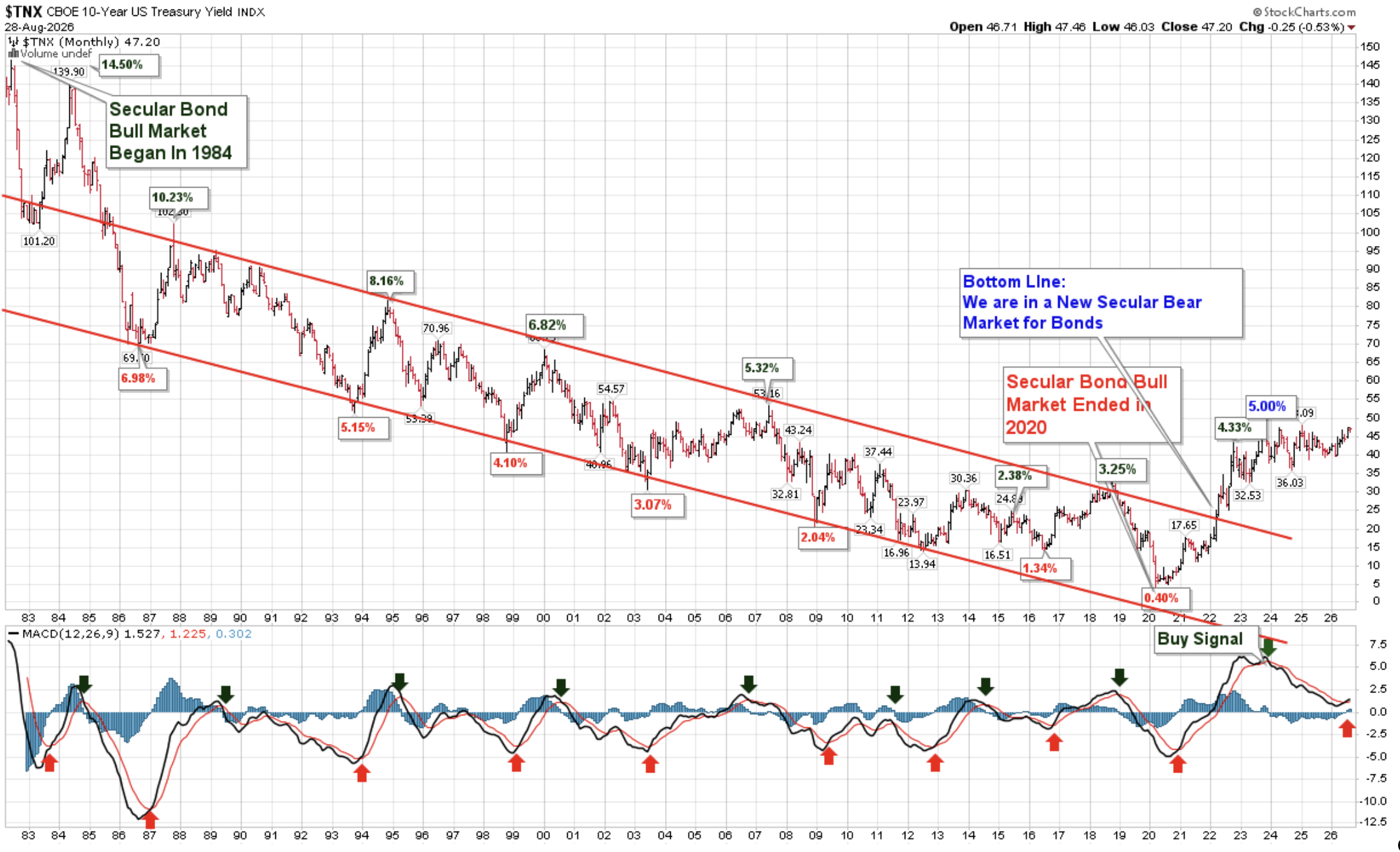
Source: Stockcharts.com, cmgprivatewealth.com
Grab your coffee and find your favorite chair — there's good reading ahead.
First, a link below to a short 2023 interview with Scott Bessent that's a must-watch through a game theory lens. Watch investor Scott Bessent try to read policymakers' next move, back when that was his job, not his title. Today, he's the one making the moves. Worth keeping in mind as we do our best to handicap what comes next.
You'll also find a few other links I flagged this week, plus a replay of a podcast conversation with my dear friend Joe Quartucci and his CIO, Arpit Sharma. Read a section or two, take a break, top off the coffee, and come back for more.
On My Radar: Playing Whack-A-Mole
Boockvar (Whack-A-Mole), Habib (Warsh’s Favored Inflation Measure)
OMR is for informational and educational purposes only. No consideration is given to your specific investment needs, objectives, or tolerances.
Please see the Important Disclosures at the bottom of this page. Reminder: This is not a recommendation to buy or sell any security. My views may change at any time. The information is for discussion and educational purposes only.
If you like what you are reading, you can subscribe for free.

2023 Scott Bessent Interview
Put your game theory hat on as we do our best to understand the probability of next moves and the probability of outcomes - the following is a 2023 Scott Bessent interview.
Here are my summary bullet point notes (click to watch below):
De-Dollarization and Market Sequencing
Bessent characterized de-dollarization as a slow-moving process but noted that a dollar rally may first emerge as companies and countries repaying dollar-denominated debt create an interim shortage of dollars before broader efforts to reduce dollar usage take hold. (SB here: He was describing this back in 2023. He now controls the lever. I think the plan is to reduce the value of the dollar… some form of restructuring is coming. I find it interesting that the title of this year’s Jackson Hole Symposium is “Financial Innovation: Implications for Payments and Policy.”
The interviewer identified de-dollarization as a leading investment theme and asked how to assess the path ahead and determine when to build related positions. Bessent responded that the investment team looks for stress in the financial system as a potential signal for implementation. (SB here: remember this was Bessent the investor, not the current Treasury Secretary).
Bessent reported that a recent three-day London offsite highlighted the difficulty of converting long-term, “meta” ideas into actionable market positions. He cited activity at the Shanghai Gold Exchange and India's and China's ability to pay for oil in rupees and RMB as marginal developments that may reduce the dollar’s role in global trade. (SB here: Think about how much gold China has and continues to buy. A currency backed by gold. Building an alternative to the dollar).
Geopolitical and Reserve-System Signals:
Bessent described a December (2022) discussion with a French consultant as a personal wake-up call. The consultant argued that it was untenable for the United States to extend its foreign policy to an ally through the dollar, citing the multibillion-dollar fine imposed on BNP as a possible incentive for France to consider alternative arrangements.
The discussion broadened from the “Global South” seeking alternatives to the dollar system to the possibility that even the French Republic could eventually seek greater monetary independence.
The interviewer suggested that the treatment of Russia’s foreign-exchange reserves may have accelerated this trend. Bessent clarified that he had been told the reserves were frozen rather than formally seized, while expressing his own view that the assets could ultimately disappear.
Purchasing-Power Preservation and Gold:
The interviewer emphasized preservation of purchasing power as a central investment consideration in a system with substantial debt and currencies that function primarily as a relative-value comparison. Bessent also noted a long-term belief in gold and a distrust of central banks. (SB here: interesting to think about now that Bessent sits in the seat he now sits).
Bessent described gold as non-fiat, limited in supply, recognized as a store of value, and capable of being held in a vault and moved when necessary. He used Russia’s reserve strategy as an example: Russia reduced its dollar exposure but shifted into euros, apparently underestimating the willingness of European governments to follow the United States. Bessent argued that an all-gold reserve allocation would have preserved the reserves, although gold’s price would likely have been higher. (SB here: the point is what happens when countries move away from the dollar. This is why the yen carry trade issue I’ve been flagging is so important. Selling treasuries, selling dollars, and buying yen would not be bullish for the dollar nor bullish for fixed-rate bond investments. We are sitting at an interesting T-juncture. We can’t drive streight; turning left has consequences, turning right has consequences. Both roads lead to inflation. What a pickle we are in.)
Bessent raised the possibility that China could be adopting a more defensive posture toward Taiwan, noting that the PBOC is currently a major buyer of gold. He asked whether an RMB exchangeable into gold, potentially at a premium, could eventually emerge; this was presented as a hypothetical scenario rather than an established policy or recommendation. (SB here: that was in 2023. This is exactly what has happened since then.)
Gold and Bitcoin Risk Characteristics:
The interviewer stated that the gold discussion was broadly consistent with Bessent’s views and contrasted those views with skepticism about Bitcoin. Bessent drew a distinction between the assets, stating that gold can function as either a risk-off or risk-on asset, whereas Bitcoin is a risk-on asset. (SB here: reflecting back on the name of this year's Jackson Hole Symposium - “Financial Innovation: Implications for Payments and Policy.” I smell blockchain, gold and a system-wide restructuring. A “great reset” as my friend John Mauldin keeps calling it? My read is we are seeing the chess moves in motion.)
Issues / Challenges:
Converting Long-Term Themes into Trades: The team’s London offsite identified an unresolved implementation challenge: translating a broad de-dollarization thesis into specific, timely market positions. Bessent cited financial-system stress as a potential decision lens, but no formal trigger, position size, or timing framework was established. (SB here: No identifiable trigger points in 2023. In hindsight, he had the right read. Today, he’s the captain of the ship. He knows how the gears work. He told us what he, as an investor, is watching out for. And here we are today, stuck in a trap with two market-savvy leaders with their hands solidly placed upon the levers. Fighting the economic fight of their lives. All of us sit in its wake.)
Uncertainty Over Reserve Security: The exchange over whether Russia’s reserves are frozen or seized, and Bessent's concern that they may ultimately disappear, illustrates uncertainty around the legal and practical security of sovereign reserves held within the dollar- and euro-based system. (SB here: foreign investors are growing distrustful of the US.)
Game theory hats on - Click on the photo to watch the 4-minute interview:
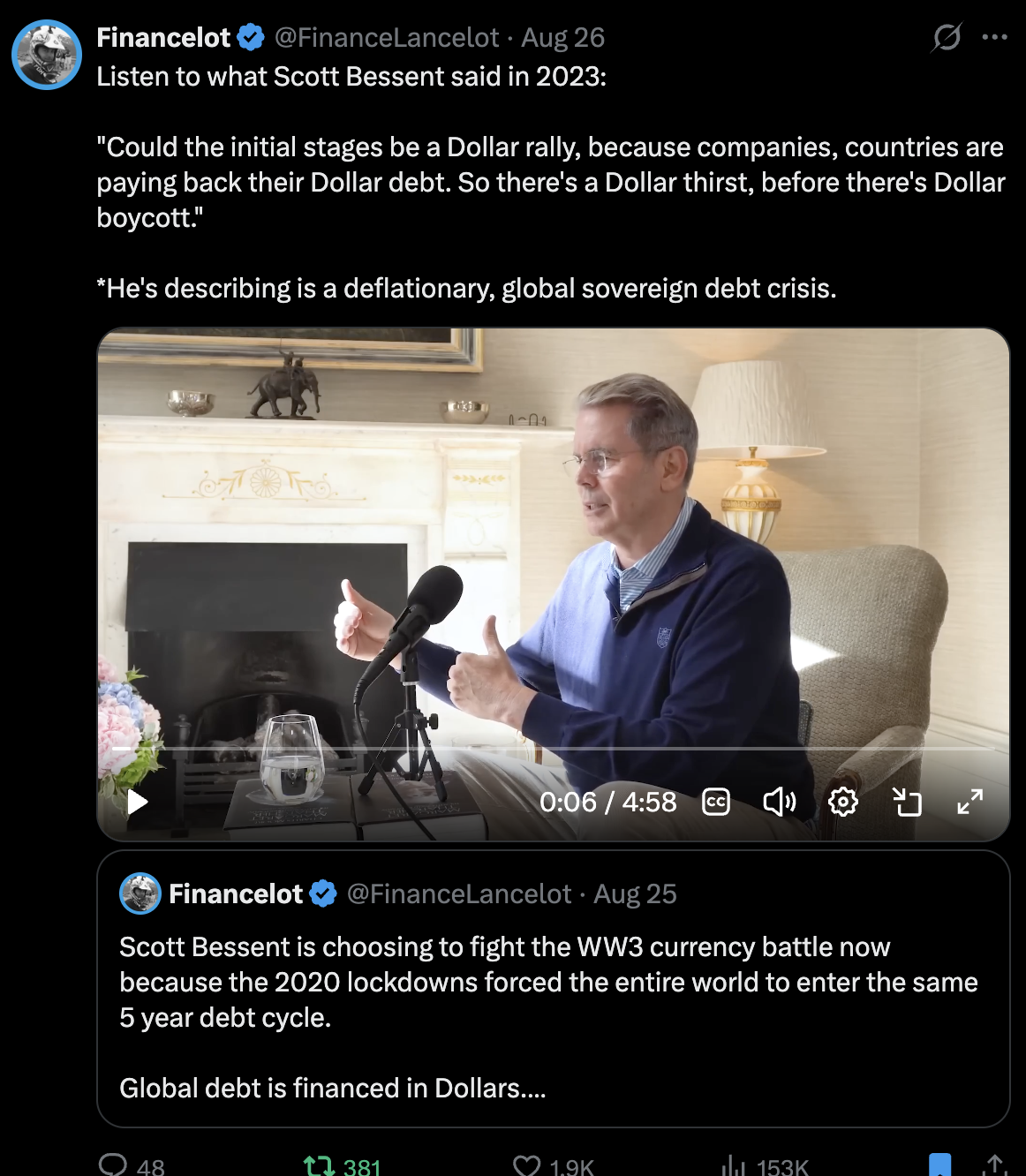
Source: @FinanceLancelot
Factor the following into your calculus:
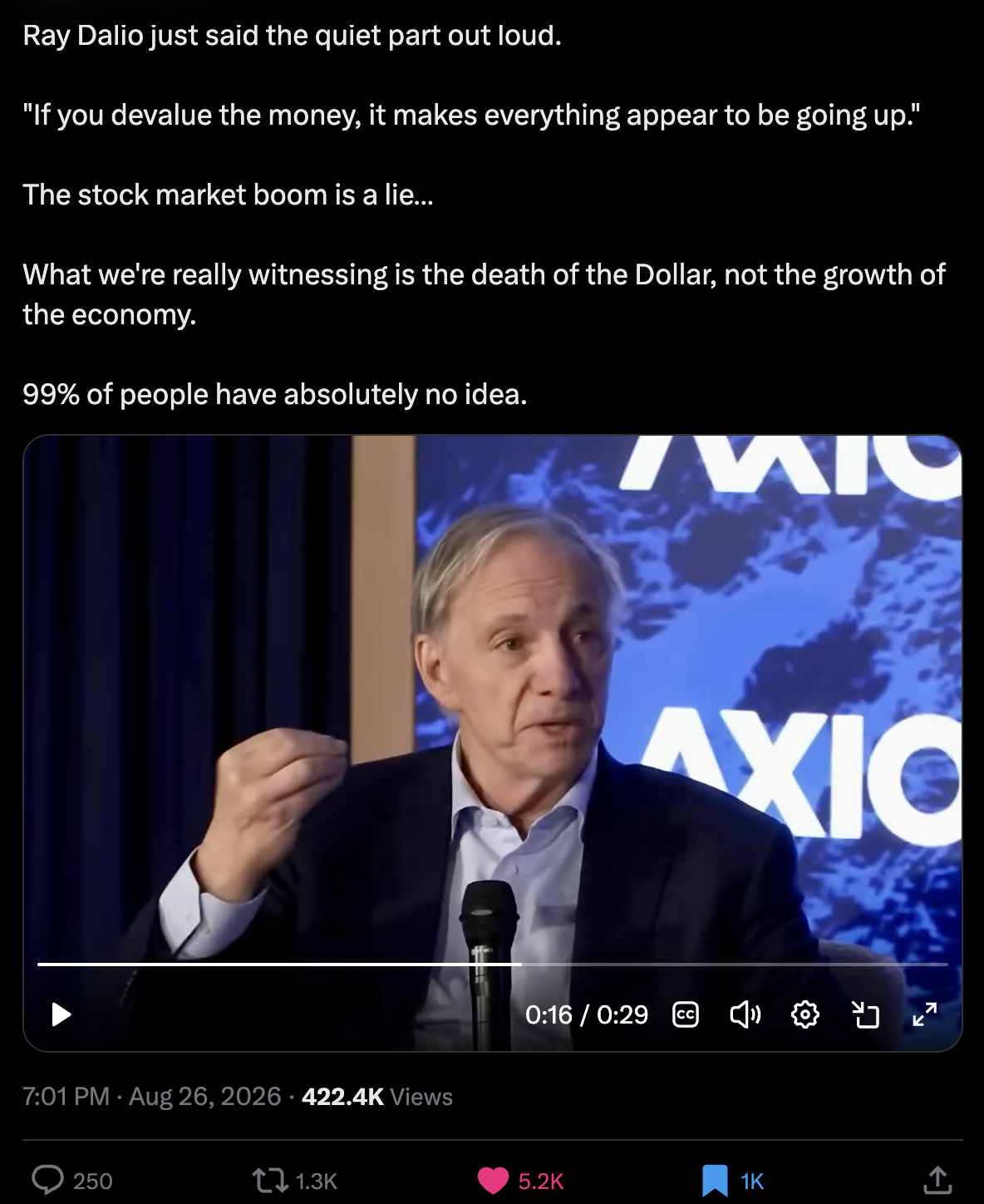
Source: @fuelkek, Axios
And this (while keeping Bessent’s 2023 comments top of mind):
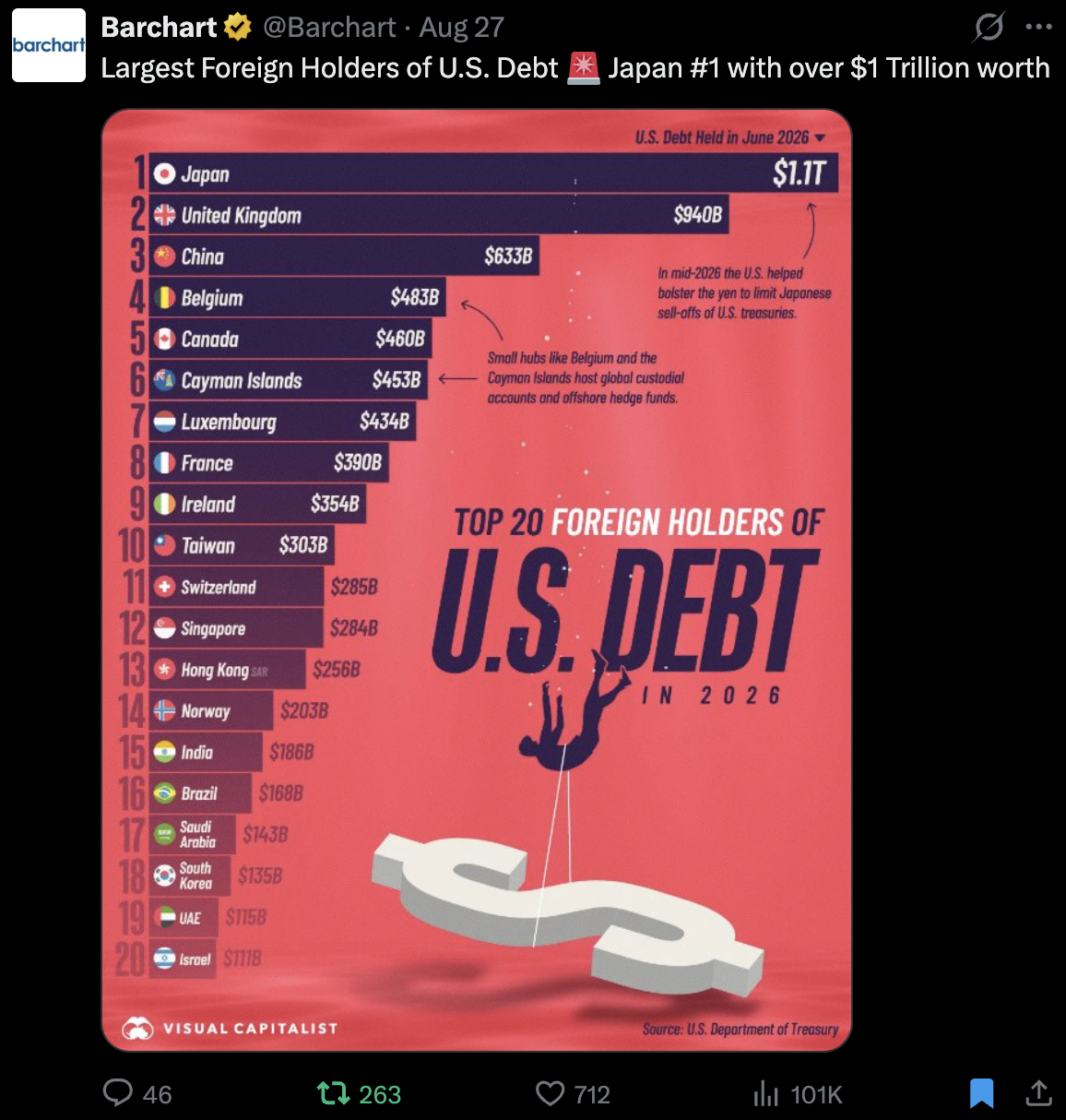
Opinions are subject to change. Not a recommendation to buy or sell any security. Provided for discussion and educational purposes only.
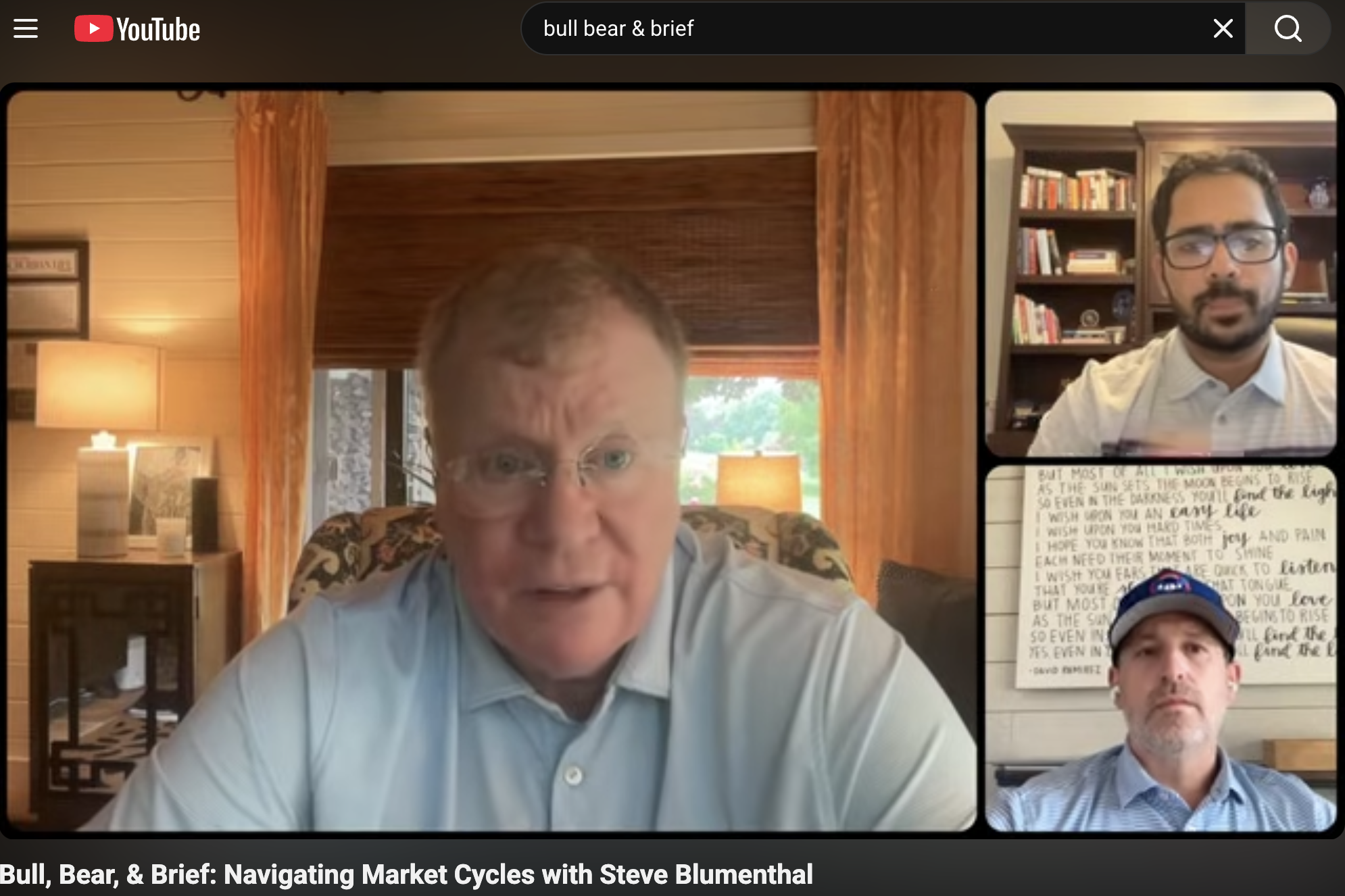
Bull, Bear, & Brief: Navigating Market Cycles
Navigating Market Cycles with Steve Blumenthal
In this special episode of Bull, Bear, & Brief, Joe Quartucci and Arpit Sharma sit down with yours. I share my perspective on today's market environment, the long-term debt cycle, elevated valuations, the risk of inflation and rising interest rates, and the forces that could shape markets over the next several years.
Click on the photo or here to watch the video:
See important disclaimers below. Not a recommendation to buy or sell anything.
If you are a Spotify subscriber, you can find the audio version here.
Opinions are subject to change. Not a recommendation to buy or sell any security. Provided for discussion and educational purposes only.
Boockvar (Whack-A-Mole), Habib (Warsh’s Favored Inflation Measure)
A few more hot links to put on your radar.
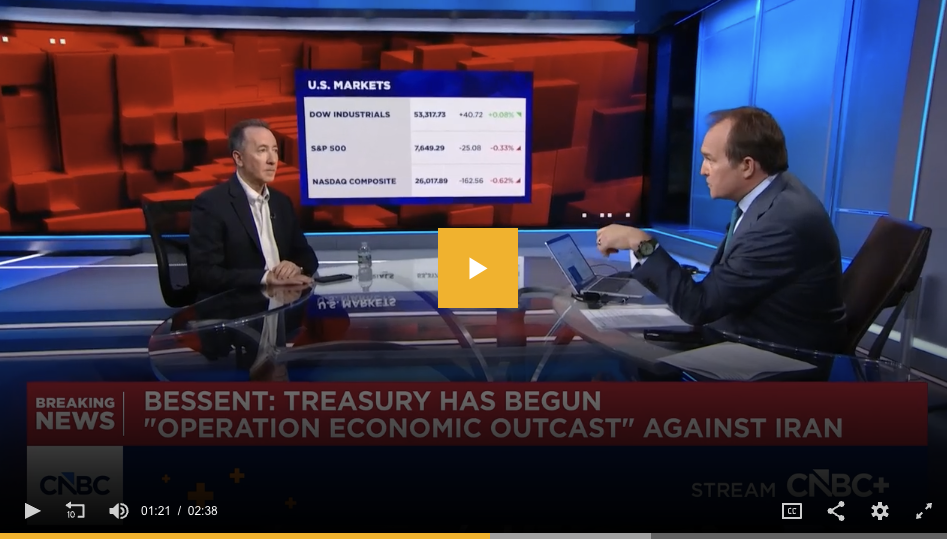
Peter Boockvar
“If the Fed chair won't raise rates himself, the bond market's long end will do it for him,” Peter said.
Worth the watch. Click on the photo and jump to the 1-minute 15-second mark. Playing whack-a-mole.
Source: CNBC
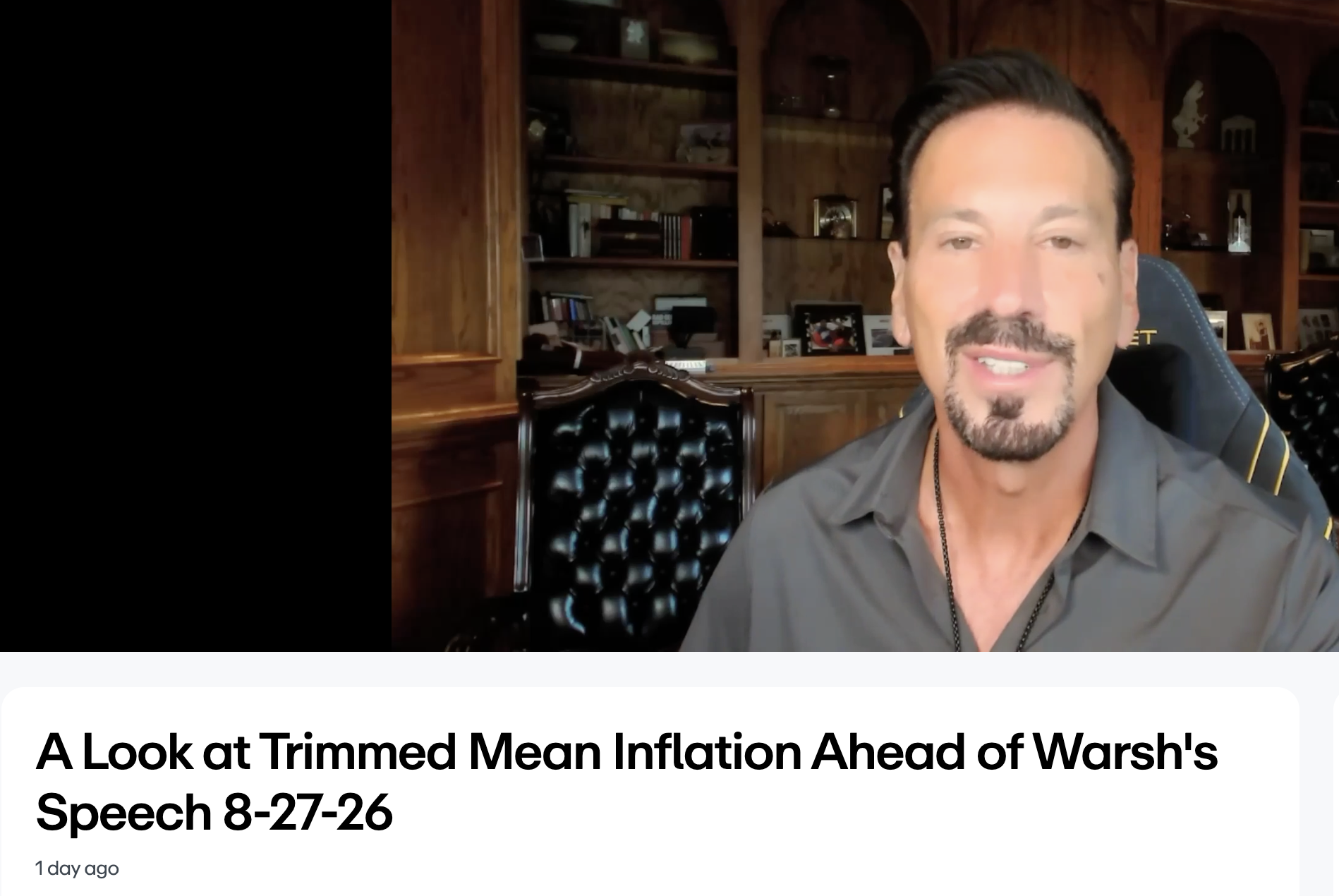
Barry Habib
Ahead of the Jackson Hole Symposium, Barry breaks down Fed Chairman Kevin Warsh’s favorite economic indicator, Trimmed Mean. Bottom line: no major inflation in the latest Dallas Fed Trimmed Mean report. The MBS Highway team doesn’t believe the Fed will raise rates in September.
A short video, worth your attention.
Source: MBS Highway
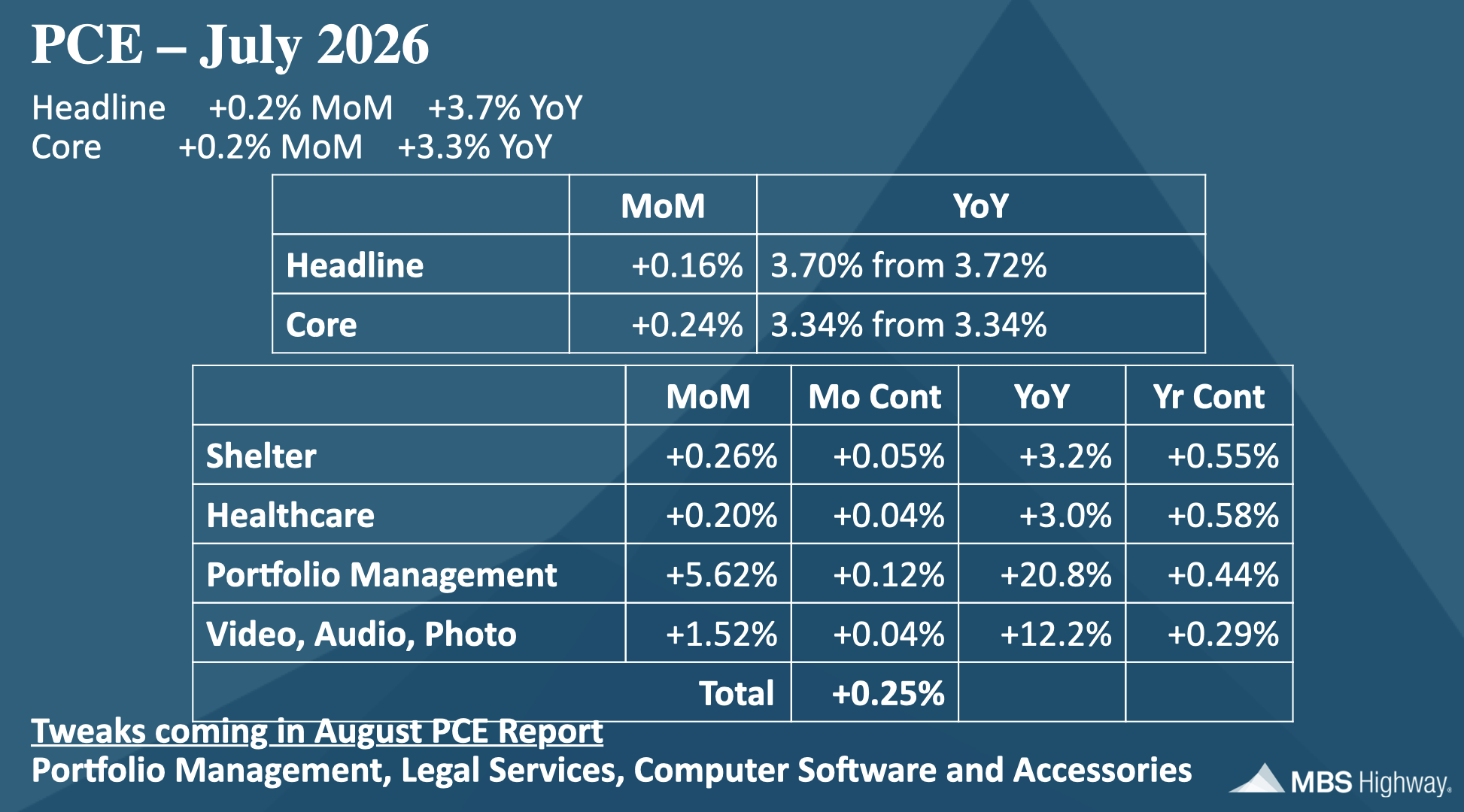
More from Barry on this week’s GDP report here.
Source: MBS Highway
Opinions are subject to change. Not a recommendation to buy or sell any security. Provided for discussion and educational purposes only.
If you like what you are reading, click on the link and share it with a friend (it’s free).
CLICK HERE TO SUBSCRIBE TO ON MY RADAR
Trade Signals: August 20, 2026 Update
Trade Signals
The Indicators Dashboard - Stocks, Investor Sentiment, Bonds, Commodities, Currencies, and Gold
Valuations and Subsequent 10-year Returns
Supporting Charts with Explanations

TRADE SIGNALS SUBSCRIPTION ACKNOWLEDGEMENT / IMPORTANT DISCLOSURES
About Trade Signals - Trade Signals is a paid subscription service that posts daily, weekly, and monthly market trends (and more). Free for CMG clients. Not a recommendation to buy or sell any security. For discussion purposes only.
The views expressed herein are solely those of Steve Blumenthal as of the date of this report and are subject to change without notice. Please note that the information provided is not recommended for buying or selling any security and is provided for discussion purposes only.
Personal Note: Game Day
Varsity tryouts are over, and the new team is formed. When this email hits your inbox today, I'll be on the sideline with notepad and pen in hand, scouting the opposition. The MP Friars have two preseason games today, and I'm looking forward to watching Coach Sue work with this group of young men.
I love the courage it takes to step onto the field. I love what competition brings out — the joy in a win, the tears after a loss. But mostly, I love watching a diverse group of young people come together in support of each other and a shared goal.
Over the last few years, I've shared a few stories from the soccer field with you. Indulge me again this year. Coach isn't quite sure what this team has in store, but the core players are strong, and she is, as always, optimistic.
Best of luck to your young ones as their new season begins.
Glasses high — ever forward!
With kind regards,
Steve
CLICK HERE TO SUBSCRIBE TO ON MY RADAR - IT’S FREE
You can share this letter on X by clicking here.
You can share this letter on LinkedIn by clicking here.
Subscribe to OMR for free by clicking the photo.
Stephen B. Blumenthal
Executive Chairman & CIO
CMG Capital Management Group, Inc.
75 Valley Stream Parkway, Suite 201,
Malvern, PA 19355
CMG Customer Relationship Summary (Form CRS)
Metric-Financial, LLC Customer Relationship Summary (Form CRS)

Stephen Blumenthal founded CMG Capital Management Group in 1992 and serves today as its Executive Chairman and CIO. Steve authors a free weekly e-letter entitled, “On My Radar.” Steve shares his views on macroeconomic research, valuations, portfolio construction, asset allocation and risk management. Author of Forbes Book: On My Radar, Navigating Stock Market Cycles.
Follow Steve on X @SBlumenthalCMG and LinkedIn.
IMPORTANT DISCLOSURE INFORMATION
This document is prepared by CMG Capital Management Group, Inc. (“CMG”) and is circulated for informational and educational purposes only. There is no consideration given to the specific investment needs, objectives, or tolerances of any of the recipients. Additionally, CMG’s actual investment positions may, and often will, vary from its conclusions discussed herein based on any number of factors, such as client investment restrictions, portfolio rebalancing, and transaction costs, among others. Recipients should consult their own advisors, including tax advisors, before making any investment decision. This material is for informational and educational purposes only and is not an offer to sell or the solicitation of an offer to buy the securities or other instruments mentioned. This material does not constitute a personal recommendation or take into account the particular investment objectives, financial situations, or needs of individual investors which are necessary considerations before making any investment decision. Investors should consider whether any advice or recommendation in this research is suitable for their particular circumstances and, where appropriate, seek professional advice, including legal, tax, accounting, investment, or other advice. The views expressed herein are solely those of Steve Blumenthal as of the date of this report and are subject to change without notice.
Investing involves risk.
This letter may contain forward-looking statements relating to the objectives, opportunities, and future performance of the various investment markets, indices, and investments. Forward-looking statements may be identified by the use of such words as; “believe,” anticipate,” “planned,” “potential,” and other similar terms. Examples of forward-looking statements include, but are not limited to, estimates with respect to financial condition, results of operations, and success or lack of success of any particular market, index, investment, or investment strategy. All are subject to various factors, including, but not limited to, general and local economic conditions, changing levels of competition within certain industries and markets, changes in legislation or regulation, Federal Reserve policy, and other economic, competitive, governmental, regulatory, and technological factors affecting markets, indices, investments, investment strategy and portfolio positioning that could cause actual results to differ materially from projected results. Such statements are forward-looking in nature and involve a number of known and unknown risks, uncertainties, and other factors, and accordingly, actual results may differ materially from those reflected or contemplated in such forward-looking statements. Investors are cautioned not to place undue reliance on any forward-looking statements or examples. All statements made herein speak only as of the date that they were made. Investing is inherently risky and all investing involves the potential risk of loss.
Past performance does not guarantee or indicate future results. Different types of investments involve varying degrees of risk, and there can be no assurance that the future performance of any specific investment, investment strategy, or product (including the investments and/or investment strategies recommended or undertaken by CMG), or any non-investment related content, made reference to directly or indirectly in this commentary will be profitable, equal any corresponding indicated historical performance level(s), be suitable for your portfolio or individual situation or prove successful. Due to various factors, including changing market conditions and/or applicable laws, the content may no longer be reflective of current opinions or positions. Moreover, you should not assume that any discussion or information contained in this commentary serves as the receipt of, or as a substitute for, personalized investment advice from CMG. Please remember to contact CMG, in writing, if there are any changes in your personal/financial situation or investment objectives for the purpose of reviewing/evaluating/revising our previous recommendations and/or services, or if you would like to impose, add, or to modify any reasonable restrictions to our investment advisory services. Unless, and until, you notify us, in writing, to the contrary, we shall continue to provide services as we do currently. CMG is neither a law firm, nor a certified public accounting firm, and no portion of the commentary content should be construed as legal or accounting advice.
No portion of the content should be construed as an offer or solicitation for the purchase or sale of any security. References to specific securities, investment programs or funds are for illustrative purposes only and are not intended to be, and should not be interpreted as recommendations to purchase or sell such securities.
This presentation does not discuss, directly or indirectly, the amount of the profits or losses realized or unrealized, by any CMG client from any specific funds or securities. Please note: In the event that CMG references performance results for an actual CMG portfolio, the results are reported net of advisory fees and inclusive of dividends. The performance referenced is that as determined and/or provided directly by the referenced funds and/or publishers, has not been independently verified, and does not reflect the performance of any specific CMG client. CMG clients may have experienced materially different performance based upon various factors during the corresponding time periods. See in links provided citing limitations of hypothetical back-tested information. Past performance cannot predict or guarantee future performance. Not a recommendation to buy or sell. Please talk to your advisor.
Information herein has been obtained from sources believed to be reliable, but we do not warrant its accuracy. This document is general communication and is provided for informational and/or educational purposes only. None of the content should be viewed as a suggestion that you take or refrain from taking any action nor as a recommendation for any specific investment product, strategy, or other such purposes.
In a rising interest rate environment, the value of fixed-income securities generally declines, and conversely, in a falling interest rate environment, the value of fixed-income securities generally increases. High-yield securities may be subject to heightened market, interest rate, or credit risk and should not be purchased solely because of the stated yield. Ratings are measured on a scale that ranges from AAA or Aaa (highest) to D or C (lowest). Investment-grade investments are those rated from highest down to BBB- or Baa3.
NOT FDIC INSURED. MAY LOSE VALUE. NO BANK GUARANTEE.
Certain information contained herein has been obtained from third-party sources believed to be reliable, but we cannot guarantee its accuracy or completeness.
In the event that there has been a change in an individual’s investment objective or financial situation, he/she is encouraged to consult with his/her investment professional.
Written Disclosure Statement. CMG is an SEC-registered investment adviser located in Malvern, Pennsylvania. Stephen B. Blumenthal is CMG’s founder and CEO. Please note: The above views are those of CMG and its CEO, Stephen Blumenthal, and do not reflect those of any sub-advisor that CMG may engage to manage any CMG strategy, or exclusively determines any internal strategy employed by CMG. A copy of CMG’s current written disclosure statement discussing advisory services and fees is available upon request or via CMG’s internet web site at www.cmgwealth.com/disclosures. CMG is committed to protecting your personal information. Click here to review CMG’s privacy policies.
See CMG Disclosures at the bottom of this page.
For more information about NDR, please visit at www.ndr.com.
NDR, Inc. (NDR), d.b.a. Ned Davis Research Group (NDRG), any NDRG affiliates or employees, or any third-party data provider, shall not have any liability for any loss sustained by anyone who has relied on the information contained in any NDRG publication. The data and analysis contained herein are provided "as is." NDRG disclaims any and all express or implied warranties, including, but not limited to, any warranties of merchantability, suitability or fitness for a particular purpose or use. NDRG's past recommendations and model results are not a guarantee of future results. This communication reflects our analysts' opinions as of the date of this communication and will not necessarily be updated as views or information change. All opinions expressed herein are subject to change without notice. NDRG or its affiliated companies or their respective shareholders, directors, officers and/or employees, may have long or short positions in the securities discussed herein and may purchase or sell such securities without notice. For NDRG's important additional disclaimers, refer to www.ndr.com/invest/public/copyright.html. Further distribution prohibited without prior permission. Copyright 2025 © NDR, Inc. All rights reserved.