On My Radar: Plugging The Leak

August 21, 2026
By Steve Blumenthal
"There's no such thing as a free lunch."
— Milton Friedman
Remember the old Dutch folktale about a boy who finds a small leak in the dike holding back the sea? He plugs it with his finger and stays there all night, alone in the cold, to save his town. It's a nice story. Children love it because the boy is the hero. Adults should notice something else: the dike itself never gets fixed. The boy just buys time until someone else shows up with mortar and stone.
I thought about that this week while watching Treasury Secretary Scott Bessent do something Treasury doesn't normally do: reach directly into the bond market and try to hold a leak closed with his own two hands.
Grab your coffee, find your favorite chair. Today, let’s walk through what happened, what Bessent’s move did (and didn't do) to yields, and why I think this is just another chapter in the story I've been writing about for months, not a new one.
On My Radar:
Personal Note: The First Whistle
OMR is for informational and educational purposes only. No consideration is given to your specific investment needs, objectives, or tolerances.
Please see the Important Disclosures at the bottom of this page. Reminder: This is not a recommendation to buy or sell any security. My views may change at any time. The information is for discussion and educational purposes only.
If you like what you are reading, you can subscribe for free.

What Bessent Actually Did
On Wednesday, August 19th, Treasury announced it was doubling the maximum size of its "liquidity support" buybacks for longer-dated debt, from $2 billion per operation to "at least" $4 billion, covering 10- to 20-year and 20- to 30-year nominal coupon securities. The new, bigger operations run from September 9th through November 4th, when Treasury will lay out its plans for the next quarter.
In plain English: The Treasury is buying back its own older, less-liquid long bonds. Many of them are low-coupon bonds issued back when short rates were near zero, now trading around 50 cents on the dollar, and replacing that debt with new issuance further out the curve... which right now mostly means short-term T-bills. That means the interest cost to the Treasury is going from less than 0.50% to 3.75%. What!!! That’s like you refinancing a 3% 20-plus-year mortgage at 6.75%. You'd be insane to do that.
The next day, in an interview with CNBC's Sara Eisen, Bessent gave two explanations. The first: illiquidity at the back end of the curve, exacerbated by thin August trading. The second, more revealing one: he said he knows "something the market doesn't know" about where 30-year yields are headed, without saying what that something is. He also said the true fix is "fiscal consolidation," spending discipline out of Congress, something I suspect neither of us believes is coming in an election year.
The market's verdict on the "I know something you don't" line came fast. The 30-year yield, instead of falling on the reassurance, rose from 5.19% to 5.23% right after his comments. When you make an unfalsifiable claim to a room full of professional skeptics, don't be surprised when they call the bluff.
The Rally That Didn't Last
The announcement worked, for about a day. The 30-year yield, which had touched a 19-year high near 5.34%, dropped roughly 10 basis points. The 10-year fell about 6 basis points to 4.66%. TD Securities' Gennadiy Goldberg called it "effectively the equivalent of verbal intervention... Treasury firing a warning shot across the market's bow," and compared it to an Operation Twist; swapping duration, not printing money.
By Thursday, most of that relief was gone. The 20-year auction that day priced at 5.204%, the second-highest yield on record for that maturity, and without Bessent's intervention that morning, it likely would have been the highest ever. The auction still priced worse than the market expected going in; bid-to-cover came in at 2.53x, the weakest since February, and foreign ("indirect") demand fell to 62.9% of the auction from 69.1% the month before. As of today, the 10-year sits back around 4.70%, and the 30-year is still north of 5.2%. Essentially back where this all started. Source: TradingEconomics
One buyback announcement moved the needle for about 24 hours. That tells you something about how much force is actually behind this tool, relative to the size of the problem it's aimed at.
Peter Boockvar: “What a Box We're In”
Peter Boockvar of The Boock Report put his finger on the real mechanics better than anyone I read this week, and I want to walk through his logic because it explains why this kind of intervention tends to solve one problem by quietly creating three more.
Treasury is retiring old, low-coupon long bonds well below par and replacing that funding with T-bills, which currently yield around 3.75%. That sounds like a win: lower long rates today, but it means the government's overall interest bill goes up, not down, because more of our debt now resets at short-term rates instead of being locked in for decades.
Second, the dollar fell to a three-month low on the news. A weaker dollar imports inflation and raises the odds that foreign holders who aren't currency-hedged decide to lighten up on Treasuries. This is the buyer base we can least afford to lose.
Third - and this is the part that matters most for new Fed Chair Kevin Warsh - pushing more issuance into bills ties his hands. If inflation reaccelerates and the Fed needs to raise short-term rates, that becomes far more expensive for a government that's now financed more heavily in Treasury bills - further inflating the deficit and pushing long rates up anyway. As Boockvar put it, "if Warsh doesn't hike, the long end will do it for him." Either way, rates likely end up higher. That's the box.
Boockvar also flagged something worth watching that has nothing to do with bonds directly: global shipping costs are climbing fast. The Shanghai-to-New York rate for a 40-foot container jumped another 9.2% week-over-week to $9,507, up from $2,771 in late February, more than triple in six months, with the Panama Canal's water levels adding to the squeeze. Shanghai-to-Los Angeles rose 8.9% to $6,802. That's the kind of quiet, unglamorous data point that shows up in your grocery bill and your furniture delivery long before it shows up in a Fed speech. It's also a big reason I don't think inflation is going away anytime soon.
What Wall Street Is Saying
I try to bring you (and me too) more than one voice on something like this, because when smart people agree on the diagnosis but disagree on the prognosis, that's usually where the real signal is.
Mohamed El-Erian called the move "financial engineering" - a Band-Aid that "buys time without fixing the underlying issue," which remains too much government debt and a too-large deficit. He noted interest payments now consume roughly 20% (SB here: it’s actually 25%) of federal tax revenue on a $40 trillion debt load (a number we hit this week), and separately said the announcement matters less for its own small size than for what it signals: a possible step toward broader "yield curve control." He pointed to Japan's decades-long experience with YCC as a cautionary tale, not a template.
That is something I’ve been saying for some time. I believe the box we are in will lead us to all-out yield curve control. This will be massively bearish for the dollar and inflationary as we remain dependent on importing a lot of what we need. A lower dollar means we need more dollars to buy the same goods. Net net, it costs us more.
Evercore ISI's Krishna Guha was blunter still, dismissing it as an "Operation Twist-like" gesture that could backfire by signaling instability rather than strength. JPMorgan's Maia Crook argued the intervention "belies underlying structural challenges" and risks undermining Treasury's decades-old commitment to a boring, predictable, rules-based issuance calendar. Note, boring is a feature of a healthy Treasury market, not a bug.
Luke Gromen, on the Monetary Matters podcast with Jack Farley ("Why Bessent Blinked"), went furthest: he called the move a tell that the U.S. is starting to manage its own debt the way an emerging market defends a currency peg under stress — not from strength, but because it has to. He pointed out that entitlements, interest, and veterans' benefits alone now exceed total federal receipts by roughly 5%, before a single discretionary dollar is spent, and framed the choice ahead as binary: protect the real value of the Treasury market, or keep funding the AI buildout and reshoring agenda at full speed. He doesn't think Washington can fully do both.
And in a detail that captures the incoherence at the top better than any chart could: the same day Bessent told markets he was "upsizing UST buybacks to support the long end," President Trump posted on Truth Social: "SELL BONDS! Every time there is a bid for LT USTs, I will make a Truth Social post like this."
One arm of the government is trying to calm the bond market while another actively works against it, in public, in real time.
The Train Is Getting Louder
Back in April, in "I Hear the Train A-Coming," I flagged 4.50% on the 10-year as an implied line in the sand for this administration… the level where I thought we'd start seeing real intervention. I also noted that foreign private investors (yield-sensitive, unlike central banks) had overtaken foreign central banks as the marginal buyer of our debt, that hedge funds owned a record 8% of Treasuries on roughly $6 trillion of borrowed money, and that indirect (foreign) demand at long-bond auctions had slipped to 64% from a 2025 peak near 72%.
Read this week's 20-year auction number again: indirect demand at 62.9%, below even where it stood in April. The trend I flagged four months ago hasn't reversed; it's continued, quietly, auction after auction.
And the "line in the sand" didn't hold at 4.50%. It moved. We're now watching Treasury defend something closer to 4.70–4.75% on the 10-year, using its own balance sheet to do it. That's not a sign the problem is further away than I thought in April. It's a sign the whistle is blowing louder.
In May, in "Cycles, Concentration, and Consequences," I noted federal interest costs had climbed to roughly 25% of receipts. Nothing this week suggests that number is coming down. If anything, financing more of our debt in bills at close to 4% pushes it the other way.
None of this means collapse is imminent, and I want to be careful not to overstate it. Bessent is right that fiscal consolidation is the actual fix. He's also right that nobody in Washington is currently doing it. Buybacks, verbal intervention, and eventually something closer to formal yield-curve control are what a government reaches for when the real fix isn't politically feasible.
They can work for a while. They rarely work forever, and they tend to get more aggressive over time, not less.
Opinions are subject to change. Not a recommendation to buy or sell any security. Provided for discussion and educational purposes only.
How Countries Go Broke
While all this was unfolding, Ray Dalio published a piece that gives a name to everything above: the Big Debt Cycle. His one-sentence summary of how these things end: "the bonds have a bad return until the money and the debt eventually become so cheap that they can attract demand and/or the debt can be cheaply bought back or restructured by the government." Read that twice. It's a fair description of exactly what happened in the Treasury market this week.
Dalio's larger point, built on 35 historical cases stretching back centuries, including the fall of the Dutch guilder and the British pound as reserve currencies, is that this process is measurable, not mysterious.
Dalio watches for debt service rising faster than income, more debt for sale than there is demand to absorb it, and a central bank that responds by cutting rates and then printing money to buy what it can't otherwise sell, eventually monetizing the debt outright. The result, he says, is the equivalent of an "economic heart attack:” debt-financed spending seizes up, and the economy's normal flow shuts down with it.
Here's the part that hit me hard. Dalio writes that early in the final stage of the cycle, the market shows three specific tells:
long-term rates rising,
the currency falling (especially against gold), and
the government's own Treasury Department shortening the maturity of what it sells because there isn't enough demand for long-term paper.
Now reread everything above with that checklist in hand.
Long rates elevated for months.
The dollar at a three-month low.
And this week, Treasury explicitly retiring long bonds and replacing that funding with short-term bills.
I'm not reaching for a scary parallel; I'm simply spotlighting Dalio's own definition of stage one, published before this week's news. I did not fit it after the fact.
Dalio also lays out the U.S. arithmetic in plain terms worth repeating directly. Picture the federal government as a business: about $5.5 trillion coming in this year, $7.5 trillion going out, equaling a $2 trillion shortfall. Spending is running about 40% ahead of revenue, with almost no room to cut because nearly all of it is already committed. Total debt outstanding runs about six times annual revenue, which is roughly $240,000 per household. The interest bill alone is close to $1.4 trillion, about 25% of tax revenue. Add the principal coming due this year and another roughly $10 trillion that has to be rolled over or repaid, and total debt service runs near $11 trillion, or about 200% of what comes in the door.
Left on the current path, Dalio and most independent forecasters see the debt near $55–60 trillion in ten years, about seven times revenue. Simply, a gigantic problem.
Dalio’s proposed fix, a "3% 3-part solution," would bring the deficit down to 3% of GDP through roughly equal parts spending cuts, revenue increases, and lower rates. Think of this as no single lever needed to be pulled to an extreme.
He's explicit that the third lever has to arrive honestly: rates coming down because spending discipline and stronger revenue restore confidence, not because the Fed "unnaturally" forces them down.
His own guess on timing, absent a change of course: a crisis in three years, give or take two. He points to 1991–1998, when the U.S. actually cut its deficit by 5% of GDP with a good outcome, as proof this isn't fantasy; it's been done before, just not recently, and not yet this time.
I want to focus on that "unnaturally" a little harder than a footnote deserves, because I think it's the crux of everything above. Dalio is describing a fork: real rates fall because the fiscal picture actually improves, or real rates are pushed down by decree while the fiscal picture remains broken. Only the first one ends well.
Now look again at what we just walked through. Treasury is buying bonds specifically to suppress a market price it doesn't like. It's funding itself more and more through short-term Treasury bills, which Boockvar's math shows are meant to constrain what Fed Chairman Kevin Warsh can do without further inflating interest costs on Treasury debt. And the President is publicly demanding lower long rates on Truth Social the same day his own Treasury Secretary is trying to engineer exactly that, administratively.
That's three separate levers, three separate people, all pushing toward one outcome: rates forced lower, not earned lower.
Dalio wrote the warning label for this before this week happened. We're watching the thing he’s been warning us about, in real time, and Warsh is the one man in this story whose job depends on not letting it happen on his watch. This is heating up. We’ll see.
On the "the dollar is different" argument, Dalio is direct: every prior reserve currency broke down through this same mechanism, and dollar dominance doesn't repeal the math. His counter to "Japan proves you can live with high debt forever" is equally direct: Japanese government bonds have lost 51% of their value relative to U.S. dollar debt, and 76% relative to gold, since 2013, while Japanese wages have fallen 55% versus American wages in common-currency terms over the same stretch.
That's what "living with it" has actually looked like for Japanese savers. His own prescription: diversify across countries and asset classes, invest in companies with strong balance sheets, be underweight in bonds, and hold roughly 10–15% in gold, with a smaller allocation to Bitcoin.
SB views: This is not a good environment for traditional buy-and-hold fixed income investments. I favor quality high- and growing-dividend-paying companies with high free cash flow businesses and low debt. We like unique niche lending strategies and absolute-return strategies. Commodities, grid infrastructure, defense, robotics, energy, cybersecurity, AI, gold, and bitcoin. Surgical positioning vs. buy-and-hold, cap-weighted indices. Reach out to me if you’d like to learn more. NOT A SPECIFIC RECOMMENDATION FOR YOU.
Click on “How the Mechanics Work.” It is an important 5-minute read. Source: Ray Dalio, LinkedIn

Opinions are subject to change. Not a recommendation to buy or sell any security. Provided for discussion and educational purposes only.
The Second China Shock
The geopolitical battle between the US and China. I found the following post from Apollo worth the read.
Given the challenges of a rising power, China, seeking to overtake the current power, the US, let’s keep the following top of mind.
China Shock 2.0 Is Here - August 21, 2026, Dr. Torsten Slok, Chief Economist, Apollo
“China Shock 1.0 flooded global markets with cheap consumer goods in the 2000s, but China Shock 2.0 represents a sharper acceleration in manufacturing exports where the country now dominates advanced sectors like EVs and semiconductors through industrial policy and overcapacity, see the first chart below.
Brad Setser warns that, unlike the first shock, there's nowhere left to move production when China controls the cutting edge, especially as domestic demand is increasingly met by domestic production, leaving massive export surpluses to flood global markets, see the second chart below.”
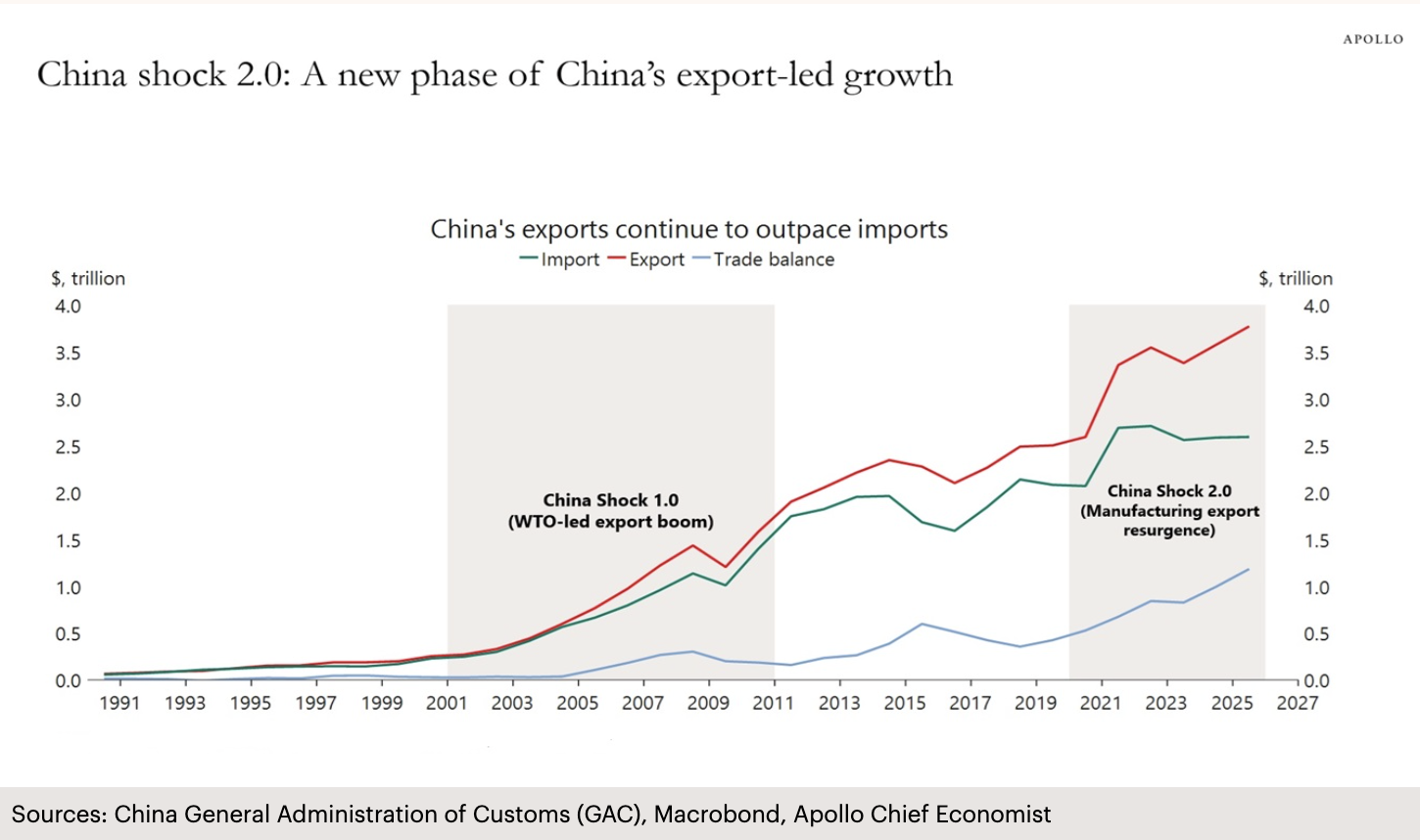
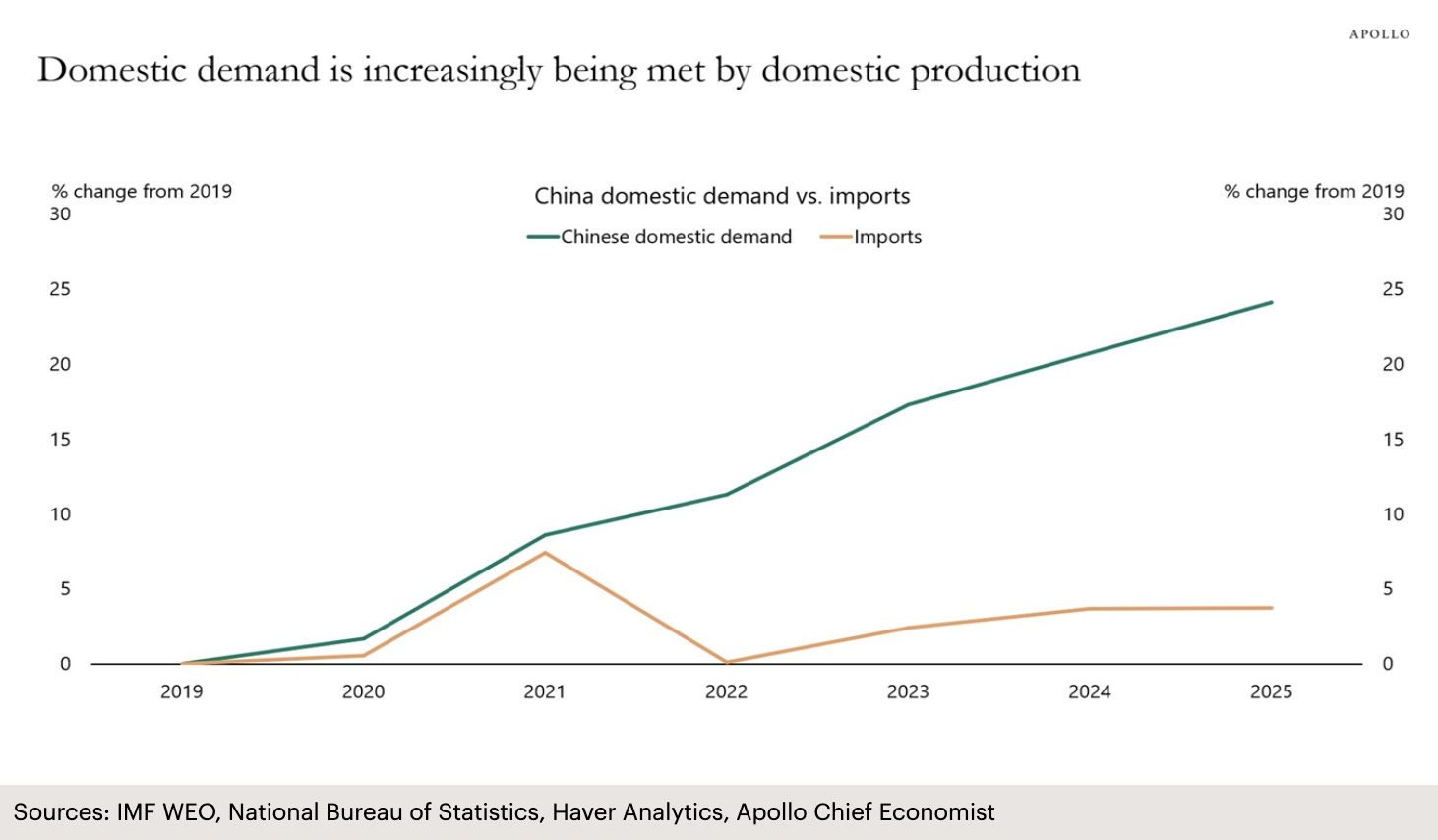
For more discussion, see: The Second China Shock - How This Time Is Different with Brad Setser | Markus' Academy | Ep. 165-1
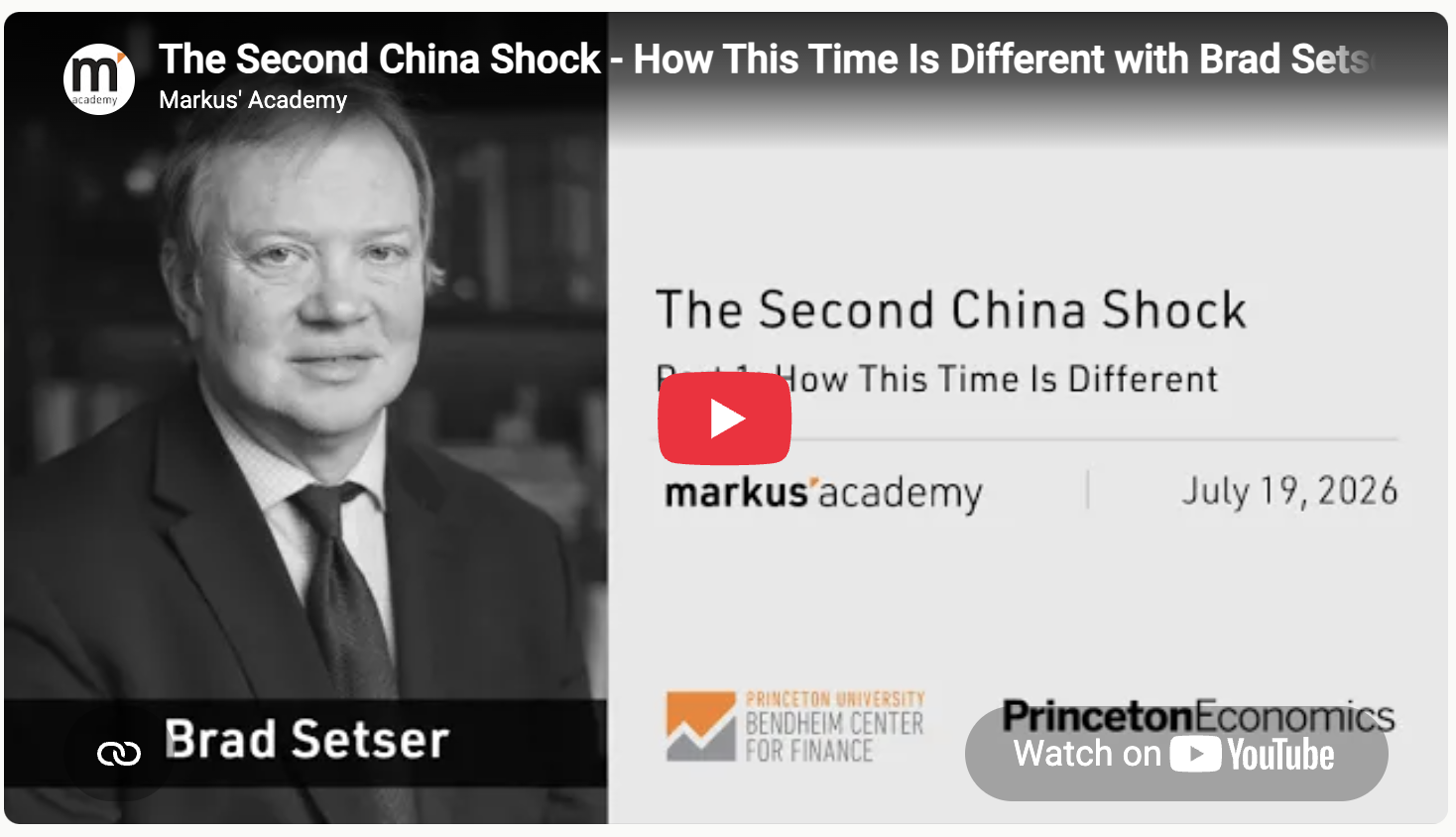
Source: Substack, hat tip to Torsten Slok, Apollo
Opinions are subject to change. Not a recommendation to buy or sell any security. Provided for discussion and educational purposes only.
If you like what you are reading, click on the link and share it with a friend (it’s free).
CLICK HERE TO SUBSCRIBE TO ON MY RADAR
Trade Signals: August 20, 2026 Update
Trade Signals
The Indicators Dashboard - Stocks, Investor Sentiment, Bonds, Commodities, Currencies, and Gold
Valuations and Subsequent 10-year Returns
Supporting Charts with Explanations

TRADE SIGNALS SUBSCRIPTION ACKNOWLEDGEMENT / IMPORTANT DISCLOSURES
About Trade Signals - Trade Signals is a paid subscription service that posts daily, weekly, and monthly market trends (and more). Free for CMG clients. Not a recommendation to buy or sell any security. For discussion purposes only.
The views expressed herein are solely those of Steve Blumenthal as of the date of this report and are subject to change without notice. Please note that the information provided is not recommended for buying or selling any security and is provided for discussion purposes only.
Personal Note: The First Whistle
Next Monday, the Malvern Prep Friars' varsity soccer season kicks off. Long-time readers know my wife, Susan, Coach Sue to her players, is the head coach, and on game days you'll find me on the sideline next to her, notepad in hand, quietly pointing out what I'm seeing in the other team's shape: their tendencies, their strengths, and where the seams are.
This is her eighth season. Eight years of two-a-days, long bus rides, ice packs, and a scoreboard that feels like everything for ninety minutes and almost nothing years later. Well, almost nothing. The league is competitive, and the games are full of emotion, and this year's group will have their hands full — feet full, I should say. We've got a strong first eleven and a few underclassmen I have a feeling are going to surprise people.
As I've done the last several seasons, I'll share some stories from the sideline with you in the weeks ahead. We are going for the wins, but the win is something much bigger than what we see on the scoreboard.
Grantland Rice put it better than I can: "For when the One Great Scorer comes to write against your name, He writes not if you won or lost but how you played the Game." So much heart, determination, failure, and getting back up, learning, and stepping forward. And yes, wins. That’s the goal, but the end goal sets the path for the journey. And, oh, the journey. That’s where the fun is!
Summer's winding down. Baseball's heading into its playoffs, football's about to kick off, and somewhere near you, a kid is lacing up cleats or cracking open shin guards for the first practice of a new season. If that's your child, your grandchild, your niece or nephew, good luck to them this fall. I hope they get a coach who makes them a little braver, teammates who make them a little better, and a season worth remembering long after the final whistle blows.
And good luck to your favorite team, too.
With kind regards,
Steve
CLICK HERE TO SUBSCRIBE TO ON MY RADAR - IT’S FREE
You can share this letter on X by clicking here.
You can share this letter on LinkedIn by clicking here.
Subscribe to OMR for free by clicking the photo.
Stephen B. Blumenthal
Executive Chairman & CIO
CMG Capital Management Group, Inc.
75 Valley Stream Parkway, Suite 201,
Malvern, PA 19355
CMG Customer Relationship Summary (Form CRS)
Metric-Financial, LLC Customer Relationship Summary (Form CRS)

Stephen Blumenthal founded CMG Capital Management Group in 1992 and serves today as its Executive Chairman and CIO. Steve authors a free weekly e-letter entitled, “On My Radar.” Steve shares his views on macroeconomic research, valuations, portfolio construction, asset allocation and risk management. Author of Forbes Book: On My Radar, Navigating Stock Market Cycles.
Follow Steve on X @SBlumenthalCMG and LinkedIn.
IMPORTANT DISCLOSURE INFORMATION
This document is prepared by CMG Capital Management Group, Inc. (“CMG”) and is circulated for informational and educational purposes only. There is no consideration given to the specific investment needs, objectives, or tolerances of any of the recipients. Additionally, CMG’s actual investment positions may, and often will, vary from its conclusions discussed herein based on any number of factors, such as client investment restrictions, portfolio rebalancing, and transaction costs, among others. Recipients should consult their own advisors, including tax advisors, before making any investment decision. This material is for informational and educational purposes only and is not an offer to sell or the solicitation of an offer to buy the securities or other instruments mentioned. This material does not constitute a personal recommendation or take into account the particular investment objectives, financial situations, or needs of individual investors which are necessary considerations before making any investment decision. Investors should consider whether any advice or recommendation in this research is suitable for their particular circumstances and, where appropriate, seek professional advice, including legal, tax, accounting, investment, or other advice. The views expressed herein are solely those of Steve Blumenthal as of the date of this report and are subject to change without notice.
Investing involves risk.
This letter may contain forward-looking statements relating to the objectives, opportunities, and future performance of the various investment markets, indices, and investments. Forward-looking statements may be identified by the use of such words as; “believe,” anticipate,” “planned,” “potential,” and other similar terms. Examples of forward-looking statements include, but are not limited to, estimates with respect to financial condition, results of operations, and success or lack of success of any particular market, index, investment, or investment strategy. All are subject to various factors, including, but not limited to, general and local economic conditions, changing levels of competition within certain industries and markets, changes in legislation or regulation, Federal Reserve policy, and other economic, competitive, governmental, regulatory, and technological factors affecting markets, indices, investments, investment strategy and portfolio positioning that could cause actual results to differ materially from projected results. Such statements are forward-looking in nature and involve a number of known and unknown risks, uncertainties, and other factors, and accordingly, actual results may differ materially from those reflected or contemplated in such forward-looking statements. Investors are cautioned not to place undue reliance on any forward-looking statements or examples. All statements made herein speak only as of the date that they were made. Investing is inherently risky and all investing involves the potential risk of loss.
Past performance does not guarantee or indicate future results. Different types of investments involve varying degrees of risk, and there can be no assurance that the future performance of any specific investment, investment strategy, or product (including the investments and/or investment strategies recommended or undertaken by CMG), or any non-investment related content, made reference to directly or indirectly in this commentary will be profitable, equal any corresponding indicated historical performance level(s), be suitable for your portfolio or individual situation or prove successful. Due to various factors, including changing market conditions and/or applicable laws, the content may no longer be reflective of current opinions or positions. Moreover, you should not assume that any discussion or information contained in this commentary serves as the receipt of, or as a substitute for, personalized investment advice from CMG. Please remember to contact CMG, in writing, if there are any changes in your personal/financial situation or investment objectives for the purpose of reviewing/evaluating/revising our previous recommendations and/or services, or if you would like to impose, add, or to modify any reasonable restrictions to our investment advisory services. Unless, and until, you notify us, in writing, to the contrary, we shall continue to provide services as we do currently. CMG is neither a law firm, nor a certified public accounting firm, and no portion of the commentary content should be construed as legal or accounting advice.
No portion of the content should be construed as an offer or solicitation for the purchase or sale of any security. References to specific securities, investment programs or funds are for illustrative purposes only and are not intended to be, and should not be interpreted as recommendations to purchase or sell such securities.
This presentation does not discuss, directly or indirectly, the amount of the profits or losses realized or unrealized, by any CMG client from any specific funds or securities. Please note: In the event that CMG references performance results for an actual CMG portfolio, the results are reported net of advisory fees and inclusive of dividends. The performance referenced is that as determined and/or provided directly by the referenced funds and/or publishers, has not been independently verified, and does not reflect the performance of any specific CMG client. CMG clients may have experienced materially different performance based upon various factors during the corresponding time periods. See in links provided citing limitations of hypothetical back-tested information. Past performance cannot predict or guarantee future performance. Not a recommendation to buy or sell. Please talk to your advisor.
Information herein has been obtained from sources believed to be reliable, but we do not warrant its accuracy. This document is general communication and is provided for informational and/or educational purposes only. None of the content should be viewed as a suggestion that you take or refrain from taking any action nor as a recommendation for any specific investment product, strategy, or other such purposes.
In a rising interest rate environment, the value of fixed-income securities generally declines, and conversely, in a falling interest rate environment, the value of fixed-income securities generally increases. High-yield securities may be subject to heightened market, interest rate, or credit risk and should not be purchased solely because of the stated yield. Ratings are measured on a scale that ranges from AAA or Aaa (highest) to D or C (lowest). Investment-grade investments are those rated from highest down to BBB- or Baa3.
NOT FDIC INSURED. MAY LOSE VALUE. NO BANK GUARANTEE.
Certain information contained herein has been obtained from third-party sources believed to be reliable, but we cannot guarantee its accuracy or completeness.
In the event that there has been a change in an individual’s investment objective or financial situation, he/she is encouraged to consult with his/her investment professional.
Written Disclosure Statement. CMG is an SEC-registered investment adviser located in Malvern, Pennsylvania. Stephen B. Blumenthal is CMG’s founder and CEO. Please note: The above views are those of CMG and its CEO, Stephen Blumenthal, and do not reflect those of any sub-advisor that CMG may engage to manage any CMG strategy, or exclusively determines any internal strategy employed by CMG. A copy of CMG’s current written disclosure statement discussing advisory services and fees is available upon request or via CMG’s internet web site at www.cmgwealth.com/disclosures. CMG is committed to protecting your personal information. Click here to review CMG’s privacy policies.
See CMG Disclosures at the bottom of this page.
For more information about NDR, please visit at www.ndr.com.
NDR, Inc. (NDR), d.b.a. Ned Davis Research Group (NDRG), any NDRG affiliates or employees, or any third-party data provider, shall not have any liability for any loss sustained by anyone who has relied on the information contained in any NDRG publication. The data and analysis contained herein are provided "as is." NDRG disclaims any and all express or implied warranties, including, but not limited to, any warranties of merchantability, suitability or fitness for a particular purpose or use. NDRG's past recommendations and model results are not a guarantee of future results. This communication reflects our analysts' opinions as of the date of this communication and will not necessarily be updated as views or information change. All opinions expressed herein are subject to change without notice. NDRG or its affiliated companies or their respective shareholders, directors, officers and/or employees, may have long or short positions in the securities discussed herein and may purchase or sell such securities without notice. For NDRG's important additional disclaimers, refer to www.ndr.com/invest/public/copyright.html. Further distribution prohibited without prior permission. Copyright 2025 © NDR, Inc. All rights reserved.