On My Radar: The Trap, AI’s Circular Leverage and Macro Voices

August 14, 2026
By Steve Blumenthal
“If something cannot go on forever, it will stop.”
— Herbert Stein
Herbert Stein (1916–1999) was the kind of economist who could make you laugh while telling you something uncomfortable was true. He chaired Nixon and Ford's Council of Economic Advisers in the early '70s, then spent the rest of his career at the University of Virginia and the American Enterprise Institute, writing with a wit sharp enough that he was once described as "a liberal's conservative and a conservative's liberal." He wasn't a doom-and-gloom deficit hawk; he was a pragmatist who trusted markets but didn't pretend arithmetic could be argued with, and that instinct produced the line he's remembered for, which I quoted above.
Every day, whether markets are open or closed, whether Congress is in session or on August recess, the U.S. Treasury wires out ~ $3 billion in interest on the national debt. Before you finish your coffee today, it will have paid out more than $100 million since sunrise.
That's not a one-time event; it's the run rate. Ten months into this fiscal year, net interest has totaled $963 billion, up 14% from the same period a year ago (Source: CBO, via Yahoo Finance). Annualize that run rate and keep compounding at the pace we're on, and $1.3 trillion is not far off, a number that would eat up roughly 25 cents of every dollar the government collects in taxes (Source: CBO).
Now here's the part that should keep us up at night. We can't afford forinterest rates to go higher. And on the other side of the world, as I wrote last week, Japan can't afford to keep interest rates low due to the implosion of its currency. Both countries are boxed in by the same thing: debt. Massive amounts of debt, I think, is the trap sitting underneath everything else happening in markets right now.
Grab your coffee, find your favorite chair. Today, you’ll find a pragmatic look at debt, a look at some interesting math around tech earnings, and I share with you my morning “Market Voices” section. Kind of cool.
On My Radar:
OMR is for informational and educational purposes only. No consideration is given to your specific investment needs, objectives, or tolerances.
Please see the Important Disclosures at the bottom of this page. Reminder: This is not a recommendation to buy or sell any security. My views may change at any time. The information is for discussion and educational purposes only.
If you like what you are reading, you can subscribe for free.

The Trap: Two Central Banks, One Bad Choice
Last week, I walked you through the mechanics of Japan and the U.S. jointly intervening to defend the yen (see: On My Radar: The Yen Carry Trade - Part II). Since then, I've had time to sit with it, and I've decided the intervention itself is a distraction from the real story. The real story is that both governments are trapped, and it's the same trap: too much debt, and no good way out.
Let's start with Japan, because their trap is the more visible one.
Japan's Problem Is Inflation
Japan is fighting inflation it imports rather than inflation it creates. The yen has weakened for years as investors borrowed it for next to nothing and invested the proceeds elsewhere. That's the yen carry trade: borrow yen near 0%, convert to dollars, buy something that yields more, Treasuries, corporate bonds, U.S. stocks, and pocket the spread.
A weak yen makes everything Japan imports more expensive, and Japan imports almost all of its energy. Oil is priced in dollars, so when the yen is weak, it takes more yen to buy the same barrel. That shows up throughout their economy as inflation.
The fix, in theory, is simple: raise interest rates. Higher rates attract capital, capital flows in, the yen strengthens, and a stronger yen buys more oil for the same number of yen. Problem solved.
Except raising rates unwinds the very trade that's helped keep Japan's financial system, and a good chunk of the world's, afloat for years. Investors who borrowed yen to fund other bets suddenly face a higher cost to hold that position, so they unwind it: sell what they bought with the borrowed yen, sell the dollars, buy back yen to repay the loan. That selling is bearish for the assets they bought and bullish for the yen and Japanese assets. Nobody knows exactly how large this trade is, which is what makes it dangerous. Estimates range from roughly $500 billion at the last major unwind in August 2024 to figures running into the trillions.
Bottom line: Japan needs higher rates to fix its inflation problem, but higher rates risk triggering a scramble out of a trade that touches nearly every corner of the global financial system, including our bond market.
Our Problem Is Interest
Which brings us to the other side of the trap.
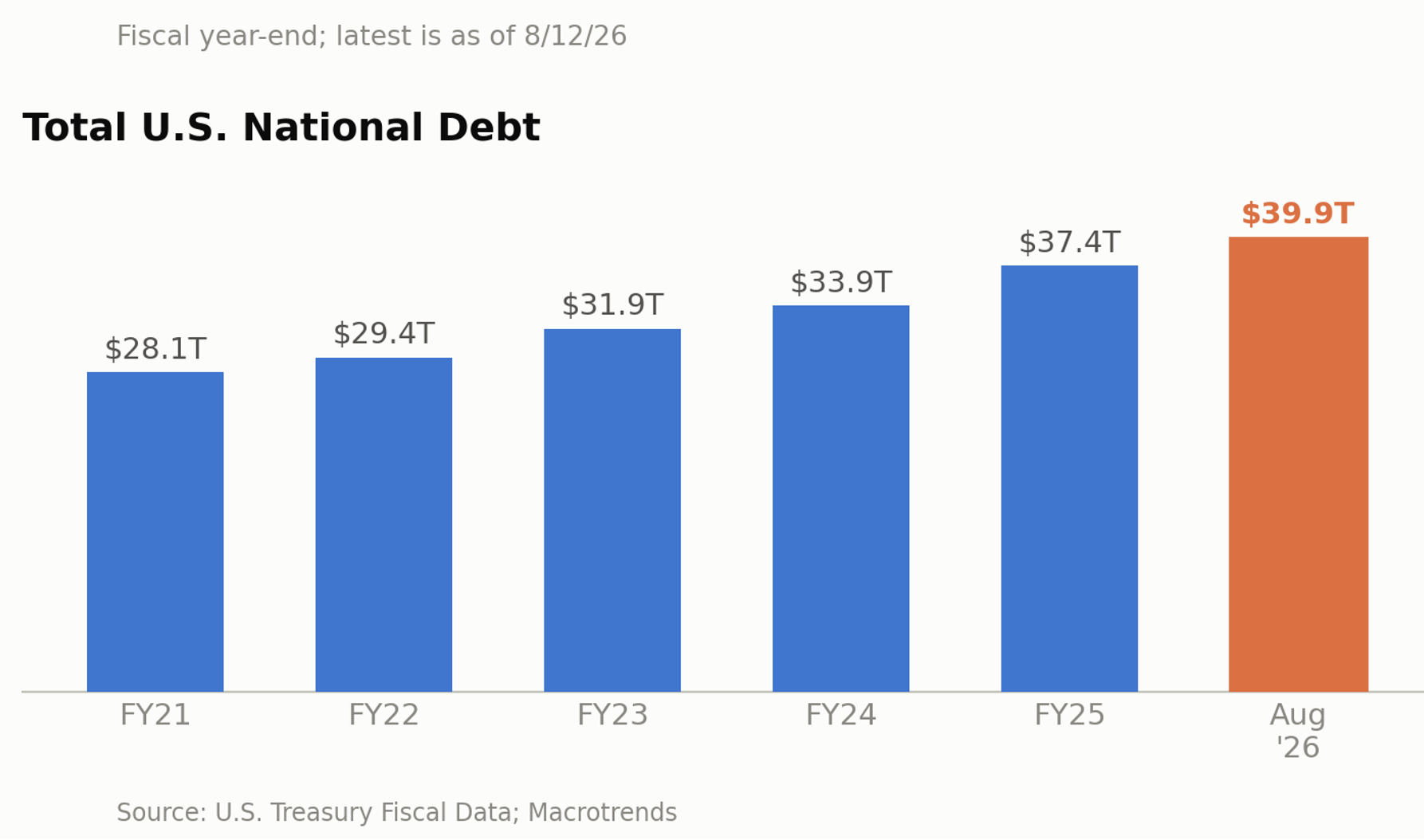
The U.S. national debt stood at $39.91 trillion as of August 12, up from $28.1 trillion at the end of fiscal 2021 (Source: U.S. Treasury Fiscal Data). We've added roughly $12 trillion in under five years.
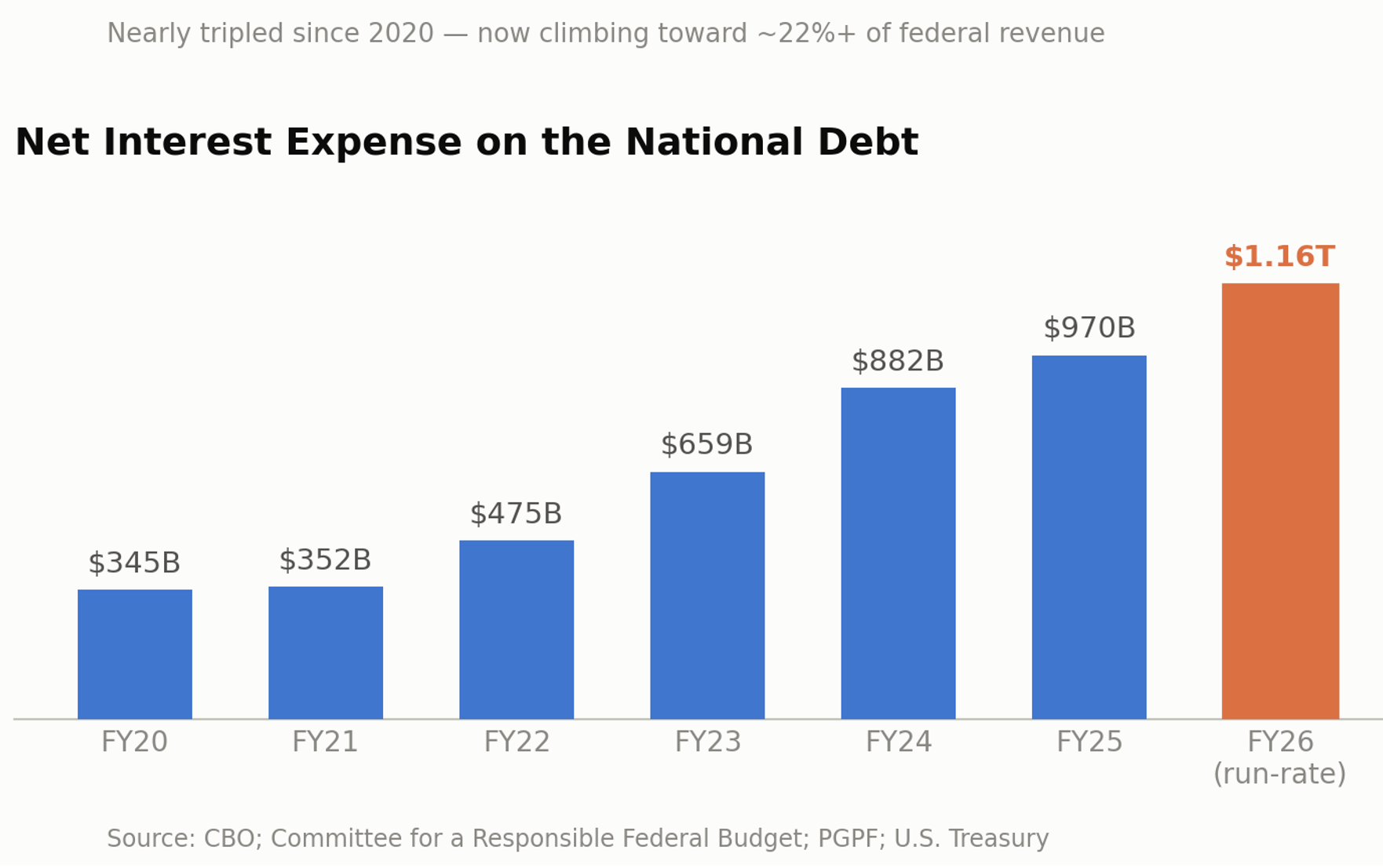
Net interest on that debt has nearly tripled since 2020. (Source: CRFB; PGPF). On the current run rate, the interest expense is climbing toward 25% ($1.3 trillion interest expense on $5 trillion in tax revenue). It's now the second-largest line item in the federal budget behind only Social Security, ahead of defense and Medicare.
I flagged this exact math back in The Match, the Fuse, and 4.50%, when net interest was running near 22% of revenue and the 10-year had just broken through what I called a “danger zone” at 4.50%. It's only gotten more expensive since.
Here's the trap: if Japan raises rates to defend the yen and fight its inflation, the carry trade risks unwinding, and part of that unwind is Japanese selling U.S. Treasuries. Japan is our largest foreign creditor, holding roughly $1.14 trillion (Source: LegalClarity, MacroMicro). Selling Treasuries pushes our yields higher. Higher yields mean we refinance trillions of dollars of maturing debt at a higher rate every year. That pushes our interest bill higher still, at the exact moment we can least afford it. Thus, the trap we find ourselves in.
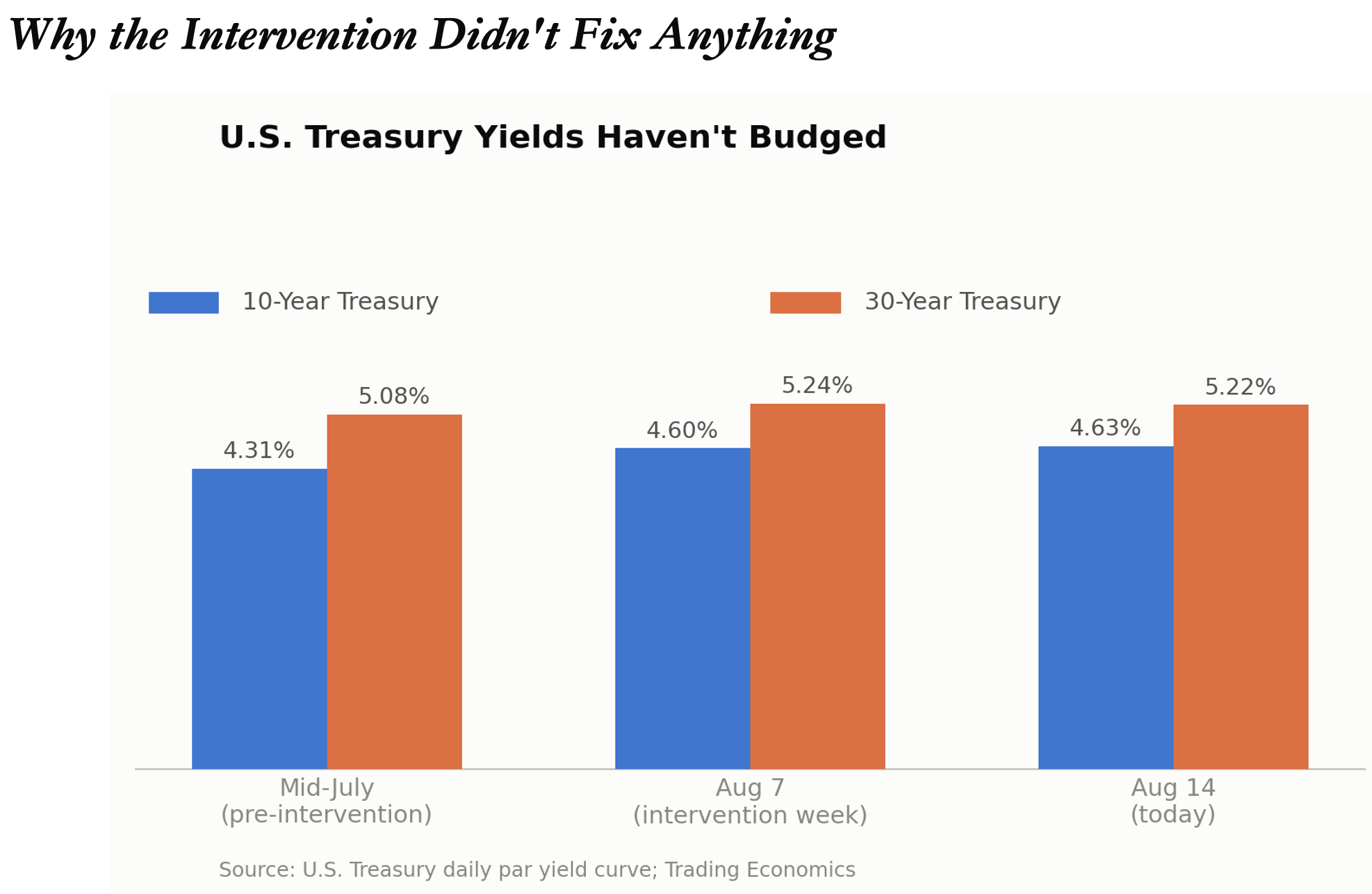
This is why the U.S. Treasury stepped in two weeks ago, buying yen with euros rather than dollars, precisely to avoid forcing Japan to sell Treasuries to fund its own defense of the currency. It worked, for about a week. The yen strengthened, then, by August 11, erased roughly half the intervention's gains (Source: Fortune). And our bond market never got the relief you'd hope for.
The 10-year yield sits at 4.63% today, actually higher than the 4.31% it traded at in mid-July, and the 30-year is still parked above 5.2%, right about where it spiked to during the week of the intervention.
Here’s a fun one:
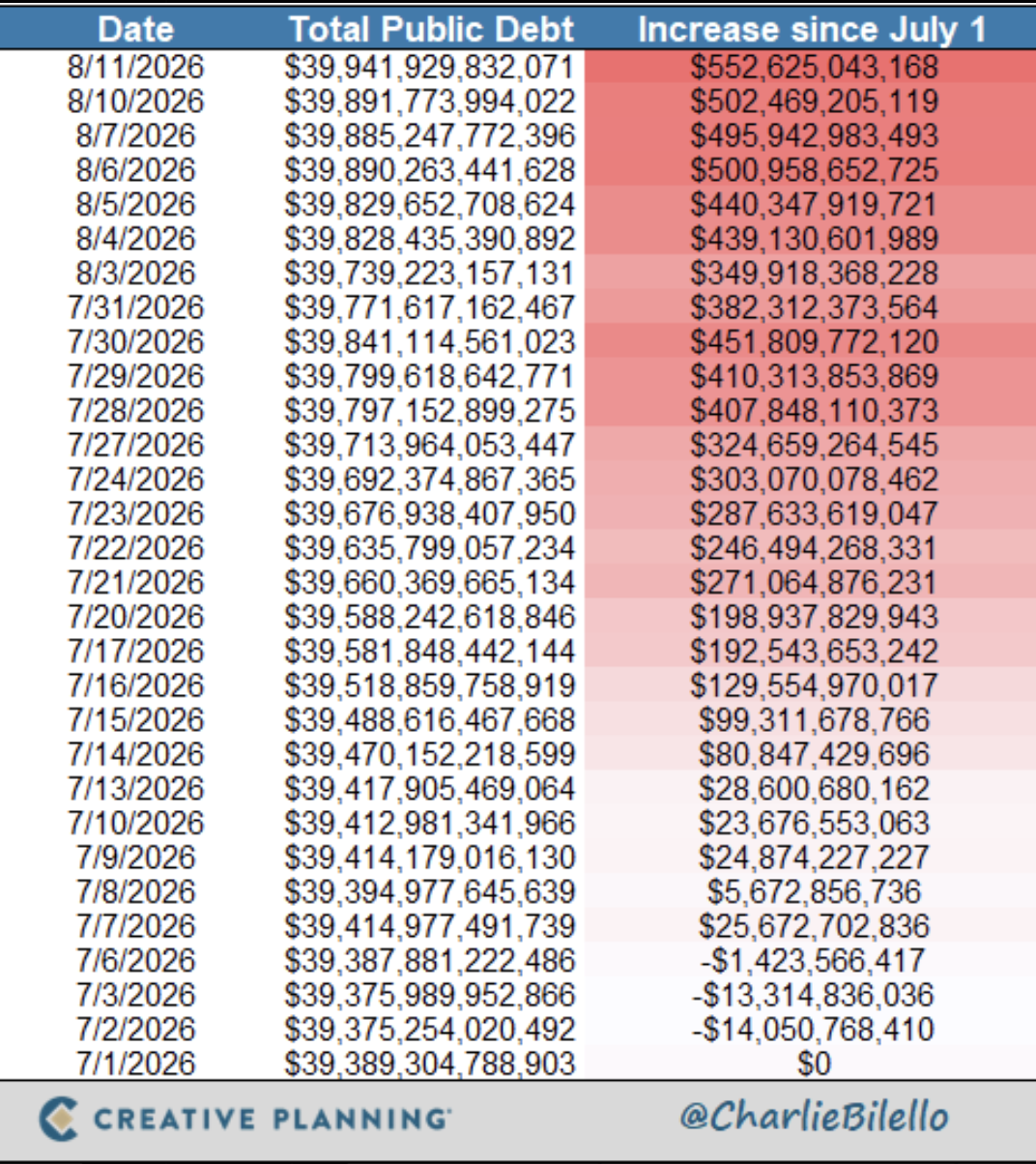
Source: @CharlieBilello
Bottom line: the fragility didn't go away. It got postponed. As Goldman Sachs put it, the intervention buys time, not a solution (Source: Fortune).
Two Governments, Two Printing Presses
This is what I mean by a trap. Japan wants higher rates to strengthen its currency and beat inflation, but higher rates risk a domestic debt crisis (Japan's own government debt is enormous relative to its economy) and a disorderly unwind of a carry trade that is hard-wired into the entire global financial system. The US wants lower rates because our interest bill is already crowding out the rest of the budget. Our largest creditor is under pressure to sell exactly the bonds we need them to keep holding.
I wrote about a version of this back in Bond Vigilantes, Narratives and Bowl Games, when I said plainly: “Trillions in government debt are coming due and must be refinanced at higher rates... we cannot foot the bill.” And further back, in If Ever There Was an OMR to Read, It's This One, I compared the debt, as Ray Dalio does, to plaque building up in an artery. That was when the debt stood at $36 trillion, and interest was running about $1.2 trillion a year. Eighteen months later, the debt is nearing $40 trillion, and interest is on track to reach $1.3 trillion. The artery hasn't burst, but the patient hasn't gotten any healthier either.
Both countries are printing, and inflation is the natural byproduct. This, as I see it, continues until something breaks. I don't know what that something is, or precisely when. Best guess is between 2028 and 2030. But really just a guess.
If higher inflation and higher interest rates are the probable outcome, then fixed-interest-rate bonds are a bad bet.
Opinions are subject to change. Not a recommendation to buy or sell any security. Provided for discussion and educational purposes only.
AI's Circular Leverage
While the sovereign debt trap builds quietly in the background, a smaller and faster version is playing out in the AI trade, and it rhymes.
Michael Burry (of the GFC - Great Short fame) has spent months warning about what's being called “circular financing” in AI. The pattern: Nvidia invests in or extends credit to companies like OpenAI, which use that money to buy Nvidia chips, which shows up as Nvidia revenue, which supports Nvidia's stock price, which supports its ability to keep investing in or lending to those same companies.
Burry has called it Nvidia's “overreaching,” warning that circular spending is reaching “biblical proportions” alongside a surge in credit default swap activity tied to the space (Source: Yahoo Finance). Estimates of the scale of these circular arrangements between Nvidia, OpenAI, and other partners run as high as $750 billion (Source: TradingKey).
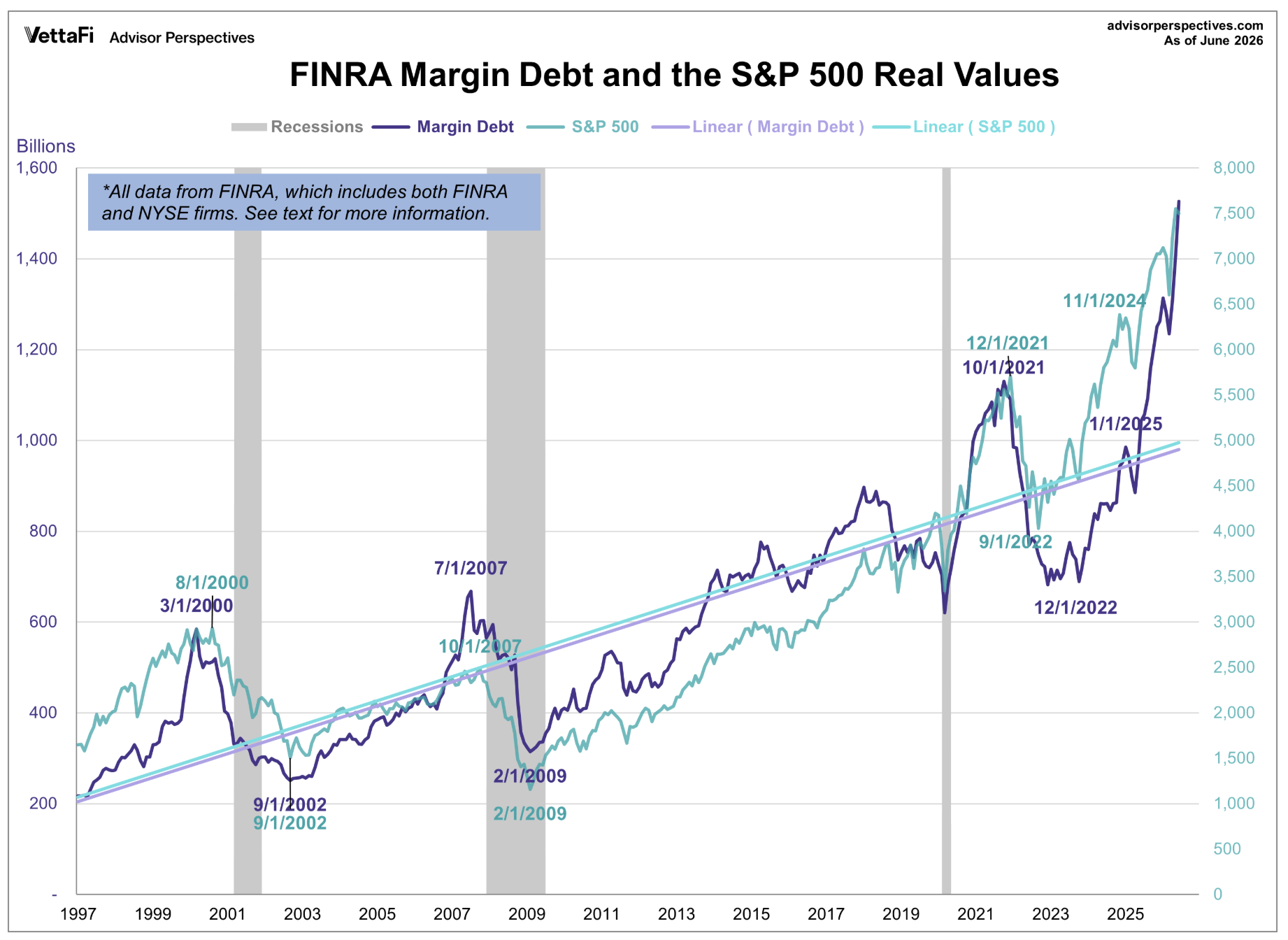
It's a different mechanism than the yen carry trade, but the same basic pattern: borrowed money, or its functional equivalent in vendor financing, meets a crowded trade. Nobody quite knows how big it's gotten until it starts to unwind. Layer that on top of margin debt sitting at a record $1.53 trillion, up more than 51% from a year ago (Source: Advisor Perspectives / FINRA), and you have a market that's levered on top of that leverage.
I'm not predicting a crash. I am saying that when leverage builds in more than one place at once, “diversify away from it” becomes harder than it sounds, because the same borrowed dollar often shows up in multiple trades.
Here is a little bit more (hat tip to OMR reader Hans from Norway):
Hans asked ChatGPT, “Which specific S&P 500 companies have the largest private AI equity stakes relative to their net income, making them most vulnerable to a valuation slowdown?”
The exposure to this "dirty earnings secret" is heavily concentrated at the very top of the S&P 500. A tiny handful of mega-cap tech giants hold the largest private AI equity stakes, and because of their immense size, the paper gains they are booking have completely warped the entire index's earnings.
The companies most vulnerable to a slowdown in private valuations are Amazon, Microsoft, and Alphabet (Google).
The exact data reveals how load-bearing these private stakes have become to their corporate bottom lines, ranking them by their accounting vulnerability.
1. Amazon (AMZN) — The Most Vulnerable
Amazon is the poster child for this accounting distortion. It has invested heavily in Anthropic (including another $5 billion just this month). Because Anthropic's valuation has undergone a vertical spike, Amazon's net income is the most artificially inflated. www.anthropic.com
The Reality in Q1 2026: Amazon reported a blowout net income of $30.3 billion. thenextweb.com
The Accounting Distortion: That number included a staggering $16.8 billion non-operating gain solely from revaluing its Anthropic stake after Anthropic’s Series G funding round. thenextweb.com
The Vulnerability Percentage: An eye-watering 55% of Amazon's Q1 net income was pure paper profit. Meanwhile, its actual operational free cash flow dropped significantly due to massive AI data center spending.
2. Microsoft (MSFT) — The OpenAI Vector
While Amazon and Alphabet are tied to Anthropic, Microsoft is uniquely bound to OpenAI. Whenever OpenAI restructures or marks up its value, it triggers an accounting earthquake at Microsoft.
The Reality in Q2 FY2026 (Reported Jan 2026): Microsoft reported a massive jump in quarterly net income to $38.5 billion. www.geekwire.com
The Accounting Distortion: Under GAAP rules, Microsoft had to record a $7.6 billion after-tax accounting gain stemming entirely from OpenAI’s massive recapitalization round. www.geekwire.com
The Vulnerability Percentage: Roughly 20% of Microsoft's blowout winter earnings were non-operational paper gains.
3. Alphabet (GOOGL) — Dual Exposure
Alphabet is caught in a double-whammy. It has its own internal AI divisions (Gemini), but it also aggressively co-invested in Anthropic alongside Amazon to secure Anthropic as a Google Cloud client.
The Reality in Q1 2026: Google reported stellar Cloud growth and strong net income. However, financial analyses noted that roughly 35% to 40% of Alphabet and Amazon’s combined "blowout AI profit growth" in Q1 was driven strictly by their shared Anthropic paper marks.
The Risk Factor: Google's core search and cloud businesses are healthy, but their growth rates appear far more aggressive than they actually are due to these passive venture-capital markups.
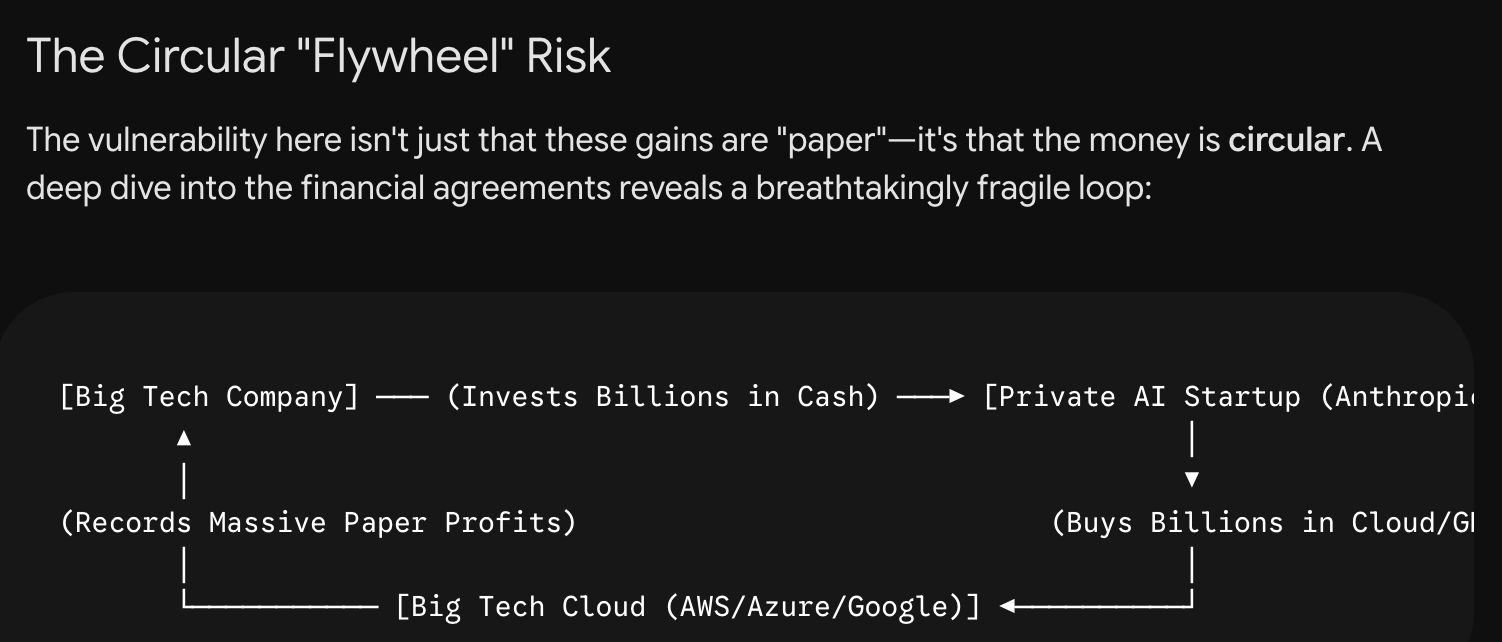
The Cash Outflow: Amazon, Microsoft, and Google give billions of dollars to Anthropic and OpenAI. Source:
The Revenue Loop: Anthropic and OpenAI immediately hand that exact same cash right back to Amazon (AWS), Microsoft (Azure), and Google Cloud to pay for the massive server capacity needed to train models. This inflates Big Tech’s operating cloud revenue. Source:
The Valuation Loop: Because the startups are "growing" so fast, they raise a new private funding round at a near-trillion-dollar valuation. Big Tech marks up its equity stake and records billions in non-operating paper income. Source www.morningstar.com
The Ultimate Conclusion: The Q3 Threat
This circular loop works beautifully when private valuations are rising. But as Anthropic just touched a $965 billion valuation following its Series H round this month, it is virtually impossible for it to double again by Q3. Source: www.morningstar.com
When the private rounds stop, the non-operating income drops to zero. Simultaneously, the startup's ability to buy more cloud computing from Big Tech slows down. Your thesis is entirely correct: Q3 is highly vulnerable because the circular AI flywheel will mathematically run out of momentum, leaving these stock market titans exposed on pure, un-inflated cash flow.”
In my very simple OMR terms, it is leverage that always blows things up.
Opinions are subject to change. Not a recommendation to buy or sell any security. Provided for discussion and educational purposes only.
Key Charts to Watch
A short list of what I'm watching closely right now:
The 10-year Treasury Yield
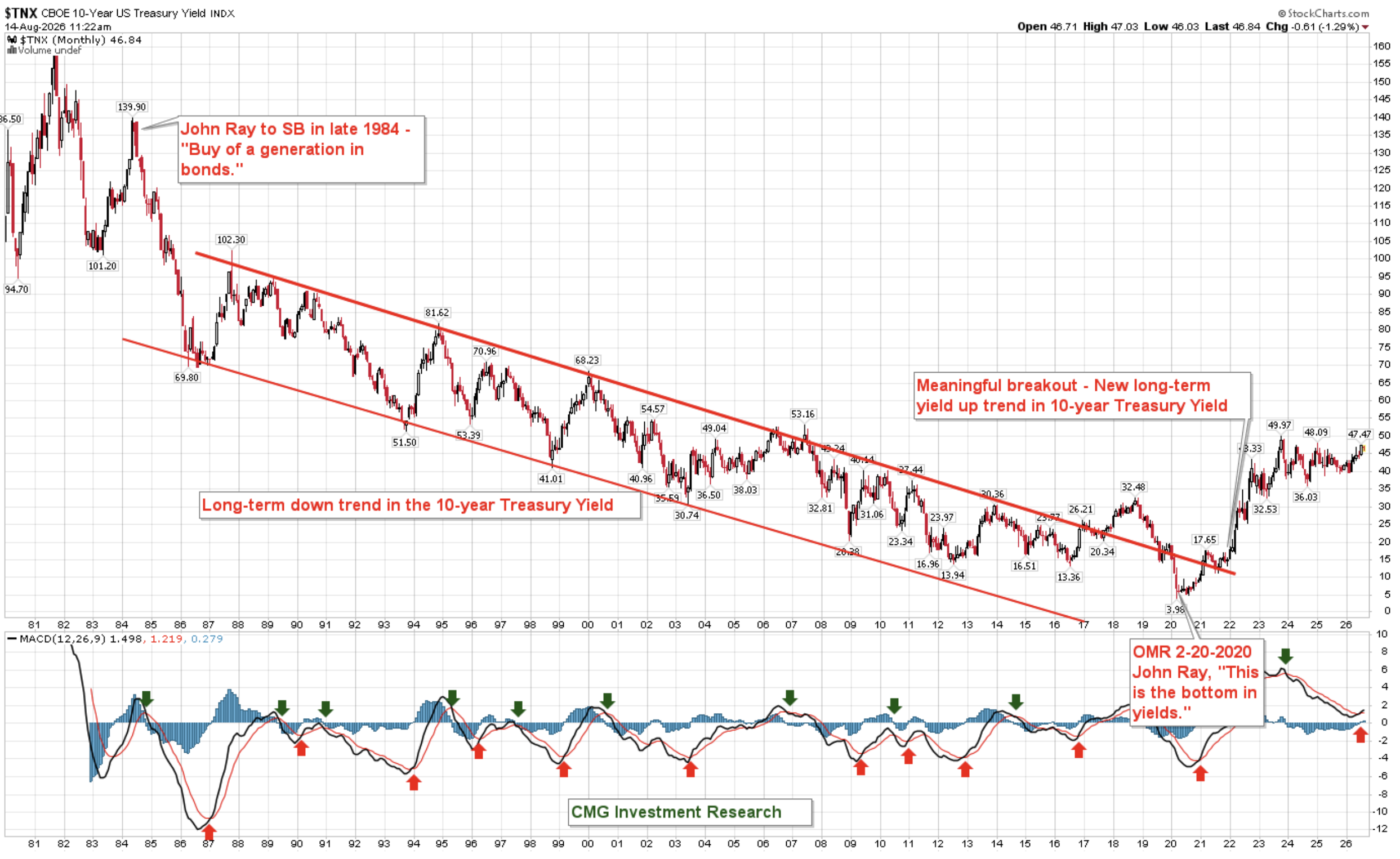
Source: StockCharts.com, CMG annotations
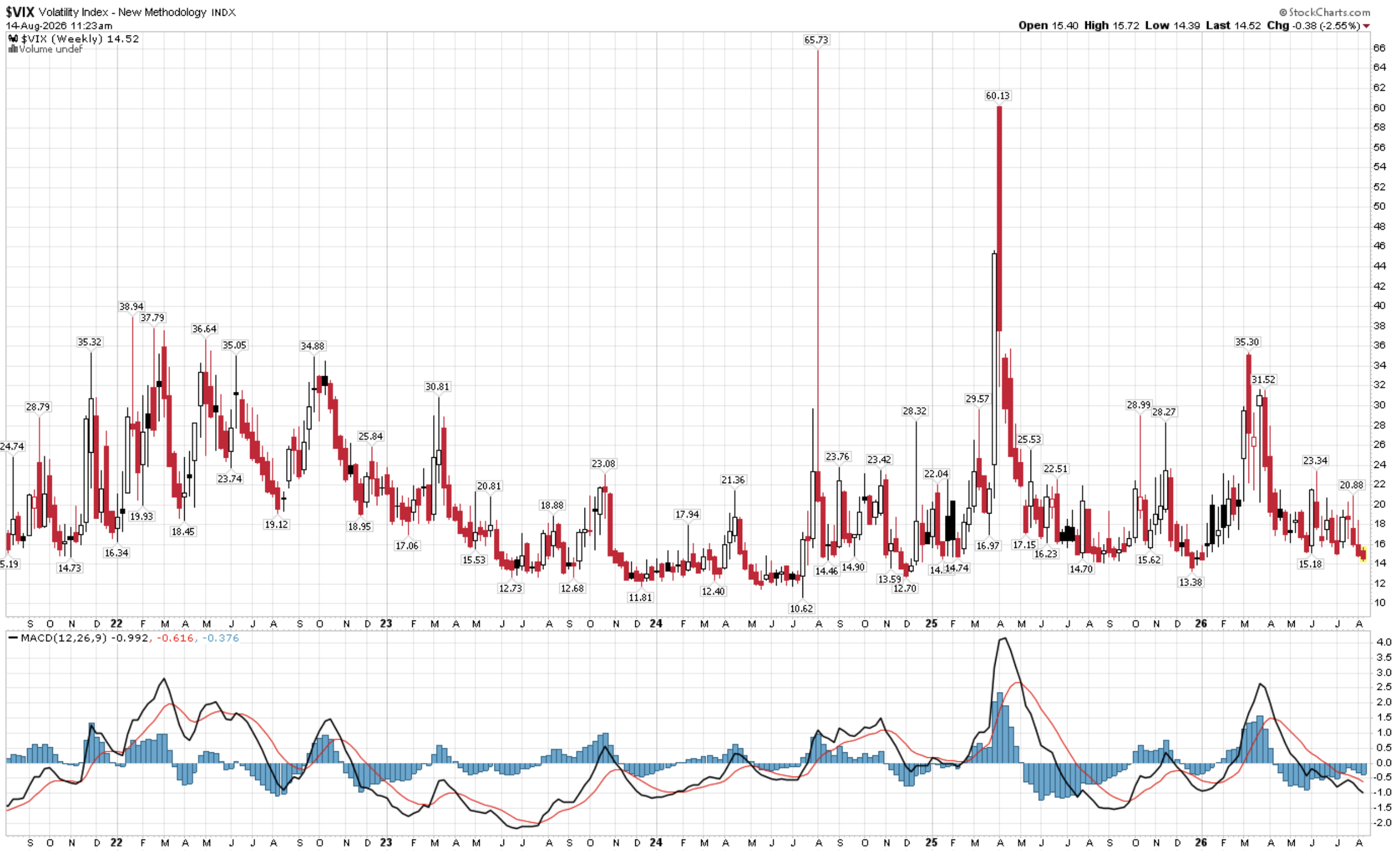
The VIX sits at 14.53, calm, complacent territory. Historically, that kind of quiet has preceded some of the more violent repricings, not because low volatility causes trouble, but because it's often a sign that too few people are positioned for it.
Note the prior lows dating back 5 years. The current reading is the low this year.
Source: StockCharts.com
Margin debt is at a record $1.53 trillion as of June, up 7.9% in a single month and over 51% year-over-year (Source: Advisor Perspectives).
Source: AdvisorPerspectives
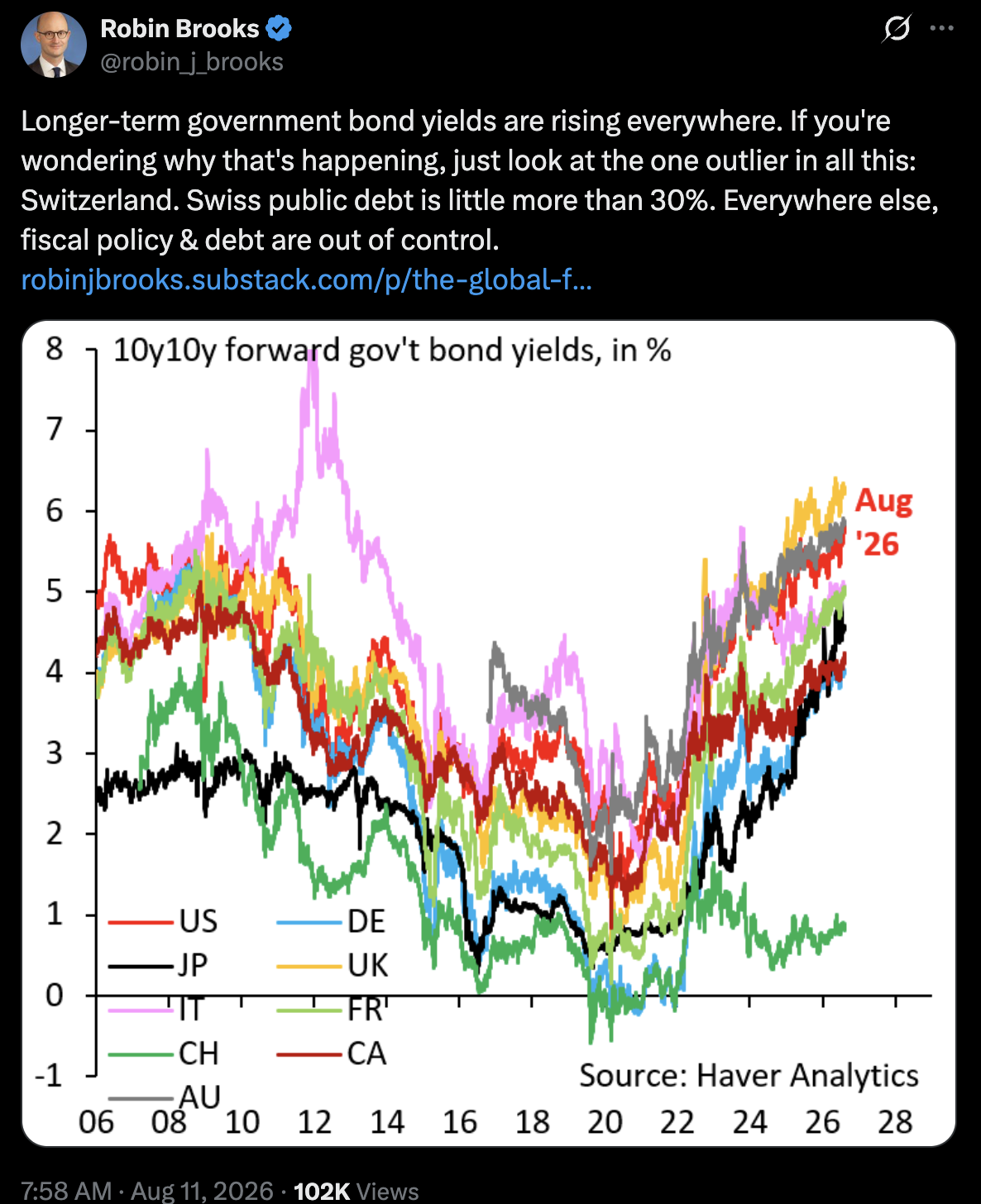
Global yields are moving together. Germany's 10-year bund has climbed to 3.13%, a level not seen in years (Source: Trading Economics), and gilts in the UK, JGBs in Japan, and BTPs in Italy have all been drifting higher too. When yields rise everywhere at once, it's usually not a local story. It's a global one about the price of money and the amount of government debt competing for the same pool of capital.
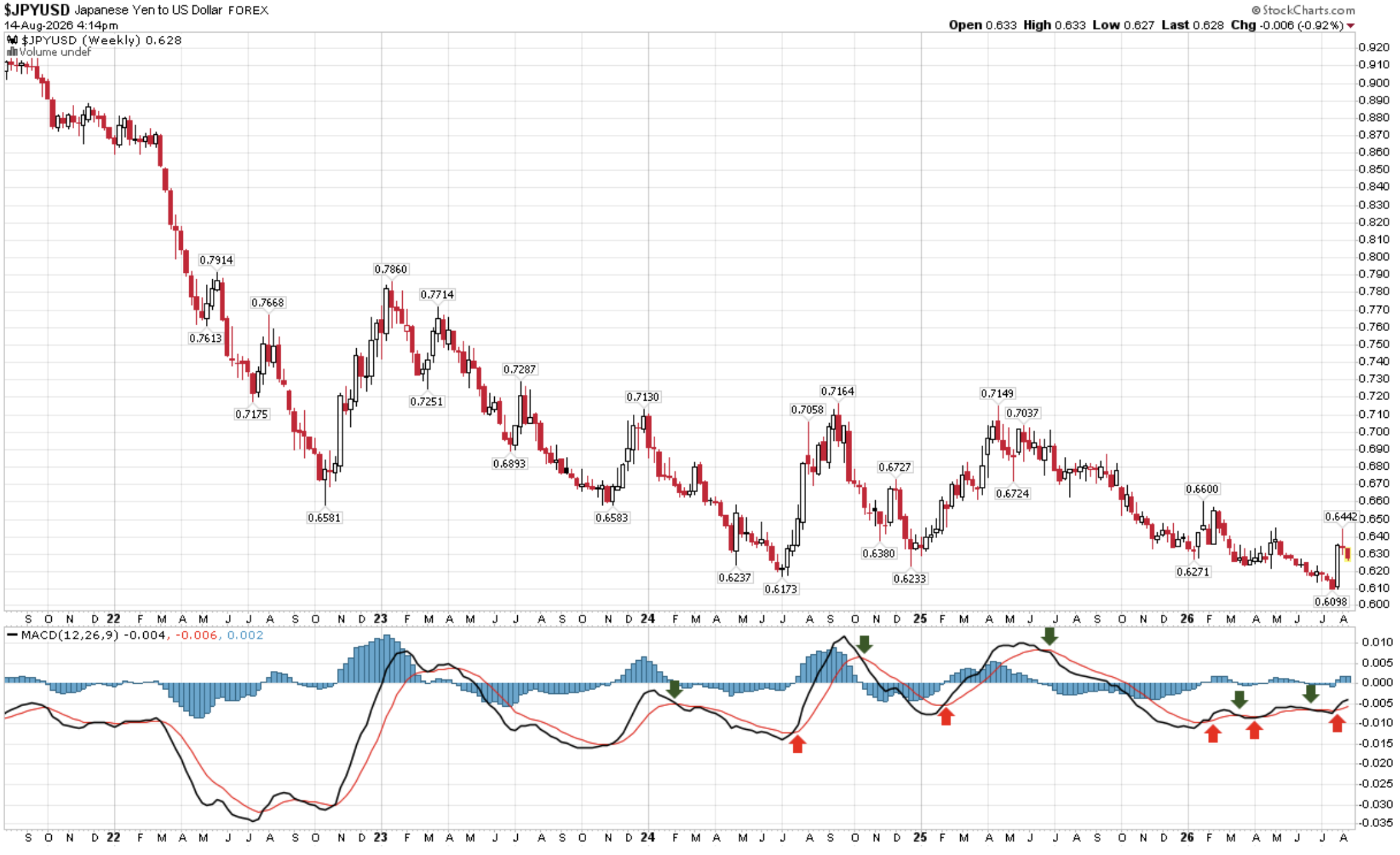
The Yen vs the Dollar
That spike higher two weeks ago was the yen intervention.
The red arrows point to a rising yen price trend. A rising yen is generally bearish for global liquidity. Too much of a move risks the unwinding of the yen carry trade. Declining yen trends are indicated by green arrows. Bullish for global liquidity and bearish for Japanese citizens (inflationary due to energy funding needs - oil trades in dollars).
Source: StockCharts.com, CMG annotations
Opinions are subject to change. Not a recommendation to buy or sell any security. Provided for discussion and educational purposes only.
Market Voices
In Claude, I created something I call a “Morning Brief.” Of the various tasks, one is to research timely commentary from several of whom I consider to be the top investment minds in the business.
Sharing with you from yesterday’s Morning Brief:
1 Ray Dalio: play the board as it’s configured
He likens investing now to bridge or chess — the move is dictated by how the board is actually set up, not how you wish it were, per his Substack.
and, Dalio Sees Echoes of 1929 and 2000
He points to AI-era IPO manias rhyming with the dot-com and 1929 peaks and reminds investors that wealth isn’t the same as money, per Fortune.
2 Stanley Druckenmiller skips megacap tech almost entirely
His latest 13-F shows Amazon as his only Magnificent Seven holding after exiting Alphabet and trimming TSMC again, per The Motley Fool.
3 Paul Tudor Jones likens this rally to 1999
He says the AI bull market has “another year or two to run” but the eventual drawdown could be steep, per CNBC.
4 Seth Klarman: markets show “a bubble”’s traits
He’s positioning without retreating to cash and has named assisted living his highest-conviction idea right now, per Hedge Fund Alpha.
5 Howard Marks revisits his own AI skepticism
Prompted by his venture-capitalist son, he’s rethinking a cautious memo he wrote questioning AI’s trajectory, per AdvisorAnalyst
6 Gundlach Says the Bond Market Is Forcing the Fed’s Hand
He thinks long Treasury yields could reach the mid-5s before the September meeting if the Fed doesn’t address inflation, per CNBC.
7 Boockvar Flags Cooler CPI Print
He’s been watching how Japan’s fiscal push and the BOJ’s rate path are spilling into U.S. Treasury yields, per The Boock Report.
8 Gromen Says Fed Faces a No-Win Choice
With federal debt at $39.5 trillion, he argues policymakers must pick between Treasury-market dysfunction and a weaker dollar — and that China is quietly capitalizing on the distraction, per Competent Investor.
Share this letter on X by clicking here.
Opinions are subject to change. Not a recommendation to buy or sell any security. Please note that the information provided is not recommended for buying or selling any security and is provided for discussion purposes only.
If you like what you are reading, click on the link and share it with a friend (it’s free).
CLICK HERE TO SUBSCRIBE TO ON MY RADAR
Trade Signals: August 13, 2026 Update
Trade Signals
The Indicators Dashboard - Stocks, Investor Sentiment, Bonds, Commodities, Currencies, and Gold
Valuations and Subsequent 10-year Returns
Supporting Charts with Explanations

TRADE SIGNALS SUBSCRIPTION ACKNOWLEDGEMENT / IMPORTANT DISCLOSURES
About Trade Signals - Trade Signals is a paid subscription service that posts daily, weekly, and monthly market trends (and more). Free for CMG clients. Not a recommendation to buy or sell any security. For discussion purposes only.
The views expressed herein are solely those of Steve Blumenthal as of the date of this report and are subject to change without notice. Please note that the information provided is not recommended for buying or selling any security and is provided for discussion purposes only.
Personal Note: Define Success
I loved this line from Howard Marks' interview on success (link here), quoting the writer Christopher Morley: "There is only one success — to live your life your own way." Marks' takeaway for the next generation is a demanding one: "You can't let your friends decide what you should do. You can't let society decide. You can't let your parents decide. You have to think it out for yourself." Find something, he says, that plays to your strengths, avoids your weaknesses, and makes you happy. That sounds obvious. The problem, as Marks acknowledges, is that most people never do it.
Great advice for young people. And for those of us who are older too.
By the time this week's OMR hits your inbox, I'll be on my way to Penn State (Happy Valley) for a reunion with former teammates. The soccer team has a new head coach, Rob Dow, and he asked if we'd come speak with the current players.
It turns out the 1979–1984 teams were the winningest in Penn State soccer history. Former teammates and long-time friends Lou Karbiener and Jeffrey Maierhofer went to work pulling the group together.
It begins tonight with a preseason game against Syracuse, and we'll all be reflecting back in time. The most successful of those teams was our 1979 squad, coached by the legendary Walter Bahr and led by team captain Jimmy Stamatis. Coach Bahr won Coach of the Year honors that season, and Jimmy won the Hermann Trophy as the country's most valuable player.
We advanced to the final four in Tampa, Florida, and lost a hard-fought semifinal game 3-2. Our national championship dream ended there. With the game tied 2-2 and minutes left, we ripped a shot off the crossbar, nearly taking the lead. The ball rebounded to their left back, who sent it quickly up the field. I can still see that 40-yard knuckleball shot finding the upper right corner of the goal.
We went on to win the consolation game, but third in the country is third, not first. The real win was in the journey. That's true of most things in life, and it's a journey we'll keep going this weekend.
What was the secret to our success? Nine of us were freshmen in 1979, and we had strong upperclassmen leadership in Kevin Scott, Duncan MacEwan, and Danny Canter — and we had Jimmy. Lou put it simply: "The plan was don't break, don't break, don't break, and get the ball to Jimmy."
This weekend's plan is simpler still: meet the current players and their new coach, talk about culture and family, and bring our checkbooks. And, of course, head to The First for a few cold beers, some late-night music, and enjoy time with old friends.
"There is only one success — to live your life your own way." True, but you can't do it alone. We're better together.
Wishing you some fun times with your old friends.
Kind regards,
Steve
CLICK HERE TO SUBSCRIBE TO ON MY RADAR - IT’S FREE
You can share this letter on X by clicking here.
You can share this letter on LinkedIn by clicking here.
Subscribe to OMR for free by clicking the photo.
Stephen B. Blumenthal
Executive Chairman & CIO
CMG Capital Management Group, Inc.
75 Valley Stream Parkway, Suite 201,
Malvern, PA 19355
CMG Customer Relationship Summary (Form CRS)
Metric-Financial, LLC Customer Relationship Summary (Form CRS)

Stephen Blumenthal founded CMG Capital Management Group in 1992 and serves today as its Executive Chairman and CIO. Steve authors a free weekly e-letter entitled, “On My Radar.” Steve shares his views on macroeconomic research, valuations, portfolio construction, asset allocation and risk management. Author of Forbes Book: On My Radar, Navigating Stock Market Cycles.
Follow Steve on X @SBlumenthalCMG and LinkedIn.
IMPORTANT DISCLOSURE INFORMATION
This document is prepared by CMG Capital Management Group, Inc. (“CMG”) and is circulated for informational and educational purposes only. There is no consideration given to the specific investment needs, objectives, or tolerances of any of the recipients. Additionally, CMG’s actual investment positions may, and often will, vary from its conclusions discussed herein based on any number of factors, such as client investment restrictions, portfolio rebalancing, and transaction costs, among others. Recipients should consult their own advisors, including tax advisors, before making any investment decision. This material is for informational and educational purposes only and is not an offer to sell or the solicitation of an offer to buy the securities or other instruments mentioned. This material does not constitute a personal recommendation or take into account the particular investment objectives, financial situations, or needs of individual investors which are necessary considerations before making any investment decision. Investors should consider whether any advice or recommendation in this research is suitable for their particular circumstances and, where appropriate, seek professional advice, including legal, tax, accounting, investment, or other advice. The views expressed herein are solely those of Steve Blumenthal as of the date of this report and are subject to change without notice.
Investing involves risk.
This letter may contain forward-looking statements relating to the objectives, opportunities, and future performance of the various investment markets, indices, and investments. Forward-looking statements may be identified by the use of such words as; “believe,” anticipate,” “planned,” “potential,” and other similar terms. Examples of forward-looking statements include, but are not limited to, estimates with respect to financial condition, results of operations, and success or lack of success of any particular market, index, investment, or investment strategy. All are subject to various factors, including, but not limited to, general and local economic conditions, changing levels of competition within certain industries and markets, changes in legislation or regulation, Federal Reserve policy, and other economic, competitive, governmental, regulatory, and technological factors affecting markets, indices, investments, investment strategy and portfolio positioning that could cause actual results to differ materially from projected results. Such statements are forward-looking in nature and involve a number of known and unknown risks, uncertainties, and other factors, and accordingly, actual results may differ materially from those reflected or contemplated in such forward-looking statements. Investors are cautioned not to place undue reliance on any forward-looking statements or examples. All statements made herein speak only as of the date that they were made. Investing is inherently risky and all investing involves the potential risk of loss.
Past performance does not guarantee or indicate future results. Different types of investments involve varying degrees of risk, and there can be no assurance that the future performance of any specific investment, investment strategy, or product (including the investments and/or investment strategies recommended or undertaken by CMG), or any non-investment related content, made reference to directly or indirectly in this commentary will be profitable, equal any corresponding indicated historical performance level(s), be suitable for your portfolio or individual situation or prove successful. Due to various factors, including changing market conditions and/or applicable laws, the content may no longer be reflective of current opinions or positions. Moreover, you should not assume that any discussion or information contained in this commentary serves as the receipt of, or as a substitute for, personalized investment advice from CMG. Please remember to contact CMG, in writing, if there are any changes in your personal/financial situation or investment objectives for the purpose of reviewing/evaluating/revising our previous recommendations and/or services, or if you would like to impose, add, or to modify any reasonable restrictions to our investment advisory services. Unless, and until, you notify us, in writing, to the contrary, we shall continue to provide services as we do currently. CMG is neither a law firm, nor a certified public accounting firm, and no portion of the commentary content should be construed as legal or accounting advice.
No portion of the content should be construed as an offer or solicitation for the purchase or sale of any security. References to specific securities, investment programs or funds are for illustrative purposes only and are not intended to be, and should not be interpreted as recommendations to purchase or sell such securities.
This presentation does not discuss, directly or indirectly, the amount of the profits or losses realized or unrealized, by any CMG client from any specific funds or securities. Please note: In the event that CMG references performance results for an actual CMG portfolio, the results are reported net of advisory fees and inclusive of dividends. The performance referenced is that as determined and/or provided directly by the referenced funds and/or publishers, has not been independently verified, and does not reflect the performance of any specific CMG client. CMG clients may have experienced materially different performance based upon various factors during the corresponding time periods. See in links provided citing limitations of hypothetical back-tested information. Past performance cannot predict or guarantee future performance. Not a recommendation to buy or sell. Please talk to your advisor.
Information herein has been obtained from sources believed to be reliable, but we do not warrant its accuracy. This document is general communication and is provided for informational and/or educational purposes only. None of the content should be viewed as a suggestion that you take or refrain from taking any action nor as a recommendation for any specific investment product, strategy, or other such purposes.
In a rising interest rate environment, the value of fixed-income securities generally declines, and conversely, in a falling interest rate environment, the value of fixed-income securities generally increases. High-yield securities may be subject to heightened market, interest rate, or credit risk and should not be purchased solely because of the stated yield. Ratings are measured on a scale that ranges from AAA or Aaa (highest) to D or C (lowest). Investment-grade investments are those rated from highest down to BBB- or Baa3.
NOT FDIC INSURED. MAY LOSE VALUE. NO BANK GUARANTEE.
Certain information contained herein has been obtained from third-party sources believed to be reliable, but we cannot guarantee its accuracy or completeness.
In the event that there has been a change in an individual’s investment objective or financial situation, he/she is encouraged to consult with his/her investment professional.
Written Disclosure Statement. CMG is an SEC-registered investment adviser located in Malvern, Pennsylvania. Stephen B. Blumenthal is CMG’s founder and CEO. Please note: The above views are those of CMG and its CEO, Stephen Blumenthal, and do not reflect those of any sub-advisor that CMG may engage to manage any CMG strategy, or exclusively determines any internal strategy employed by CMG. A copy of CMG’s current written disclosure statement discussing advisory services and fees is available upon request or via CMG’s internet web site at www.cmgwealth.com/disclosures. CMG is committed to protecting your personal information. Click here to review CMG’s privacy policies.
See CMG Disclosures at the bottom of this page.
For more information about NDR, please visit at www.ndr.com.
NDR, Inc. (NDR), d.b.a. Ned Davis Research Group (NDRG), any NDRG affiliates or employees, or any third-party data provider, shall not have any liability for any loss sustained by anyone who has relied on the information contained in any NDRG publication. The data and analysis contained herein are provided "as is." NDRG disclaims any and all express or implied warranties, including, but not limited to, any warranties of merchantability, suitability or fitness for a particular purpose or use. NDRG's past recommendations and model results are not a guarantee of future results. This communication reflects our analysts' opinions as of the date of this communication and will not necessarily be updated as views or information change. All opinions expressed herein are subject to change without notice. NDRG or its affiliated companies or their respective shareholders, directors, officers and/or employees, may have long or short positions in the securities discussed herein and may purchase or sell such securities without notice. For NDRG's important additional disclaimers, refer to www.ndr.com/invest/public/copyright.html. Further distribution prohibited without prior permission. Copyright 2025 © NDR, Inc. All rights reserved.