On My Radar: The Strait of Hormuz

March 20, 2026
By Steve Blumenthal
“A short closure is an oil shock. A long one becomes an inflation and growth shock.”
It’s early morning, coffee in hand, and another Friday has quickly arrived. The world is off-kilter and moving faster than it should. There’s a lot to sort through.
Markets are trying to make sense of rising geopolitical tensions, oil pushing higher, and a Fed that, for now, remains on pause. Underneath it all, a question keeps surfacing: Is this just another cycle… or something more structural?
As Ray Dalio often reminds us, “the times ahead will be radically different from those we’ve experienced in our lifetimes.” Eyes wide open. The evidence is clear.
That doesn’t mean panic; it means perspective.
If America succeeds in restoring commercially viable traffic through Hormuz, the most dangerous economic phase of the conflict may be shortened. If it does not, then the world will move from a short-term oil panic into a more persistent phase of higher energy prices, tighter fuel markets, renewed inflation, and slower growth.
This is one of the few true macro “tripwires” in the world. Systemically important, immediately felt, and historically recessionary.
Pressure is building: Energy costs are rising, supply chains are being affected, and global tensions are impacting sentiment. Complicating the job of the Fed. Odds now favor a rate increase before a rate decrease. I retweeted this earlier today:
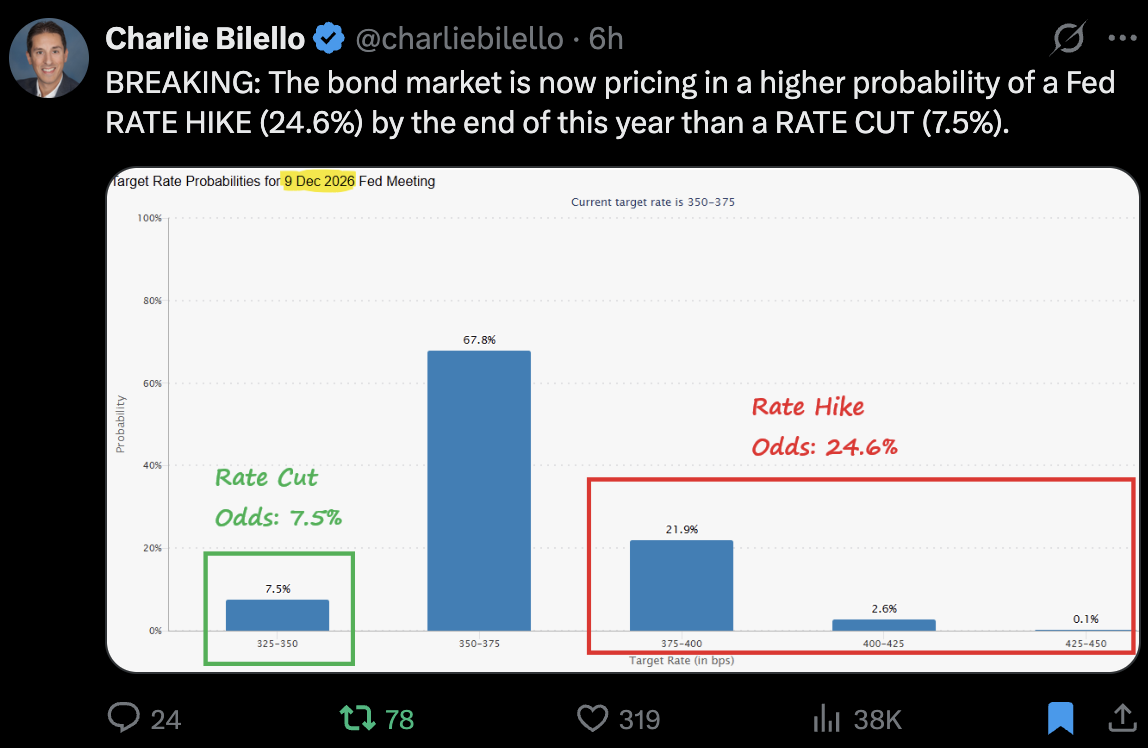
Source: X, @charliebilello
If the Strait of Hormuz remains closed for another 3–4 weeks, we move from concern to consequence fast.
Roughly a fifth of the world’s energy supply flows through that narrow passage. Oil, LNG, and key inputs like fertilizers and industrial commodities all pass through. When that artery clogs, the global economy feels it.
This is one of the few true macro tripwires; pull it, and recession risk rises quickly.
Markets don’t do well in recessions.
Speaking of tripwires, the 10-year Treasury yield closed near the day's high of 4.39%. The 30-year yield is pressing toward 5%. Meanwhile, U.S. debt has now pushed past $39 trillion and is climbing quickly.
Take that second sip of coffee and settle in. I track ten recession indicators each week. For now, none are signaling trouble. I’ll let you know the moment that changes. In the meantime, you’ll find a few charts this week that are worth your attention.
On My Radar:
OMR is for informational and educational purposes only. No consideration is given to your specific investment needs, objectives, or tolerances.
Please see the Important Disclosures at the bottom of this page. Reminder: This is not a recommendation to buy or sell any security. My views may change at any time. The information is for discussion and educational purposes only.
If you like what you are reading, you can subscribe for free.

The Strait of Hormuz
The Strait of Hormuz is one of those places most people never think about (until it matters). It’s a narrow waterway, but roughly 20% of the world’s oil supply flows through it. In many ways, it’s the central artery of the global energy system. If it closes — even temporarily — the impact is felt almost immediately and far beyond the Middle East.
The first move is oil. Prices spike quickly as tankers halt, insurance costs surge, and supply tightens. But it doesn’t stop at the pump. Higher energy costs ripple through transportation, manufacturing, and food. Inflation, which had been easing, begins to reaccelerate. And just like that, the narrative shifts.
The second phase is more subtle, and even more important. Higher costs slow economic activity. Consumers pull back, corporate margins compress, and growth starts to weaken. If the disruption lasts long enough, the risk is not just inflation, it is stagflation: higher prices combined with slower growth. Historically, that’s been one of the more difficult environments for both policymakers (Central Banks and Treasury) and markets.
And then there’s the bigger picture: a prolonged closure would force a global response, both economic and military.
We are seeing nations activate strategic reserves, adjust supply chains , and move energy security to center stage. The deeper the impasse grows, the more markets will need to navigate not just an oil shock but a broader shift in geopolitical stability.
Bottom line: a short disruption is an oil story. A longer one becomes an inflation-and-growth story. And, if it persists, it could evolve into something much more structural.
Head up, this is one of those moments worth watching closely. For investors, if markets break down, get ready for a buy-when-everyone-else-is-selling moment. One can feel the collective pressure on overvalued asset prices growing.
A Few Notable Charts
At the end of the day, price is truth.
You can debate the economy, argue valuations, forecast earnings, and build elegant models, but price reflects the collective judgment of millions of participants, each acting on their own information, biases, and expectations. It is the final vote. Not perfect, not always rational, but real.
Great technicians have always understood this.
Paul Tudor Jones put it simply: “Price is the final arbiter of truth.” He built one of the greatest trading careers of all time not by predicting what should happen, but by reacting to what is happening. When the price moves, something has changed. The job is not to argue with it but to listen. Source: Paul Tudor Jones (widely cited trading principle)
Jesse Livermore, one of the original market legends, said it even more directly: “Markets are never wrong, opinions often are.” It’s a humbling reminder. The market doesn’t care about our narratives. It discounts the future in real time, often before the story becomes obvious. Source: Reminiscences of a Stock Operator (1923)
And Ned Davis, founder of Ned Davis Research, framed it with discipline: “The weight of the evidence is in the price.” Trends, momentum, and breadth are not abstract concepts. They are all derived from price behavior. They tell us whether money is flowing in or out, whether risk appetite is expanding or contracting. Source: Ned Davis, Ned Davis Research
Here’s the key insight:
Price leads. Fundamentals follow.
By the time the data confirms a trend, the price has often already moved. Paying attention to price, trend, direction, and momentum is so critical. It keeps us aligned with the market rather than fighting it.
As you know by now, I’m a big Ned Davis Research fan. A few of my must-watch charts signaled this week. They are not investment strategies. Think of them like a risk gauge, signaling that we are in the high-risk zone. Not a recommendation to buy or sell any security.
Let me briefly go through each one.
High-yield Bonds and Small-Cap Stocks
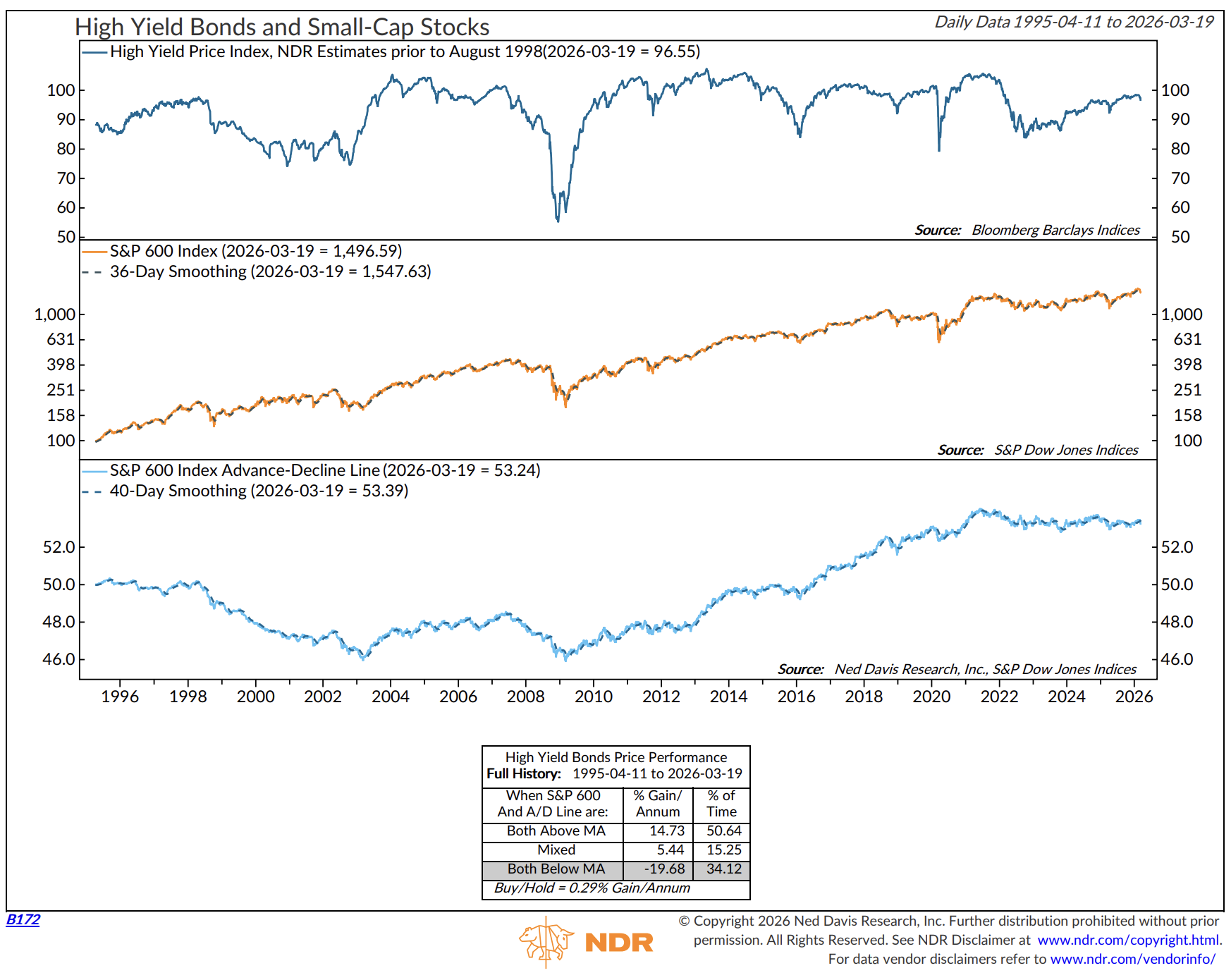
High-yield bonds and small-cap stocks tend to travel together, and for good reason. They are risk assets that tend to be a canary in the coal mine for markets (early warning).
Approximately 50.64% of the time (data 1995 to present), the signal in the first chart is “risk-on.” When liquidity is abundant and confidence is rising, investors reach for yield and growth. Junk bonds rally. Small caps outperform.
When conditions tighten, these are two higher-risk asset classes that feel it quickly.
Think of high yield as a close cousin to small caps. Different wrappers, same underlying driver: risk appetite and need for access to capital.
When small-cap trends are positive and breadth is expanding, high-yield prices tend to move higher as well. When those trends roll over, junk bonds often follow.
Bottom line: I watch this chart to understand the market’s appetite for risk. The current signal is “risk off.”
Source: NDR
Don’t Fight The Tape or The Fed
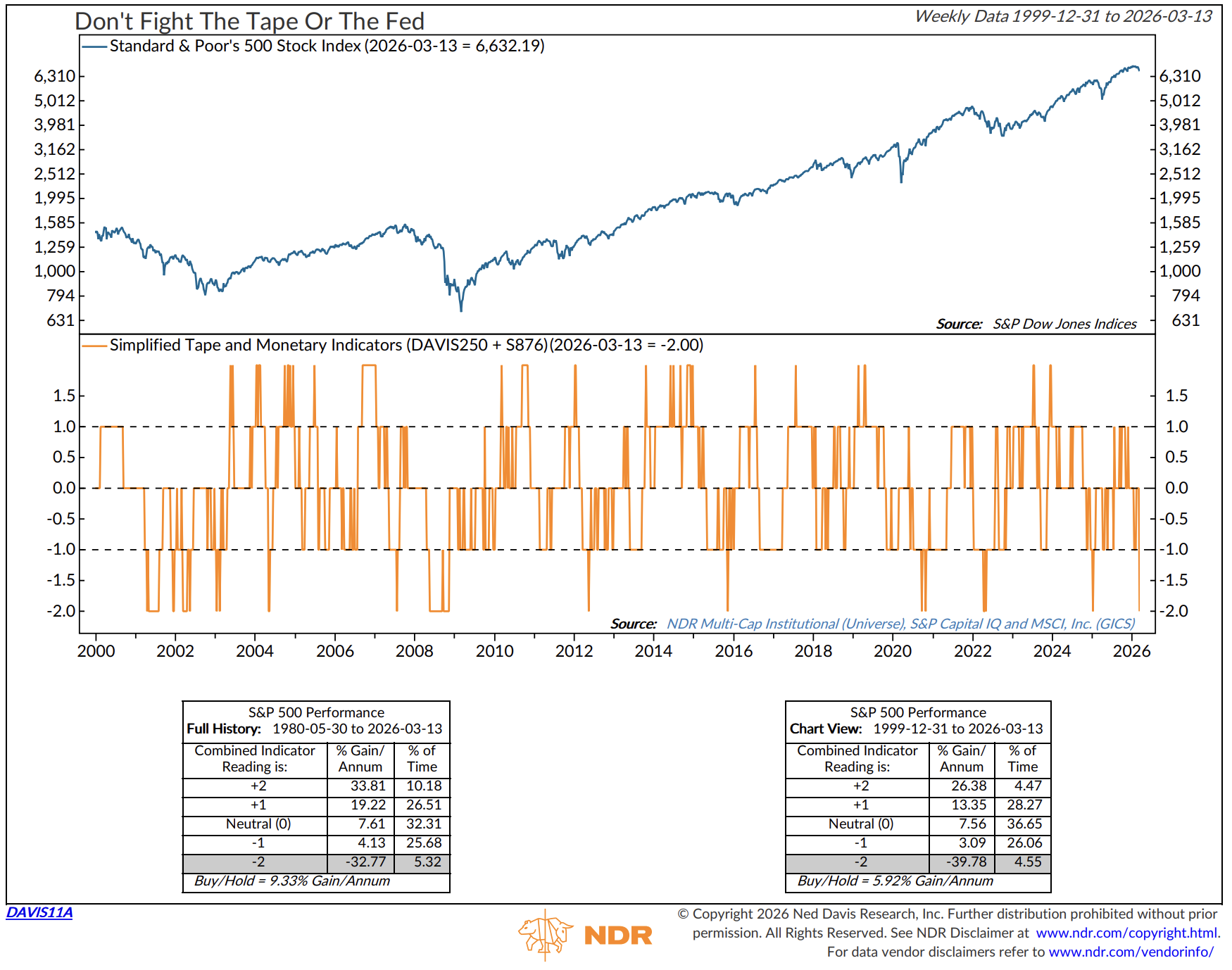
The next chart was designed to test the old adage, “don’t fight the trend or the Fed.” In this case, the tape (or price trend) is measured by NDR’s Big Mo composite indicator, and the Fed is measured by price action in Treasuries.
Bottom line: Watch out for -2.
Signals range from +2 to -2.
A -2 signal triggered this week. Such signals are infrequent. The problem is the bad stuff in stocks tends to happen when Don’t Fight The Tape Or The Fed is scoring -2.
Take a look at the data box in the lower section of the chart.
Source: NDR
There are many ways to approach and manage risk. Reach out to me if you need some help.
Views are subject to change. Not a recommendation to buy or sell any security. Please note that the information provided is not recommended for buying or selling any security and is provided for discussion purposes only. Current viewpoints are subject to change. Please note that the information provided is not recommended for buying or selling any security and is provided for discussion purposes only. See important CMG disclosures below.
If you like what you are reading, click on the following link.
CLICK HERE TO SUBSCRIBE TO ON MY RADAR - IT’S FREE
Not a recommendation to buy or sell any security. Please note that the information provided is not recommended for buying or selling any security and is provided for discussion purposes only. Current viewpoints are subject to change. Please note that the information provided is not recommended for buying or selling any security and is provided for discussion purposes only.
Trade Signals: March 20, 2026 Update
Trade Signals Sections:
Market Commentary
The Indicators Dashboard - Stocks, Investor Sentiment, Bonds, Commodities, Currencies, and Gold
Valuations and Subsequent 10-year Returns
Supporting Charts with Explanations
Why Trend Following Matters
Not a recommendation for you to buy or sell any security. For information purposes only. Outlook and viewpoints are subject to change at a moment's notice. This material is for discussion purposes and does not give you specific advice. Please discuss needs, goals, time horizons, and risk tolerances with your advisor. Important disclosures.Not a recommendation for you to buy or sell any security. For information purposes only. Outlook and viewpoints are subject to change at a moment's notice. This material is for discussion purposes and does not give you specific advice. Please discuss needs, goals, time horizons, and risk tolerances with your advisor.
About Trade Signals - Trade Signals is a paid subscription service that posts the daily, weekly, and monthly trends in the markets (and more). Free for CMG clients. Not a recommendation to buy or sell any security. For discussion purposes only.
“Extreme patience combined with extreme decisiveness. You may call that our investment process. Yes, it’s that simple.” – Charlie Munger

TRADE SIGNALS SUBSCRIPTION ACKNOWLEDGEMENT / IMPORTANT DISCLOSURES
The views expressed herein are solely those of Steve Blumenthal as of the date of this report and are subject to change without notice. Not a recommendation to buy or sell any security.
Please note that the information provided is not recommended for buying or selling any security and is provided for discussion purposes only. Current viewpoints are subject to change. Please note that the information provided is not recommended for buying or selling any security and is provided for discussion purposes only.
Personal Note: Spring is Here
Spring officially arrives tomorrow, March 21, 2026. I see the low 70s in the weekend forecast. I always dread the day we put the patio furniture away… and love the day we bring it back out. This feels like one of those weekends.
For most of the past week, I’ve been flat on my back with an upper back injury. A golf injury of all things. I saw the physical therapist this morning and was surprised to hear him say, “You’ll be good to play by the weekend.” Susan, who’s been taking great care of me, is urging a bit more caution.
Here’s what I learned: there’s a small bone that’s part of the rib, connecting in two places - where the rib meets the spine and where it attaches to the vertebra. These joints sit right under and alongside the shoulder blade. A strong rotational move, like a golf swing, can irritate or slightly misalign that joint.
The body responds by tightening the surrounding muscles to protect it. Tightening is an understatement. It was a full-on spasm.
The therapist sat me up, positioned me just right, and then - crack. Back into place. Immediate relief. Feeling much better and ready for spring.
Enjoy your weekend. Hug your loved ones—and keep pressing forward.
Warm regards,
Steve
CLICK HERE TO SUBSCRIBE TO ON MY RADAR - IT’S FREE
You can share this letter on X by clicking here.
You can share this letter on LinkedIn by clicking here.
Subscribe to OMR for free by clicking the photo.
Stephen B. Blumenthal
Executive Chairman & CIO
CMG Capital Management Group, Inc.
75 Valley Stream Parkway, Suite 201,
Malvern, PA 19355
CMG Customer Relationship Summary (Form CRS)
Metric-Financial, LLC Customer Relationship Summary (Form CRS)

Stephen Blumenthal founded CMG Capital Management Group in 1992 and serves today as its Executive Chairman and CIO. Steve authors a free weekly e-letter entitled, “On My Radar.” Steve shares his views on macroeconomic research, valuations, portfolio construction, asset allocation and risk management. Author of Forbes Book: On My Radar, Navigating Stock Market Cycles.
Follow Steve on X @SBlumenthalCMG and LinkedIn.
IMPORTANT DISCLOSURE INFORMATION
This document is prepared by CMG Capital Management Group, Inc. (“CMG”) and is circulated for informational and educational purposes only. There is no consideration given to the specific investment needs, objectives, or tolerances of any of the recipients. Additionally, CMG’s actual investment positions may, and often will, vary from its conclusions discussed herein based on any number of factors, such as client investment restrictions, portfolio rebalancing, and transaction costs, among others. Recipients should consult their own advisors, including tax advisors, before making any investment decision. This material is for informational and educational purposes only and is not an offer to sell or the solicitation of an offer to buy the securities or other instruments mentioned. This material does not constitute a personal recommendation or take into account the particular investment objectives, financial situations, or needs of individual investors which are necessary considerations before making any investment decision. Investors should consider whether any advice or recommendation in this research is suitable for their particular circumstances and, where appropriate, seek professional advice, including legal, tax, accounting, investment, or other advice. The views expressed herein are solely those of Steve Blumenthal as of the date of this report and are subject to change without notice.
Investing involves risk.
This letter may contain forward-looking statements relating to the objectives, opportunities, and future performance of the various investment markets, indices, and investments. Forward-looking statements may be identified by the use of such words as; “believe,” anticipate,” “planned,” “potential,” and other similar terms. Examples of forward-looking statements include, but are not limited to, estimates with respect to financial condition, results of operations, and success or lack of success of any particular market, index, investment, or investment strategy. All are subject to various factors, including, but not limited to, general and local economic conditions, changing levels of competition within certain industries and markets, changes in legislation or regulation, Federal Reserve policy, and other economic, competitive, governmental, regulatory, and technological factors affecting markets, indices, investments, investment strategy and portfolio positioning that could cause actual results to differ materially from projected results. Such statements are forward-looking in nature and involve a number of known and unknown risks, uncertainties, and other factors, and accordingly, actual results may differ materially from those reflected or contemplated in such forward-looking statements. Investors are cautioned not to place undue reliance on any forward-looking statements or examples. All statements made herein speak only as of the date that they were made. Investing is inherently risky and all investing involves the potential risk of loss.
Past performance does not guarantee or indicate future results. Different types of investments involve varying degrees of risk, and there can be no assurance that the future performance of any specific investment, investment strategy, or product (including the investments and/or investment strategies recommended or undertaken by CMG), or any non-investment related content, made reference to directly or indirectly in this commentary will be profitable, equal any corresponding indicated historical performance level(s), be suitable for your portfolio or individual situation or prove successful. Due to various factors, including changing market conditions and/or applicable laws, the content may no longer be reflective of current opinions or positions. Moreover, you should not assume that any discussion or information contained in this commentary serves as the receipt of, or as a substitute for, personalized investment advice from CMG. Please remember to contact CMG, in writing, if there are any changes in your personal/financial situation or investment objectives for the purpose of reviewing/evaluating/revising our previous recommendations and/or services, or if you would like to impose, add, or to modify any reasonable restrictions to our investment advisory services. Unless, and until, you notify us, in writing, to the contrary, we shall continue to provide services as we do currently. CMG is neither a law firm, nor a certified public accounting firm, and no portion of the commentary content should be construed as legal or accounting advice.
No portion of the content should be construed as an offer or solicitation for the purchase or sale of any security. References to specific securities, investment programs or funds are for illustrative purposes only and are not intended to be, and should not be interpreted as recommendations to purchase or sell such securities.
This presentation does not discuss, directly or indirectly, the amount of the profits or losses realized or unrealized, by any CMG client from any specific funds or securities. Please note: In the event that CMG references performance results for an actual CMG portfolio, the results are reported net of advisory fees and inclusive of dividends. The performance referenced is that as determined and/or provided directly by the referenced funds and/or publishers, has not been independently verified, and does not reflect the performance of any specific CMG client. CMG clients may have experienced materially different performance based upon various factors during the corresponding time periods. See in links provided citing limitations of hypothetical back-tested information. Past performance cannot predict or guarantee future performance. Not a recommendation to buy or sell. Please talk to your advisor.
Information herein has been obtained from sources believed to be reliable, but we do not warrant its accuracy. This document is general communication and is provided for informational and/or educational purposes only. None of the content should be viewed as a suggestion that you take or refrain from taking any action nor as a recommendation for any specific investment product, strategy, or other such purposes.
In a rising interest rate environment, the value of fixed-income securities generally declines, and conversely, in a falling interest rate environment, the value of fixed-income securities generally increases. High-yield securities may be subject to heightened market, interest rate, or credit risk and should not be purchased solely because of the stated yield. Ratings are measured on a scale that ranges from AAA or Aaa (highest) to D or C (lowest). Investment-grade investments are those rated from highest down to BBB- or Baa3.
NOT FDIC INSURED. MAY LOSE VALUE. NO BANK GUARANTEE.
Certain information contained herein has been obtained from third-party sources believed to be reliable, but we cannot guarantee its accuracy or completeness.
In the event that there has been a change in an individual’s investment objective or financial situation, he/she is encouraged to consult with his/her investment professional.
Written Disclosure Statement. CMG is an SEC-registered investment adviser located in Malvern, Pennsylvania. Stephen B. Blumenthal is CMG’s founder and CEO. Please note: The above views are those of CMG and its CEO, Stephen Blumenthal, and do not reflect those of any sub-advisor that CMG may engage to manage any CMG strategy, or exclusively determines any internal strategy employed by CMG. A copy of CMG’s current written disclosure statement discussing advisory services and fees is available upon request or via CMG’s internet web site at www.cmgwealth.com/disclosures. CMG is committed to protecting your personal information. Click here to review CMG’s privacy policies.
See CMG Disclosures at the bottom of this page.
For more information about NDR, please visit at www.ndr.com.
NDR, Inc. (NDR), d.b.a. Ned Davis Research Group (NDRG), any NDRG affiliates or employees, or any third-party data provider, shall not have any liability for any loss sustained by anyone who has relied on the information contained in any NDRG publication. The data and analysis contained herein are provided "as is." NDRG disclaims any and all express or implied warranties, including, but not limited to, any warranties of merchantability, suitability or fitness for a particular purpose or use. NDRG's past recommendations and model results are not a guarantee of future results. This communication reflects our analysts' opinions as of the date of this communication and will not necessarily be updated as views or information change. All opinions expressed herein are subject to change without notice. NDRG or its affiliated companies or their respective shareholders, directors, officers and/or employees, may have long or short positions in the securities discussed herein and may purchase or sell such securities without notice. For NDRG's important additional disclaimers, refer to www.ndr.com/invest/public/copyright.html. Further distribution prohibited without prior permission. Copyright 2025 © NDR, Inc. All rights reserved.