November 13, 2026
By Steve Blumenthal
"The signs were there. They always are."
— Michael Burry, after this week's Nvidia news
Grab that coffee and find your favorite chair. This one matters.
Last week, in Bankruptcy or Robots, and before that, in AI: The Canary in the Data Center, I wrote that the AI build-out was being financed in ways most investors were likely unaware of. It is called "circular financing" because the money left one of the chipmaker's pockets and returned to the other pocket as revenue. My concern was never AI itself. It was the plumbing.
This week the plumbing got a stress test. On Thursday, Nvidia announced that Jensen Huang, its co-founder and CEO of 33 years, had resigned as president, CEO and director, effective immediately. CFO Colette Kress is interim CEO while the board looks at internal and external candidates. Harvey Jones, a board member since 1993, becomes Nvidia's first-ever board chair. The stock is down nearly 15% just this week and ~ 39% from last month’s high to this week’s low. Kress takes over five days before Nvidia reports quarterly earnings. Here’s a look at the NVDA chart:
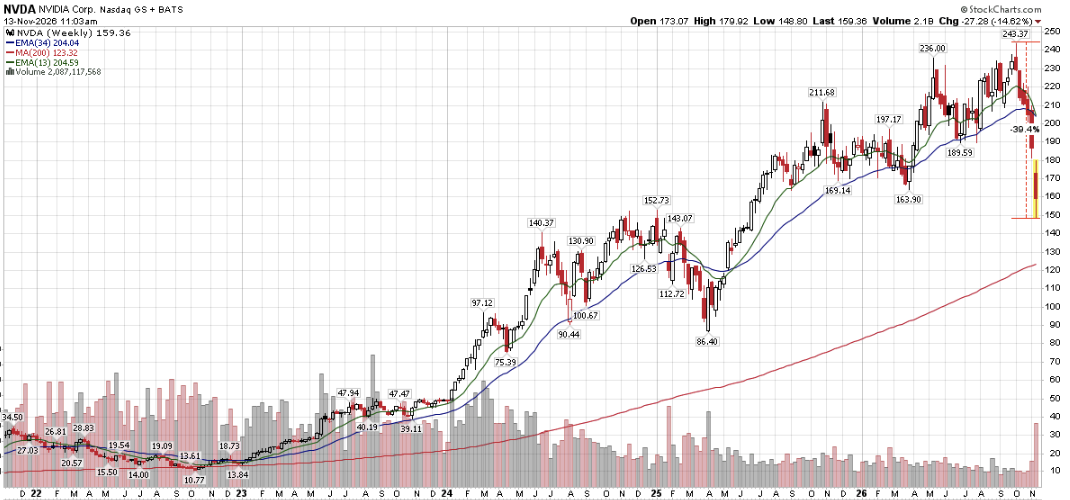
Source: Stockcharts.com
For the record, I remain very bullish on AI over the long term. The technology is real, and the productivity gains will be real. The question I keep asking is: at what price? Nvidia stock is far more attractive today than it was a month ago. Is there more tumult ahead? Maybe. I remain concerned about the high concentration of Mag 7 stocks in the S&P 500 Index and about margin debt.
Here's my bigger point today. The Nvidia news is front page news everywhere, but it isn't the whole story. This week, I want to put three sources on your radar. We’ll examine each, and you’ll find they reach a similar conclusion. Bethany McLean and Michael Burry show how much of the AI boom has been financed by the company selling the chips, and how that financing is starting to crack. Michael Howell of CrossBorder Capital fame tracks global liquidity and says the money needed to roll over a mountain of debt is shrinking, and that AI is now a net drain on it.
I used my AI notetaker to work through the transcripts with specific instructions. You’ll find the related links, and I encourage you to listen to the presentations / read the research. Each provides a different lens, and they conclude with a similar message: the technology is real, the price is the problem, and the buying opportunity is likely ahead. As I keep saying, the best entry opportunities present themselves during a crisis, which typically occurs when leveraged trades are forced to unwind (aka margin calls). Though I admit, a decline of nearly 40% is getting my attention.
Included in this week’s On My Radar:
The Bank of Nvidia: A $530 Billion Puzzle
Michael Burry - The Paradigm Shift
Concentration + Margin Debt: The Fuel for a Great Buying Opportunity
Michael Howell on Capital Flows - AI Build-out is Draining Liquidity
Trade Signals: November 12, 2026
Personal Note: Playing for Nothing and Everything
OMR is for informational and educational purposes only. No consideration is given to your specific investment needs, objectives, or tolerances.
Please see the Important Disclosures at the bottom of this page. Reminder: This is not a recommendation to buy or sell any security. My views may change at any time. The information is for discussion and educational purposes only.
If you like what you are reading, you can subscribe for free.

The Bank of Nvidia: A $530 Billion Puzzle in Plain English
Bethany McLean, who broke the Enron story at Fortune, published The Comprehensive Guide to the Bank of Nvidia at Hunterbrook on November 6. It's worth your time. Her source is mostly Nvidia's own 10-Q filing for the quarter ending July 26, 2026. Here's the short version.
Imagine a car dealer selling a record number of cars. Then you learn how. The dealer is giving buyers their down payment, co-signing their loans, and promising to buy the car back if they can’t keep up the payments. The sales numbers look fantastic. But how many of those buyers could have afforded the car on their own? And what happens to the dealer if a lot of them can’t pay?
That's what I mean by the Bank of Nvidia. The 10-Q shows $530.5 billion in commitments and guarantees, in three buckets:
Future commitments: $366 billion. Most of this ($279 billion) is supply purchases such as high-bandwidth memory and packaging. It more than doubled from $119 billion in a single quarter. If demand cools, Nvidia may still owe the suppliers. The filing doesn't say how much of this is cancelable.
Additional commitments: $56 billion. This includes $36 billion to buy back computing capacity from the "neoclouds" that bought Nvidia's chips. In other words, Nvidia is both the seller and a backstop buyer. It also includes $20 billion in 15-year data-center leases that Nvidia plans to pass on to someone else.
Important note: A neocloud is a newer company that rents out access to powerful AI computer chips over the internet, mostly Nvidia’s GPUs. Amazon, Microsoft, and Google rent out all kinds of computing services. Neoclouds like CoreWeave, Nebius, and Lambda mostly do one thing: they rent out AI chips. Think of them as specialty landlords for computing power. They borrow heavily to buy chips and build data centers, then rent out that capacity to AI companies like OpenAI that need it to build and run their models.
Why does it matter? Many neoclouds depend on Nvidia twice over. Nvidia sells them the chips and often also invests in them or promises to rent out their unused capacity. This is what circular means.
Lease guarantees: $108.5 billion. Nvidia isn't the tenant, but it pays if the tenant doesn't. $105 billion of this is tied to SB Energy (SoftBank) and a campus in Pike County, Ohio, being built for OpenAI.
On top of that:
$99 billion in equity stakes across 229 private and 13 public companies, including CoreWeave, Nebius, Intel, OpenAI, Anthropic, Mistral and Cohere. Many of these companies are also Nvidia customers. Gains on these stakes accounted for almost 17% of Nvidia's pre-tax income in the first half of the fiscal year.
Deals not included in the $530 billion, including a preliminary plan to invest up to $100 billion in OpenAI in ten installments. Each installment is tied to OpenAI placing chip orders.
A $500+ billion financing push with Apollo, BlackRock, Blackstone, Brookfield, Goldman and KKR. Huang said Nvidia could backstop up to 25% of it.
Here's how the circular loop works. Nvidia invests in CoreWeave. CoreWeave buys Nvidia GPUs. Nvidia agrees to buy CoreWeave's unused capacity through 2032. OpenAI buys from CoreWeave and also owns a piece of it. Mistral and Cohere, both Nvidia-funded, rent from CoreWeave. If one link breaks, Nvidia gets hit three ways: through its equity stakes, its chip sales and its capacity obligations.
McLean doesn't claim Nvidia is in trouble. Nvidia generated about $70 billion of free cash flow in the first half of the year, and it can absorb a great deal. Her point is subtler. No one, maybe not even Nvidia, can say how much of its revenue depends on demand it funds or guarantees. She notes the IPOs already pulled or delayed: Nscale, Firmus and SB Energy. She also draws the historical comparison I've been making: Lucent, Nortel and Cisco's vendor financing in 2000. Those companies didn't fail because the internet was a fad. They got hurt because they financed their own customers at the top.
Bottom line on the puzzle: The man who built the bank, and personally drove its deals, is gone. The CFO who reportedly pushed back on the most aggressive deals is now in charge. That's arguably a positive for discipline. But a more disciplined Bank of Nvidia probably means less financing for the whole ecosystem, and that financing has been holding up demand.
Burry: The Paradigm Shift, the Duration Mismatch and the Probes
Michael Burry has been on this for a while, and his notes this week are sharp. I’m a paid subscriber to his Substack. You can find his post here.
Three points stood out to me.
1. GPUs were the right tool, at the right time. Burry's view is that GPUs weren't designed for AI, and that for most inference work, and even for training smaller language models, they're now "overkill." The shift toward cheaper, purpose-built chips (Google's TPUs, Amazon's Trainium, custom silicon from Broadcom) and toward CPU-based inference was predictable. In his view, Nvidia added operating leverage right into that shift.
2. Duration mismatch. Nvidia and its partners are signing 15-year data-center leases and guarantees to house chips with an economic life of maybe three to five years. The risk here is funding long-term obligations with short-life assets. When the chips are obsolete, the rent is still due. I’ve written about Burry’s view on this before, spoke with a friend and client in the data center business, and came away understanding it's not 15 years vs. 3 to 5 years. It may be closer to 15 years vs. 7-10 years of GPU life.
3. Burry cited a Semafor report, attributed to two administration officials, of Department of Justice probes into Nvidia: one on antitrust, plus separate inquiries into Megaspeed and Super Micro. Recall that in March, a Super Micro co-founder and two others were charged with illegally routing $2.5 billion of Nvidia GPUs to China through a Southeast Asian front company. Burry said there are also reports that Kress pushed back on some of Huang's more aggressive dealings, and that he went around her.
His broader message: never forget that the analysts' job is to predict rosy numbers. The clues were in the stock price, the financing, and the SEC and regulatory filings all year long. (Burry also disclosed that he holds puts on SMH and the Nasdaq 100 but no direct Nvidia position.)
Look at the companies that benefited most from Nvidia's power and generosity. Nebius was down about 20% in one day this week. TSMC, ASML and CoreWeave have all been volatile over the past month. Burry says what he's looking for are market signs that Nvidia's power has significantly weakened. I'm watching the same thing. Broadcom (AVGO) and AMD stand out as the competitors most likely to benefit.
Not a recommendation for you to buy or sell any security.
Concentration + Margin Debt: The Fuel for a Great Buying Opportunity
Here's why I believe this matters beyond one company. The circular leverage within the AI system sits atop two other forms of leverage in the market.
Concentration:
Depending on whose measure you use, the ten largest stocks account for roughly 39%–43% of the S&P 500. That's at or near the highest on record. As of mid-year, Nvidia alone was the largest single weight, at nearly 7%. If you own an index fund, you own the Bank of Nvidia. Passive flows go in on the way up and come out on the way down, regardless of price.
Margin debt:
FINRA debit balances hit a record of about $1.5 trillion in June. Then July brought an $85 billion drop, the largest monthly decline in the data going back to 1997. Year-over-year growth slowed from about 54% in May to about 31% in September. History shows that when margin debt rolls over from a record high, it's usually because the market is starting to force the issue. When prices fall, margin calls force selling, which in turn pushes prices lower.
Here is a chart I follow to gauge the pace:
Focus on the orange line in the middle section. It tracks margin debt in $ billions.
A decline below the six-month smoothed moving average line is what we are watching for as a signal that it is declining. Note prior periods: 2000, 2007, 2021.
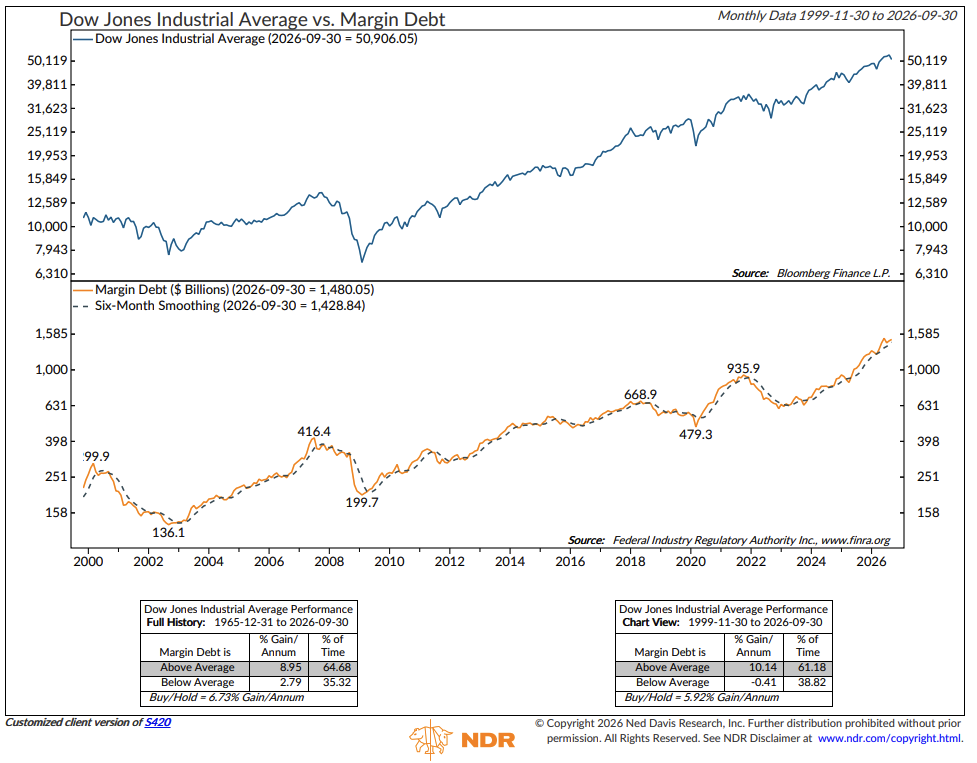
Source: NDR
Put the three together: circular vendor financing, record concentration, and record margin debt. The forced seller doesn't care about value. That's when patient capital gets paid.
I don't think we're there yet.
Opinions are subject to change. Not a recommendation to buy or sell any security. Provided for discussion and educational purposes only. Past performance is not indicative of future results.
Michael Howell on Capital Flows - AI Build-out is Draining Liquidity
Michael Howell of CrossBorder Capital, who writes the Capital Wars Substack, is one of the best liquidity analysts I know. This week, I listened to his interview with Jack Farley on Monetary Matters. His framework fits right into this week's story so I thought I’d share it with you. You can find the full interview here.
Here are the key macro points:
The global liquidity cycle has turned down. It peaked in late 2025 after a roughly three-year run. Howell measures the growth of money flowing into financial markets, not the level. The level is still high, but the momentum is slowing.
Howell says we are leaving "speculation" and entering "turbulence." Howell's cycle has four phases: Rebound, Calm, Speculation and Turbulence. Speculation lasted most of the past year. Markets could still make money, but volatility was high, and the quality of the returns was poor. Turbulence is when liquidity tightens further and making money gets harder. He says the tell-tale signs are already showing: the Russell 2000 behaving like a bear market, defensives (healthcare, staples, energy) leading, and tech mixed at best.
AI consumes liquidity. It doesn't create it. Every capital-intensive industry is cyclical, even though investors see AI as a trend. Remember fiber optics: some of the leading companies were in Chapter 11 within five years. Not all of the transformative technology companies will win.
The liquidity funding mix has flipped. 12 to 18 months ago, the story was that about 80% of the AI build-out would be funded from companies’ cash flow. Now Howell estimates roughly 80% is coming from capital markets (debt and equity). He puts hyperscaler debt needs at nearly $1 trillion per year over the next two years, with equity issuance close behind.
The debt maturity wall arrives at the same time. Debt that was financed at near-zero rates during COVID is coming due and will be refinanced at much higher rates from 2026 through 2030. Add roughly $2 trillion a year of new federal debt. In his words, markets are now mostly "refinancing systems," not capital-raising machines. Borrowers must also compete with governments that need to finance deficits and service maturing debt.
"Every crisis is a refinancing crisis." Debt needs liquidity to roll over, and liquidity needs debt as collateral. He cites the World Bank: 77% of global lending is now collateral-backed. When the debt-to-liquidity ratio rises above about 2x, refinancing crises follow. When it falls well below, bubbles form.
Howell believes, on a roughly 16-year cycle, we may be swinging from the "everything bubble" toward an "everything bust." He thinks the big one may come in the early 2030s rather than this cycle.
Credit is where the cracks show first. Howell is a net seller of credit. CoreWeave's unsecured bonds saw spreads blow out in October, and the gap between CCC and single-B spreads is widening almost daily. I believe that's the Bank of Nvidia story showing up in the bond market.
The Fed and Treasury won't let funding markets break. After the repo blowup in late 2025, the Fed launched "reserve management purchases," which Howell calls QE by another name. It now targets about $3 trillion in bank reserves. Treasury Secretary Bessent is capping bond-market volatility through bill issuance and buybacks. Howell says Fed Chair Kevin Warsh's Fed is reluctant to tighten, with stability of the Treasury market as the top priority. He expects the Fed's balance sheet to be even bigger by 2030, not smaller.
Treasury QE is feeding Main Street, not Wall Street. Shifting issuance toward T-bills, from about 23% to 30%, adds liquidity to the real economy. Howell estimates every 5-point shift is worth about $3 trillion. But a hot real economy pulls money out of financial markets. That's why nominal GDP growth is the fastest since the mid-1980s, even as market liquidity falls.
Bond yields are rising on growth, not fear. Contrary to the headlines, the yield curve has been flattening, not steepening, and term premiums are flat to falling. That points to rising demand for safe assets, not a fiscal panic. Howell sees about 5.5%–6% as fair value for the 10-year Treasury. Long-term rates are back above their 300-year average, and for the first time in a long time, he says, bonds deserve a place in portfolios.
A quick aside to my Howell notes: the 10-year yield is back above 5%, yielding 5.15% at the time of this writing.
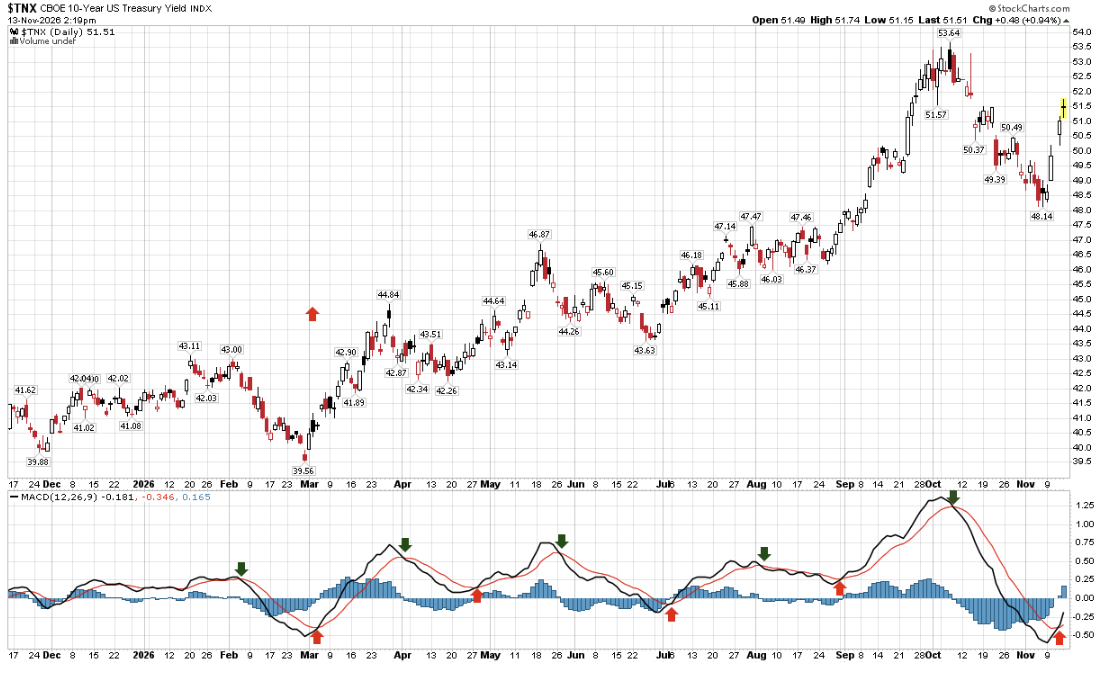
Source: StockCharts.com
Howell believes a 2027 slowdown is in the pipeline. He combines a stronger dollar, higher oil prices, and elevated bond volatility into one indicator. It points to a sharp turn lower in growth in 2027. He's not calling a recession, but he says the odds have risen. A slower economy would give the Fed room to ease.
Where he's positioned: He has cut equities and is cutting commodities after a big year, despite being long-term bullish on real assets. He's net short credit and moving into longer-duration government bonds, the one green light in his turbulence phase. He expects Bitcoin, which he calls the most liquidity-sensitive asset on the planet, to retest about $70,000. On gold, he says the real driver is China's central bank liquidity, which he expects to rise eventually. He's long-term bullish on both.
When to buy risk again: Wait for the liquidity cycle to turn. His sine wave points to a bottom in the second half of 2027, possibly sooner. He wants three or more data points confirming the upturn, a change in direction of the yield curves, and Bitcoin holding its lows. Equities do best in the Calm phase that follows Rebound. He says missing the first 10% doesn't matter.
Bottom line: Howell reaches a conclusion similar to mine from a different direction. The AI build-out is real, but it now relies on borrowed money, with liquidity shrinking and a wall of debt needing refinancing. The first cracks are showing in credit, and CoreWeave is the canary. This week’s Nvidia news is concerning. I believe policymakers will eventually step in with more liquidity because, with this much debt, they have no choice, and our politicians lack the will for fiscal restraint. Howell concludes: Get defensive now. Own some duration. Watch credit spreads and Bitcoin for the turn. Patience into 2027.
My rough checklist:
Next week's earnings and guidance from the new leadership. Watch for any changes in supply commitments, cloud capacity buybacks, or the pace of new equity and guarantee deals.
The Bank of Nvidia shrinking its loan book would be healthy for the company and a headwind for the ecosystem.
Neocloud credit. Watch CoreWeave and Nebius bond spreads, GPU-backed loan terms, and the status of the delayed IPOs. Credit usually cracks before equity does.
Margin debt contracting in a meaningful way, not one bad month. In past cycles, the best entry points came after a sustained year-over-year decline. Watch for a break below the 6-month smoothed moving average line.
Overall market valuation reset. I want to see broad-market and AI-leader valuations come back to levels where we don't need everything to go right. I'll share the specific price and multiple levels I'm watching in the coming weeks.
Our trend and sentiment signals.
Bottom Line: AI is real, and, as I wrote last week, the long-term opportunity is real. I'm still very bullish on AI and what it means for all of us. But price matters; the king has left the throne; the CFO now running the bank may be more careful, and a more careful bank lends less. Stay patient. Keep risk-management processes in place. Have a shopping list ready. Brace for opportunity.
Opinions are subject to change. Not a recommendation to buy or sell any security. Provided for discussion and educational purposes only. Past performance is not indicative of future results.
If you like what you are reading, click on the link and share it with a friend (it’s free).
CLICK HERE TO SUBSCRIBE TO ON MY RADAR
Trade Signals: November 12, 2026 Update
Market Commentary
Trade Signals is free for CMG clients and a paid subscription service for others. Selfishly, I write it for myself each week, and have for years, with the goal of staying disciplined in the markets.
Trade Signals
The Indicators Dashboard - Stocks, Investor Sentiment, Bonds, Commodities, Currencies, and Gold
Valuations and Subsequent 10-year Returns
Supporting Charts with Explanations

TRADE SIGNALS SUBSCRIPTION ACKNOWLEDGEMENT / IMPORTANT DISCLOSURES
About Trade Signals - Trade Signals is a paid subscription service that posts daily, weekly, and monthly market trends (and more). Free for CMG clients. Not a recommendation to buy or sell any security. For discussion purposes only.
The views expressed herein are solely those of Steve Blumenthal as of the date of this report and are subject to change without notice. Please note that the information provided is not recommended for buying or selling any security and is provided for discussion purposes only.
Personal Note: Playing for Nothing and Everything
The Malvern Prep Friars battled their way to a hard-fought win in the first round of the state playoffs. On Tuesday, the run came to an end with a 2-0 loss, and the joy of that first-round win turned to tears.
After the game, Susan gathered the team together. It was one of those moments that stays with you. One by one, the seven seniors talked about the game, what their years on the team have meant to them, and the bond they share with their teammates. The scoreboard said the season was over. That huddle said something else: their friendships will last a lifetime.
It brought to mind a piece I came across from The Daily Coach. It's about how you show up when there's nothing left on the scoreboard to play for. Good advice as the boys move forward on their life's journey. It felt like the right time to share it with you.
“Habits don’t take holidays. If you compromise standards in the quiet months, you might not find them when the lights come back on.
August baseball can feel like purgatory.
The lights are still bright, the games still count, but for teams out of playoff contention, the roar fades to a murmur. The standings say it’s over, yet the schedule says you’ve got 40 games left.
So… who are you now?
It’s an overlooked test of character. In high-pressure moments, adrenaline and opportunity fuel performance. But what about the moments when no one’s watching, when there’s nothing left to win but your own respect?
In 1941, Ted Williams faced a choice. He was hitting .3995 on the final day - good enough to round to .400 if he sat. His manager offered him the day off, but Williams refused. He played both games of the doubleheader, went 6-for-8, and finished at .406. He could have coasted. Instead, he bet on his standard.
“If I’m going to be a .400 hitter, I want more than my toenails on the line,” Williams said later. “Toenails on the line” is a metaphor for just barely crossing a threshold. He wanted to earn it fully and leave no doubt.
Years later, Buck Showalter managed a 42–106 Orioles team. Reporters asked how he kept his players engaged during the dog days of summer, late in the season. His answer was simple: “You do what’s right… regardless of what down the road means.” In other words, the scoreboard can’t be your only compass. For great leaders, the scoreboard is simply too shallow and limiting to define a culture or team.
Ichiro Suzuki knew this, too. For much of his career in Seattle, October baseball was a fantasy. Yet his preparation never wavered: early cage work, stretching, every detail precise. He spoke about valuing the “human element” of the game, the emotions and pride in doing something well, no matter the stage.
Suzuki knew that every time he took the field, there were people who bought tickets with their hard-earned money, and they deserved his best effort. Just like the great Joe DiMaggio, who, when asked why he played so hard all the time, said, "Because there might be somebody out there who's never seen me play." That’s leadership without a microphone.
Every leader faces “August” moments. Maybe the quarter’s lost, the stock is down, or the team is coasting. Maybe the project won’t ship on time or the market has moved on. The temptation is to disengage, to lower the bar “just until things matter again.”
But habits don’t take holidays. If you compromise standards in the quiet months, you might not find them when the lights come back on.
The best leaders use those stretches to reinforce culture:
Make the standard visible. Praise preparation, communication, and discipline over results.
Create meaning in the mundane. Tie routine to identity: “This is who we are,” not “this is what we get.”
Finish with integrity. Protect the culture over optics, even if no one’s keeping score.
The late John Wooden put it this way: “Success is peace of mind… knowing you did your best to become the best that you are capable of becoming.” That definition doesn’t expire in August, or any month, no matter your record.
The next time you or your team face a season with nothing left to “win,” ask yourself:
If the outcome were fixed and no one was watching, what would we still insist on doing well?
Where have we quietly lowered a standard because the standings told us it didn’t matter?
You can’t fake your way through the months that don’t matter. You either keep showing up, or you let those months decide the kind of leader you really are.”
Source: The Daily Coach
I'm pretty sure the boys are too interested in reading a macroeconomic letter, but I do want to share this week’s personal section with them.
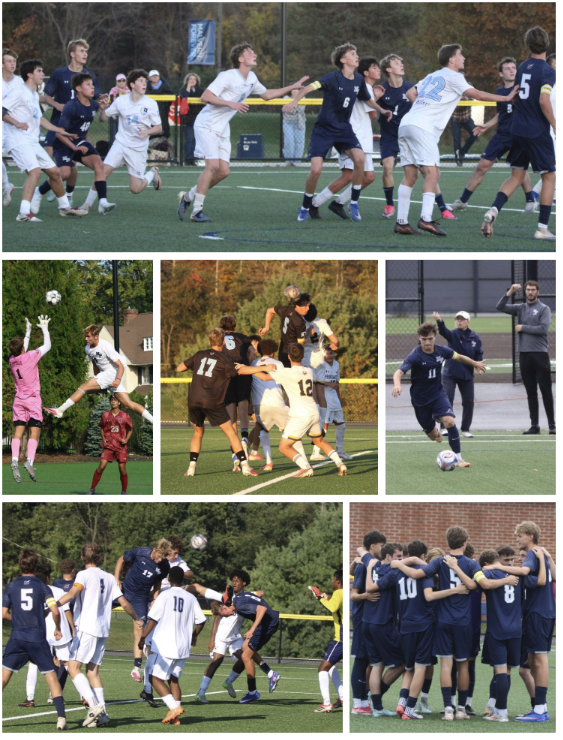
Following are a few photos. Thanks for indulging me all season.
Always growing! Ever Forward!

Coach Sue and her 2026 Malvern Prep Friars

The seven seniors - photo middle left. Coach Steve w notebook standing behind his favorite coach middle right.
Wishing you a wonderful weekend.
With kind regards,
Steve
CLICK HERE TO SUBSCRIBE TO ON MY RADAR - IT’S FREE
You can share this letter on X by clicking here.
You can share this letter on LinkedIn by clicking here.
Subscribe to OMR for free by clicking the photo.
Stephen B. Blumenthal
Founder and CEO
CMG Capital Management Group, Inc.
75 Valley Stream Parkway, Suite 201
Malvern, PA 19355
CMG Customer Relationship Summary (Form CRS)
Metric-Financial, LLC Customer Relationship Summary (Form CRS)

Stephen Blumenthal founded CMG Capital Management Group in 1992 and serves today as its CEO. Steve authors a free weekly e-letter entitled, “On My Radar.” Steve shares his views on macroeconomic research, valuations, portfolio construction, asset allocation and risk management. Author of Forbes Book: On My Radar, Navigating Stock Market Cycles.
Follow Steve on X @SBlumenthalCMG and LinkedIn.
IMPORTANT DISCLOSURE INFORMATION
This document is prepared by CMG Capital Management Group, Inc. (“CMG”) and is circulated for informational and educational purposes only. There is no consideration given to the specific investment needs, objectives, or tolerances of any of the recipients. Additionally, CMG’s actual investment positions may, and often will, vary from its conclusions discussed herein based on any number of factors, such as client investment restrictions, portfolio rebalancing, and transaction costs, among others. Recipients should consult their own advisors, including tax advisors, before making any investment decision. This material is for informational and educational purposes only and is not an offer to sell or the solicitation of an offer to buy the securities or other instruments mentioned. This material does not constitute a personal recommendation or take into account the particular investment objectives, financial situations, or needs of individual investors which are necessary considerations before making any investment decision. Investors should consider whether any advice or recommendation in this research is suitable for their particular circumstances and, where appropriate, seek professional advice, including legal, tax, accounting, investment, or other advice. The views expressed herein are solely those of Steve Blumenthal as of the date of this report and are subject to change without notice.
Investing involves risk.
This letter may contain forward-looking statements relating to the objectives, opportunities, and future performance of the various investment markets, indices, and investments. Forward-looking statements may be identified by the use of such words as; “believe,” anticipate,” “planned,” “potential,” and other similar terms. Examples of forward-looking statements include, but are not limited to, estimates with respect to financial condition, results of operations, and success or lack of success of any particular market, index, investment, or investment strategy. All are subject to various factors, including, but not limited to, general and local economic conditions, changing levels of competition within certain industries and markets, changes in legislation or regulation, Federal Reserve policy, and other economic, competitive, governmental, regulatory, and technological factors affecting markets, indices, investments, investment strategy and portfolio positioning that could cause actual results to differ materially from projected results. Such statements are forward-looking in nature and involve a number of known and unknown risks, uncertainties, and other factors, and accordingly, actual results may differ materially from those reflected or contemplated in such forward-looking statements. Investors are cautioned not to place undue reliance on any forward-looking statements or examples. All statements made herein speak only as of the date that they were made. Investing is inherently risky and all investing involves the potential risk of loss.
Past performance does not guarantee or indicate future results. Different types of investments involve varying degrees of risk, and there can be no assurance that the future performance of any specific investment, investment strategy, or product (including the investments and/or investment strategies recommended or undertaken by CMG), or any non-investment related content, made reference to directly or indirectly in this commentary will be profitable, equal any corresponding indicated historical performance level(s), be suitable for your portfolio or individual situation or prove successful. Due to various factors, including changing market conditions and/or applicable laws, the content may no longer be reflective of current opinions or positions. Moreover, you should not assume that any discussion or information contained in this commentary serves as the receipt of, or as a substitute for, personalized investment advice from CMG. Please remember to contact CMG, in writing, if there are any changes in your personal/financial situation or investment objectives for the purpose of reviewing/evaluating/revising our previous recommendations and/or services, or if you would like to impose, add, or to modify any reasonable restrictions to our investment advisory services. Unless, and until, you notify us, in writing, to the contrary, we shall continue to provide services as we do currently. CMG is neither a law firm, nor a certified public accounting firm, and no portion of the commentary content should be construed as legal or accounting advice.
No portion of the content should be construed as an offer or solicitation for the purchase or sale of any security. References to specific securities, investment programs or funds are for illustrative purposes only and are not intended to be, and should not be interpreted as recommendations to purchase or sell such securities.
This presentation does not discuss, directly or indirectly, the amount of the profits or losses realized or unrealized, by any CMG client from any specific funds or securities. Please note: In the event that CMG references performance results for an actual CMG portfolio, the results are reported net of advisory fees and inclusive of dividends. The performance referenced is that as determined and/or provided directly by the referenced funds and/or publishers, has not been independently verified, and does not reflect the performance of any specific CMG client. CMG clients may have experienced materially different performance based upon various factors during the corresponding time periods. See in links provided citing limitations of hypothetical back-tested information. Past performance cannot predict or guarantee future performance. Not a recommendation to buy or sell. Please talk to your advisor.
Information herein has been obtained from sources believed to be reliable, but we do not warrant its accuracy. This document is general communication and is provided for informational and/or educational purposes only. None of the content should be viewed as a suggestion that you take or refrain from taking any action nor as a recommendation for any specific investment product, strategy, or other such purposes.
In a rising interest rate environment, the value of fixed-income securities generally declines, and conversely, in a falling interest rate environment, the value of fixed-income securities generally increases. High-yield securities may be subject to heightened market, interest rate, or credit risk and should not be purchased solely because of the stated yield. Ratings are measured on a scale that ranges from AAA or Aaa (highest) to D or C (lowest). Investment-grade investments are those rated from highest down to BBB- or Baa3.
NOT FDIC INSURED. MAY LOSE VALUE. NO BANK GUARANTEE.
Certain information contained herein has been obtained from third-party sources believed to be reliable, but we cannot guarantee its accuracy or completeness.
In the event that there has been a change in an individual’s investment objective or financial situation, he/she is encouraged to consult with his/her investment professional.
Written Disclosure Statement. CMG is an SEC-registered investment adviser located in Malvern, Pennsylvania. Stephen B. Blumenthal is CMG’s founder and CEO. Please note: The above views are those of CMG and its CEO, Stephen Blumenthal, and do not reflect those of any sub-advisor that CMG may engage to manage any CMG strategy, or exclusively determines any internal strategy employed by CMG. A copy of CMG’s current written disclosure statement discussing advisory services and fees is available upon request or via CMG’s internet web site at www.cmgwealth.com/disclosures. CMG is committed to protecting your personal information. Click here to review CMG’s privacy policies.
See CMG Disclosures at the bottom of this page.
For more information about NDR, please visit at www.ndr.com.
NDR, Inc. (NDR), d.b.a. Ned Davis Research Group (NDRG), any NDRG affiliates or employees, or any third-party data provider, shall not have any liability for any loss sustained by anyone who has relied on the information contained in any NDRG publication. The data and analysis contained herein are provided "as is." NDRG disclaims any and all express or implied warranties, including, but not limited to, any warranties of merchantability, suitability or fitness for a particular purpose or use. NDRG's past recommendations and model results are not a guarantee of future results. This communication reflects our analysts' opinions as of the date of this communication and will not necessarily be updated as views or information change. All opinions expressed herein are subject to change without notice. NDRG or its affiliated companies or their respective shareholders, directors, officers and/or employees, may have long or short positions in the securities discussed herein and may purchase or sell such securities without notice. For NDRG's important additional disclaimers, refer to www.ndr.com/invest/public/copyright.html. Further distribution prohibited without prior permission. Copyright 2025 © NDR, Inc. All rights reserved.
The opinions are mine. Please know that there are no guarantees the above will prove correct, and that views are subject to change. See essential disclosures further below.