On My Radar: Five Fires and #26

September 11, 2026
By Steve Blumenthal
“Once markets believe Treasury is defending a price, every rise in yields becomes a test of official resolve, and the operations must grow to survive the tests.”
— Stan Druckenmiller
A lot is unfolding quickly. Picture five fires burning at the same time: the Middle East, Europe, U.S.-China relations, the Treasury market, and the Federal Reserve. Each has its own set of experts, and too often they’re looking at their piece of the puzzle without connecting it to the others.
My friend René Aninao, who runs the geopolitical advisory firm CORBŪ in New York, sent his clients a briefing this week that pulled all five together.
I don’t agree with every point, but I do agree with the bigger message: we are entering an important stretch, with a lot happening at the same time. I don’t believe the markets are fully pricing in the risks.
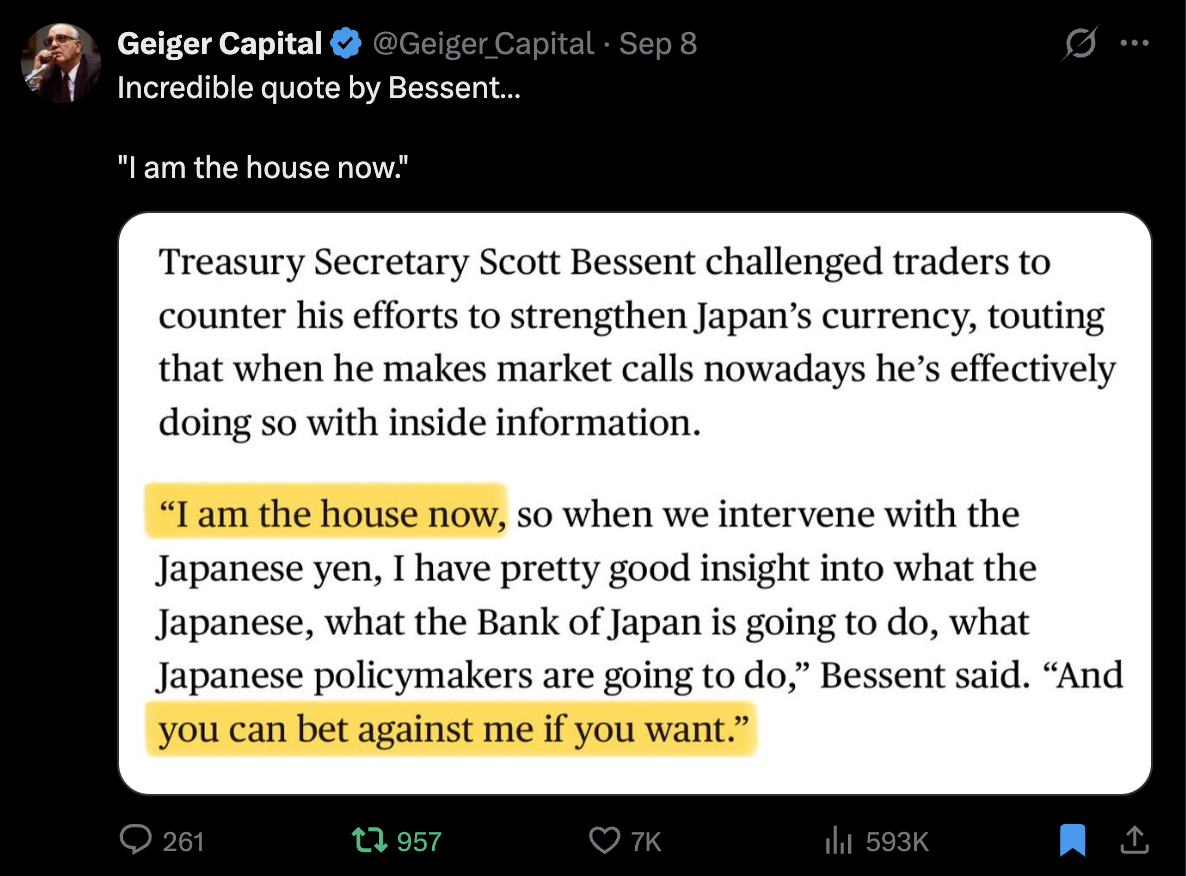
When the head of the U.S. Treasury boastfully tells you, “I’m the house now… you can bet against me if you want,” and the higher yields on the 10-year and 30-year Treasuries are signaling otherwise; our lights should turn on.
Grab your coffee, find your favorite chair. It’s heating up… Let’s go! You’ll also find some interesting charts and a warm note about a superhero of a human being, Chicago Bears #26 Matt Suhey, who passed this week.
On My Radar: Five Fires and #26
The Five Fires
Several Interesting Charts - Interest Rates, Oil and Commodities
Trade Signals: September 10, 2026
Personal Note: #26 Matt Suhey
OMR is for informational and educational purposes only. No consideration is given to your specific investment needs, objectives, or tolerances.
Please see the Important Disclosures at the bottom of this page. Reminder: This is not a recommendation to buy or sell any security. My views may change at any time. The information is for discussion and educational purposes only.
If you like what you are reading, you can subscribe for free.

The Five Fires
The Middle East
The Yemen conflict has quietly become a more dangerous flashpoint than Hormuz itself. What started as a U.S.-Iran standoff has spread into a Saudi-Houthi fight for the Bab-el-Mandeb strait and the Red Sea shipping lanes. The Houthis are, by all accounts, fighting with weapons systems well beyond what a non-state actor should have on its own. Whoever controls that chokepoint controls a meaningful slice of the world’s energy and container traffic. The through-line for us as investors is simple: escalation there shows up first as higher tanker and insurance costs, then as higher realized inflation.
Europe
Several NATO intelligence services are reportedly modeling a renewed Russian mobilization aimed at the Baltics: Narva, Daugavpils, the Suwałki Gap — echoing the same “protecting Russian speakers” justification Putin used in 2014 and 2022. Admittedly, this is a call that is hard to get right. What I take more seriously is the fiscal logic underlying it: the U.S. can no longer afford to backstop European defense the way it has since 1949. Intentional or not, this is what’s pushing European governments to finally raise their own defense spending. That’s a multi-year investment theme in its own right.
China-USA
Da Wei, about as influential a voice as China has in U.S. relations, published a piece in Foreign Affairs that, to me, reads like China declaring parity with Washington. Combine that with a reduced U.S. naval footprint in the Pacific while we’re stretched thin in the Gulf, and you get a China that feels emboldened to write new rules for maritime access in Asia. A rising power challenging the existing power. The open question is whether the U.S. and its allies push back or whether Washington instead seeks something concrete from Beijing (Treasury purchases, currency moves, diesel exports) in exchange for tacit acceptance of Taiwan, for example. Xi Jinping is scheduled to visit Washington, D.C., on September 24, 2026, for a summit with President Trump at the White House. This is one of the near-term geopolitical catalysts worth watching: particularly trade/tariffs, technology and AI, rare earths, Taiwan, and the broader effort to maintain stability in the relationship.
The Treasury & the Fed
This is where it gets most interesting for investors. Earlier this month, with the 10-year sitting at 4.5%, I said I wouldn’t be surprised to see 5.5% by the end of the month. This morning it’s trading at 4.95%, the highest since 2023. Treasury Secretary Bessent, with a touch of arrogance I found telling, told currency and bond traders this week, “I’m the house now… you can bet against me if you want,” defending a long-bond buyback plan the market already thought was undersized. Stan Druckenmiller called it a “price-management mistake,” flat out. When the man running Treasury has to talk that tough about the bond market, that’s not confidence — that’s the market sensing panic, and I suspect the Secretary knows it.
The Fed, meanwhile, under a new chairman with a hawkish bent, looks increasingly likely to raise rates next week to fight inflation that hasn’t gone away. We are seeing two arms of the same government pulling in opposite directions, and the bond market, not Bessent, is the one setting the price.
The Yen Carry Trade: Both Legs of the Squeeze
Long-time readers know the mechanics from the "Yen Carry Trade – Part II" OMR letter. I won’t go into detail again as I believe the link explains the situation well. What I want to highlight is that the yen has strengthened due to what appears to be another round of intervention this past week. Are the Japanese selling US Treasury bonds? Maybe.
Here’s why the unwinding of the yen carry trade matters: the carry trade lives on a wide interest rate differential and a weak, stable yen. Higher interest rates in Japan and a rising yen are poison to the trade. Rising rates and a rising yen are now working against it simultaneously, which may trigger the unwinding of the trade. That makes this a global problem when it unwinds.
When a trade this size and this leveraged has to unwind, it rarely stays contained to the currency itself; the obvious pressure valve is Japan selling U.S. Treasuries to fund its own currency defense, right as Japan is already our largest foreign creditor at roughly $1.1–1.2 trillion. That’s the thread that ties this section to the next one.
What I’m watching: the yen itself, the pace of JGB yield moves into the BOJ meeting, and any sign of forced deleveraging in credit or emerging-market spreads: the classic early tells from prior carry unwinds.
Treasury Yields Pressing Toward and Through 5%
As of this morning, the 10-year Treasury yield is at 4.95%, up 18 basis points on the week and the highest since 2023. The 30-year sits at 5.36%, having now closed above 5% for 28 straight sessions, the longest such stretch and highest level since 2007. Source: Investing.com
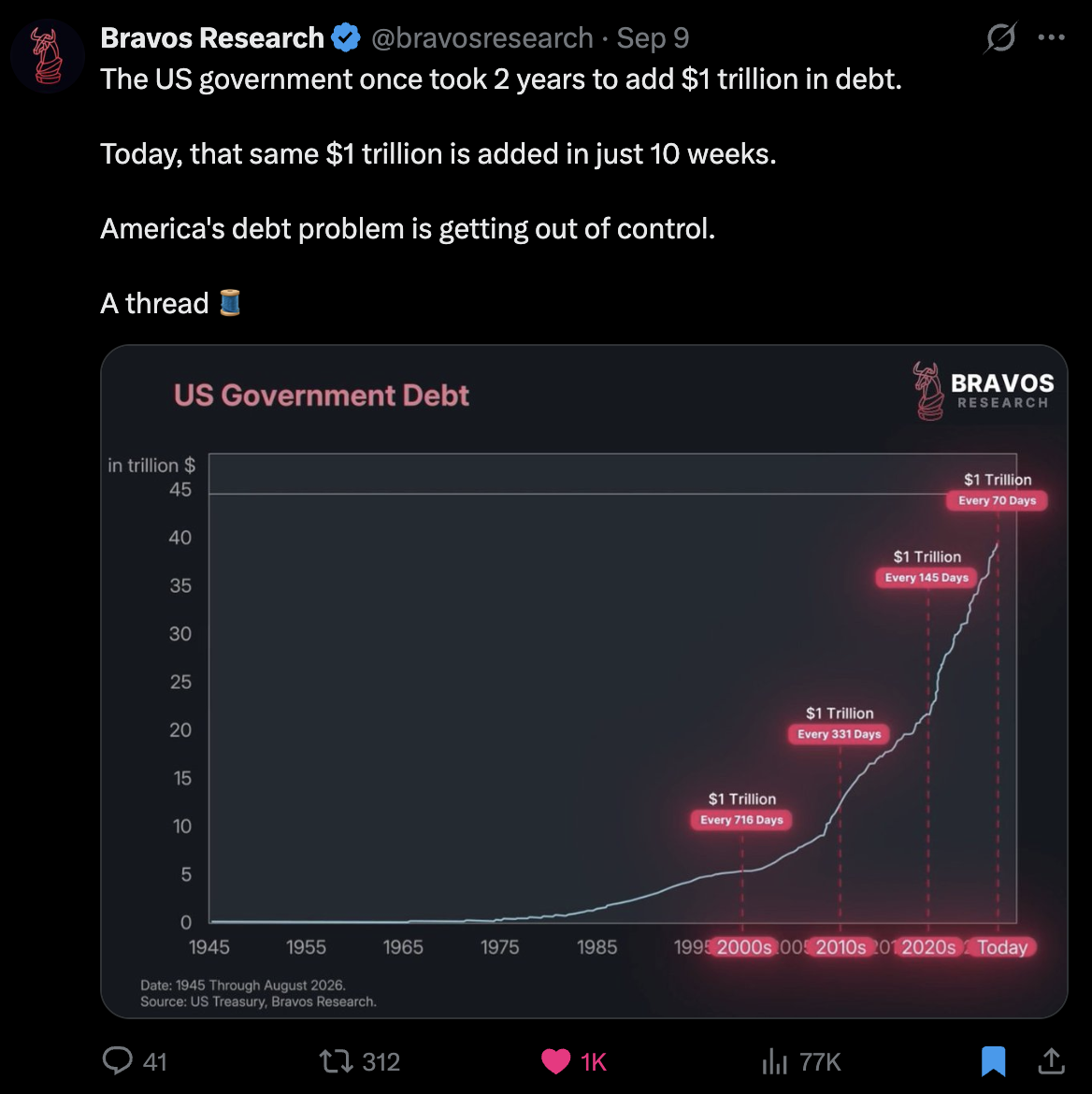
Part of this is a straightforward supply story: federal debt is north of $40 trillion, deficits are running past $2 trillion, and Secretary Bessent’s answer to a world “drowning in debt” is a long-bond buyback program he’s defending with more swagger than the sizing seems to justify. Markets are entitled to be skeptical of the math, and the long end is voting.
Layer on top of that a Fed meeting next Wednesday, September 16, that has turned into a coin flip that keeps flipping toward “yes.” As of September 8, futures markets were pricing a 60.6% probability of a hike, up from 44.4% just a month earlier. Chairman Warsh’s Jackson Hole remarks are the likely cause: he said, in effect, that fighting prices is the Fed’s job right now, and that inflation needs to get back to 2% “at sufficient speed.” The first time he’s put a clock on it. A solid August jobs report (162,000 added, unemployment steady at 4.1%) took away the labor-market excuse to wait, whether the number was BS from the BLS or not. Source: Motley Fool
What makes this unusual is that we’re used to talking about Fed rate cut odds; here the debate is over a hike, into a bond market already under pressure, from a Fed openly at odds with its own Treasury Department and White House on both the level of rates and the direction of the dollar. The President has said plainly that “U.S. rates are too high right now.”
Fed Chairman Kevin Warsh sets center stage next week. You’ll see in the Several Interesting Charts section, odds favor three rate increases by year-end. Put that in your yen carry trade calculus.
I’m not sure I’ve seen a more dangerous market risk environment in my 42 years in the business. All signs point to some form of global debt monetization. I believe there are restructuring plans already in place. Something Scott Bessent has called a "Grand global economic reordering." It will take a crisis to reset the monetary system.
Bessent first used it in his November 2024 interview right after being named as Trump's Treasury Secretary pick, telling reporters: "We are going to have to have some kind of a grand global economic reordering." Source: RealClear Politics
The reasoning underneath it, which he's laid out in various interviews, is that the post-WWII dollar-centered order is ending on its own regardless of what the U.S. does: China's rise, creeping de-dollarization, COVID exposing how fragile global supply chains were, and now the inflation left over from pandemic-era stimulus.
His bet is that the next decade reshuffles who creates and captures wealth, shifting more of it toward China, India, Brazil, and the rest of the emerging world, while the U.S. tries to hold on to the dollar's reserve-currency status through growth (AI, biotech, energy) rather than austerity.
The point here is that all five fires are expanding at the same time. This week's “I’m the house…” actions read to me like Bessent executing on the reordering he told everyone was coming over a year ago.
When I say system-wide risk has never been higher, it is due to the massive amount of government debt in the system that is accelerating at an irresponsible pace, the record leverage in investor margin debt, the leveraged bets in the yen carry trade, and similar stresses in most developing countries.
This is not bearish for everything, but it is bearish for fixed-income assets, developed-market currencies and the dollar, and bullish for hard assets, select equities (high free-cash-flow businesses), gold, commodities, and agriculture. And bitcoin too.
An inflation and a stagflation period likely remain ahead.
There are ways you can defend your wealth. Find an options expert to help you inexpensively hedge your equity exposure. Risk 10% or 20%, not 50% to 70%. Option hedging is complicated and requires ongoing attention, but it is doable.
Here are some areas to discuss with your advisor:
The asset classes that have generally held up best are:
Gold and precious metals — Gold tends to benefit from negative real rates, currency concerns, fiscal stress, and declining confidence in financial assets. It was a standout during the 1970s stagflation.
Commodities — energy, industrial metals, and agriculture can provide direct exposure to rising prices. (The catch is that a severe recession can eventually hurt commodity demand.)
Energy and energy infrastructure — Oil and gas producers can benefit from higher commodity prices and often generate significant free cash flow. They can be particularly attractive when energy itself is contributing to inflation.
TIPS — Principal adjusts with CPI, providing direct inflation protection. But real after-inflation yields still matter, so TIPS aren't immune to losses.
Short-duration Treasuries/cash — Not necessarily a big real-return winner, but much better positioned than long-duration bonds when inflation and long-term rates are rising. High short-term yields can make cash surprisingly competitive and provide future optionality to be deployed at lower prices/better valuations. Keep in mind, the goal is to beat inflation.
Infrastructure and certain real assets — Businesses with inflation-linked revenues or the ability to raise prices may hold up reasonably well.
Value and dividend-paying equities — Particularly companies with strong balance sheets, high free current cash flow, pricing power, and modest valuations. Historically, these characteristics tend to outperform expensive, long-duration growth stocks when inflation and rates remain high.
Exponential growth ideas — like robotics, quantum computing, defense and aerospace, bio-pharma, gene editing, and longevity health.
The areas I'd be most cautious about are long-duration nominal bonds and highly valued growth stocks. Both depend heavily on cash flows far into the future, making them particularly sensitive to rising inflation expectations and long-term interest rates.
If the global grand reordering is about monetizing debt and restructuring the dollar system, creating a probable inflationary outcome, then the idea is to avoid the asset classes most likely to lose and position in the assets most likely to gain.
Please know that this is not a recommendation to buy or sell any security. Speak with your advisor or reach out to one of ours.
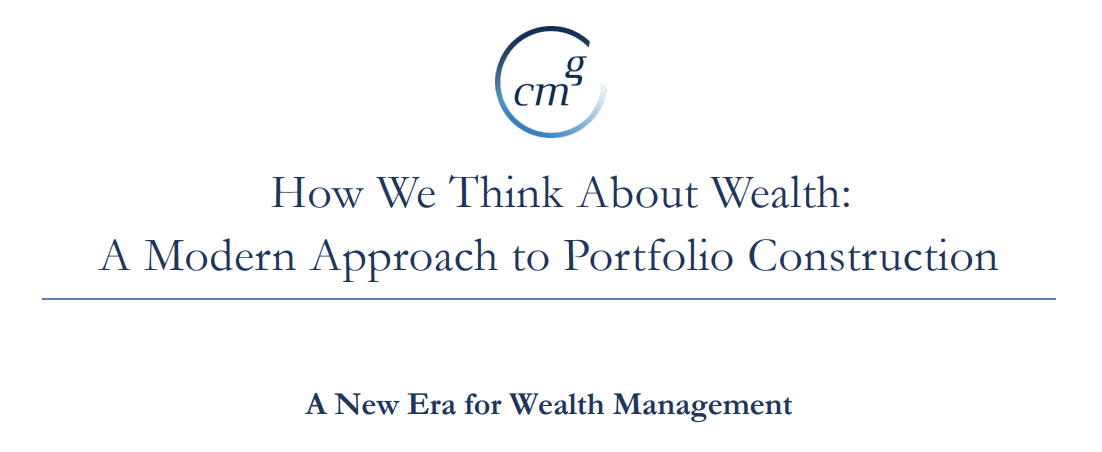
We wrote a white paper titled How We Think About Wealth. If you’d like a copy of the paper, you can access it here or click on the photo.
Opinions are subject to change. Not a recommendation to buy or sell any security. Provided for discussion and educational purposes only.
Several Interesting Charts - Interest Rates, Oil and Commodities
A quick, random walk through several things that stood out to me this week.
Let’s start with Scott Bessent’s comment this week, “I am the house now…” And the reason behind today’s intro quote, “Once markets believe Treasury is defending a price, every rise in yields becomes a test of official resolve, and the operations must grow to survive the tests.”
With the 10-year yield challenging 5%, you can put a check mark next to “test of resolve.” We are going to soon see what “you can bet against me…” means.
From Steph Pomboy (@spomboy), “Bessent is trying to persuade the market that he can do yield curve control on his own. But nobody is fooled. He needs a printing press....or alternatively to create a pile of money by revaluing gold.”
Spot on!!!
Source: X, @Geiger_Capital
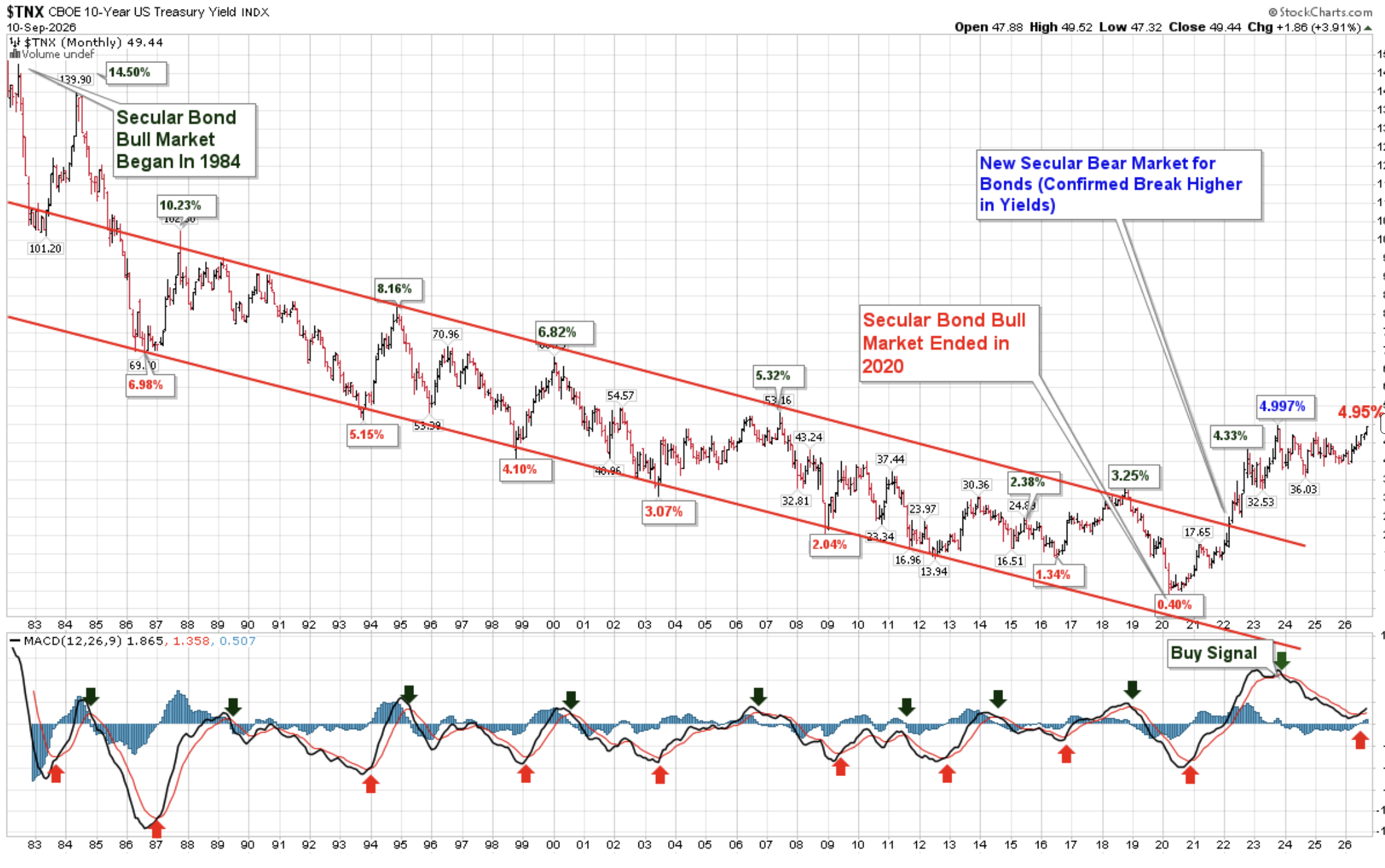
The 10-year Yield is nearing a move above 5%. The yield is 4.95% as of this post. A break above 5% would be significant. A sign that the bond vigilantes are calling Treasury Secretary Scott Bessent’s “don’t mess with the house” bluff.
Source: StockCharts.com, CMG annotations
Source: X, @bravosresearch
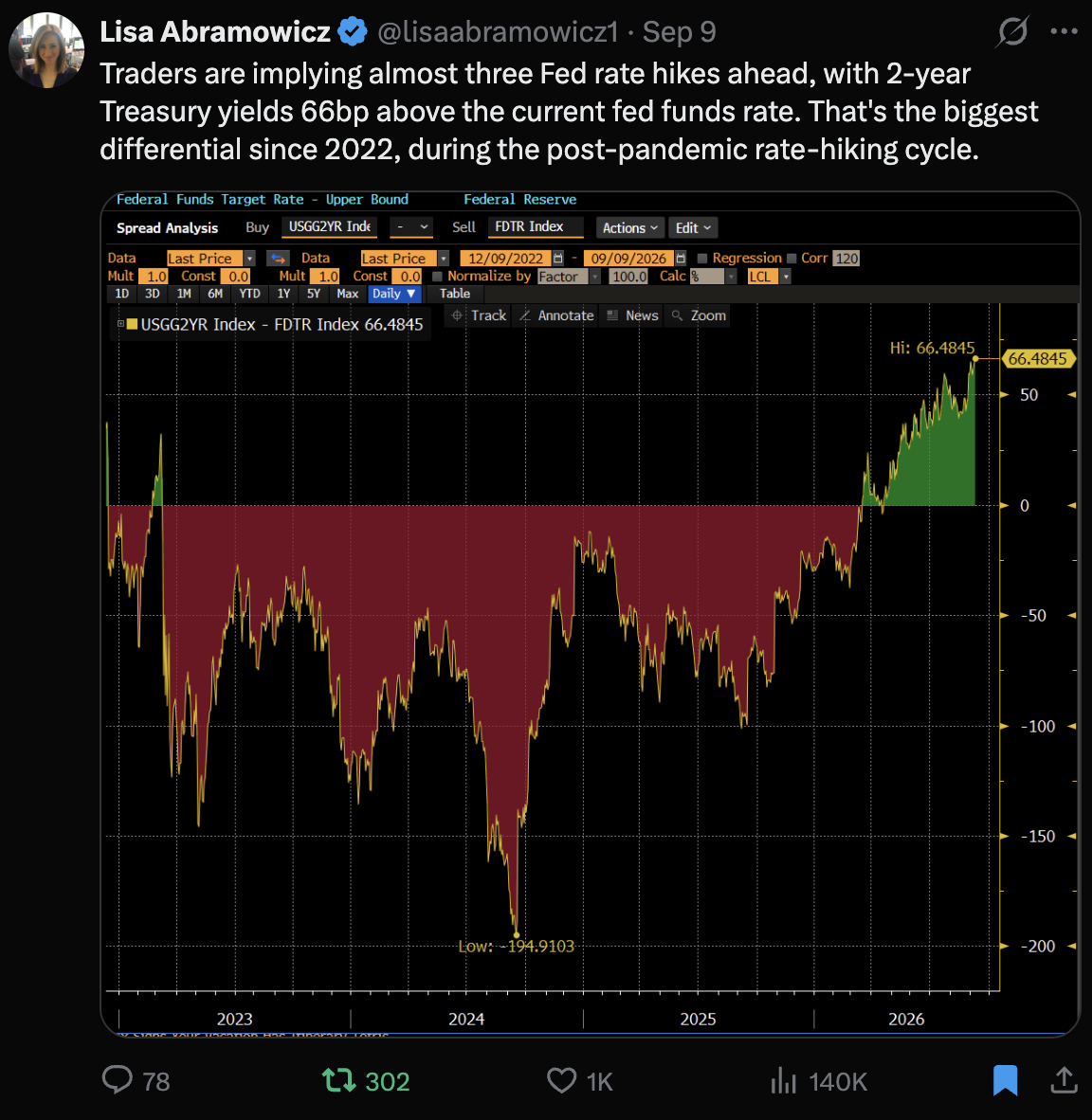
Source: X, Bloomberg’s @lisaabramowicz1
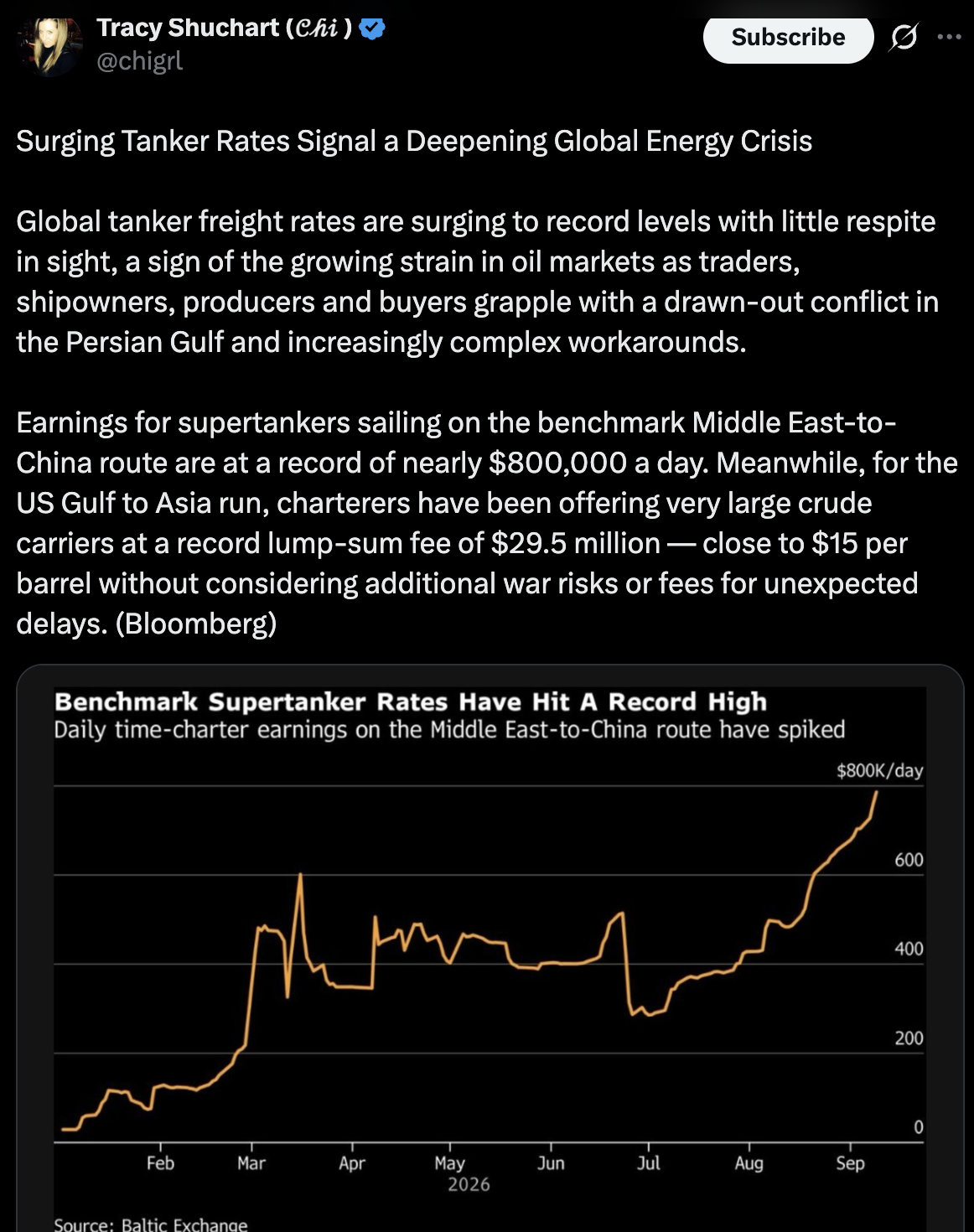
Source: X, @chigrl
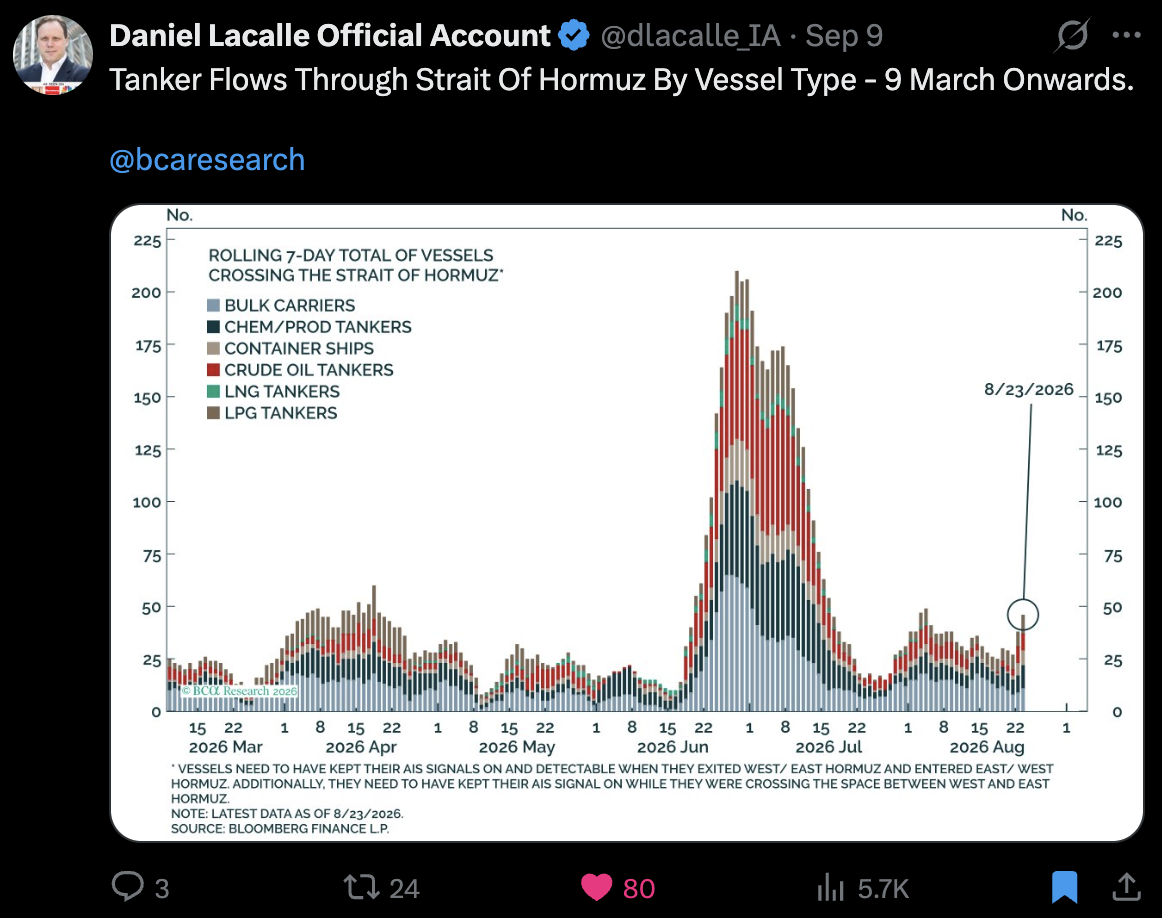
Source: X, @dlacalle_IA, @bcaresearch
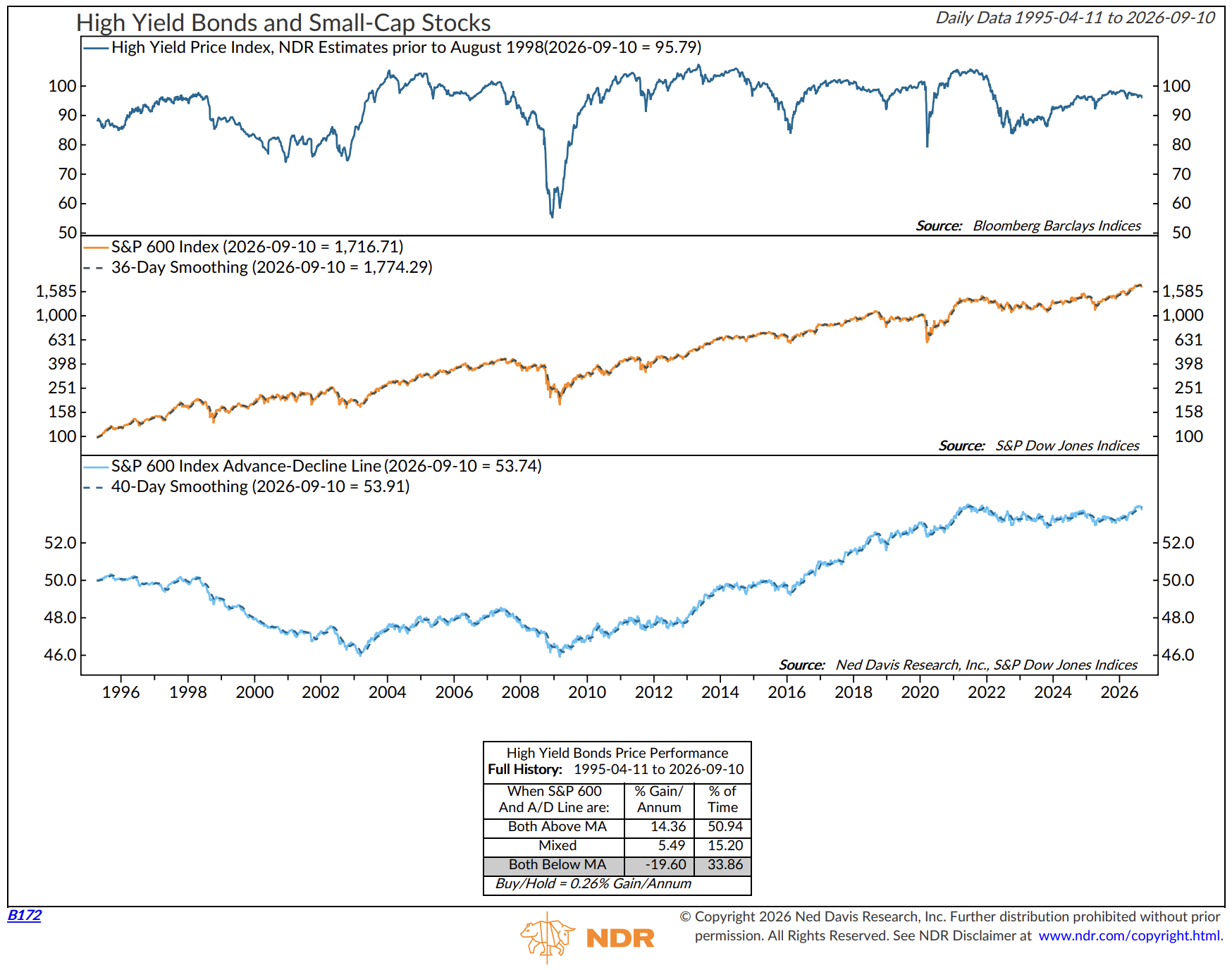
High Yield is breaking down - I always call the movement in the HY market “the canary in the coal mine.” It tends to lead stock market trends, and the stock market tends to lead economic trends.
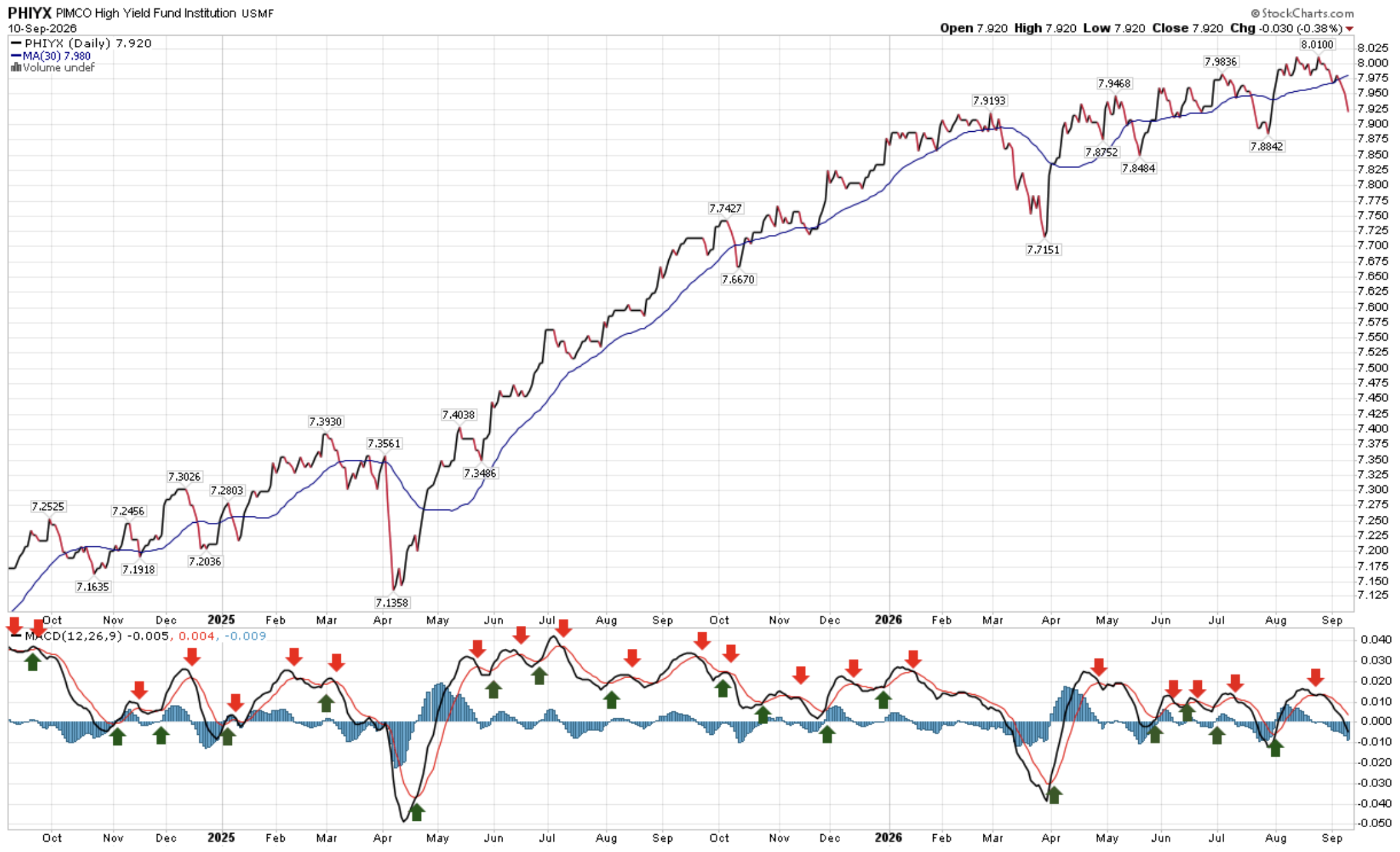
Source: StockCharts.com, CMG annotations
Another favorite economic indicator of mine looks at trends in the Small-Cap S&P 600 index and in the stocks advancing vs. declining within the index. All of this in relation to the historical performance of the high-yield bond market when both trend signals are below their moving averages.
Bottom line: This points to growing concern about the state of the economy.
Source: NDR
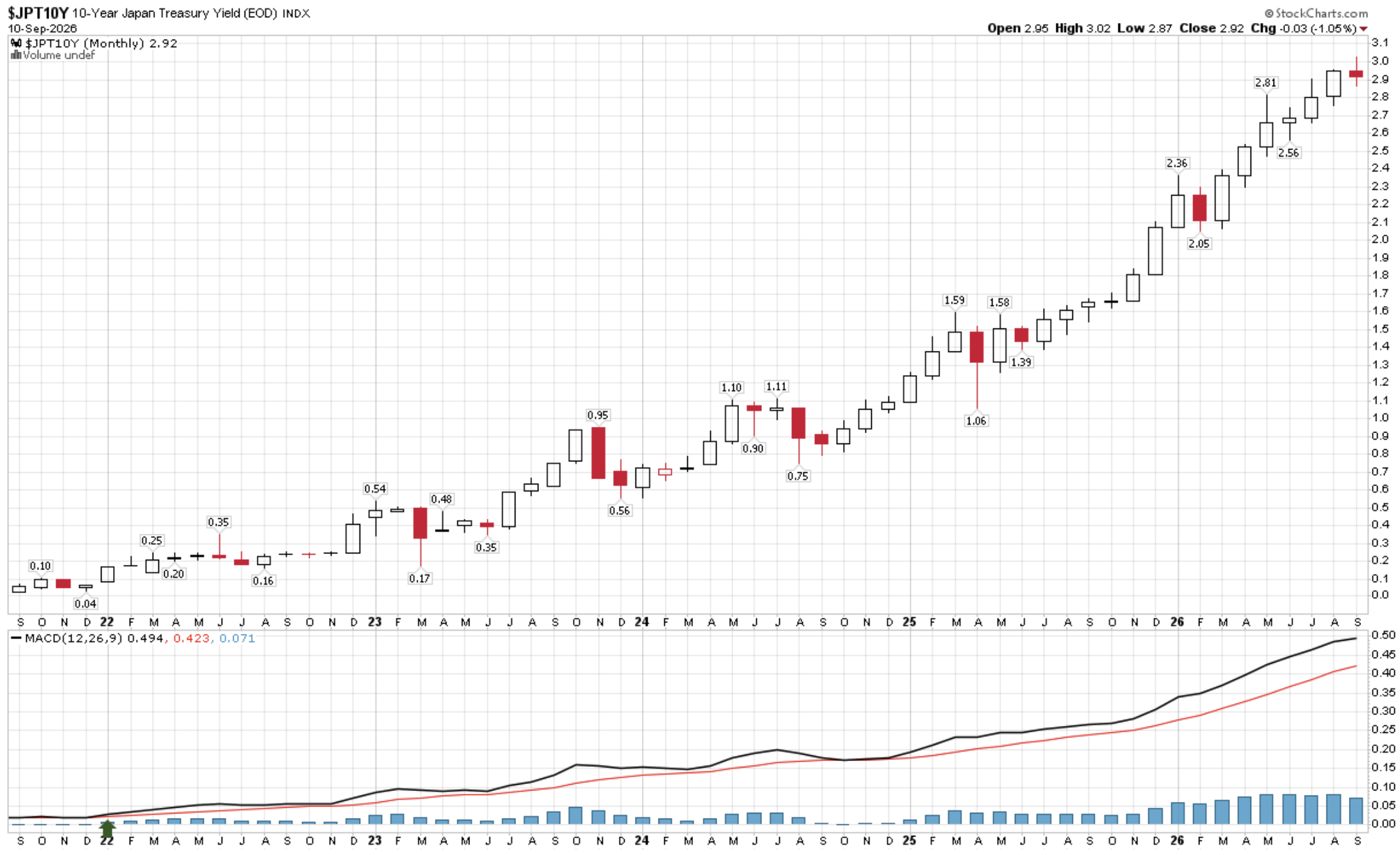
Updated - 10-year Japanese Treasury Yield at the 3% level.
Remember when an investor could borrow at less than 1% and use the proceeds to buy other, higher-yielding investments. That’s the yen-carry trade, and the risk of it unwinding increases as the cost of borrowing goes up.
Source: StockCharts.com
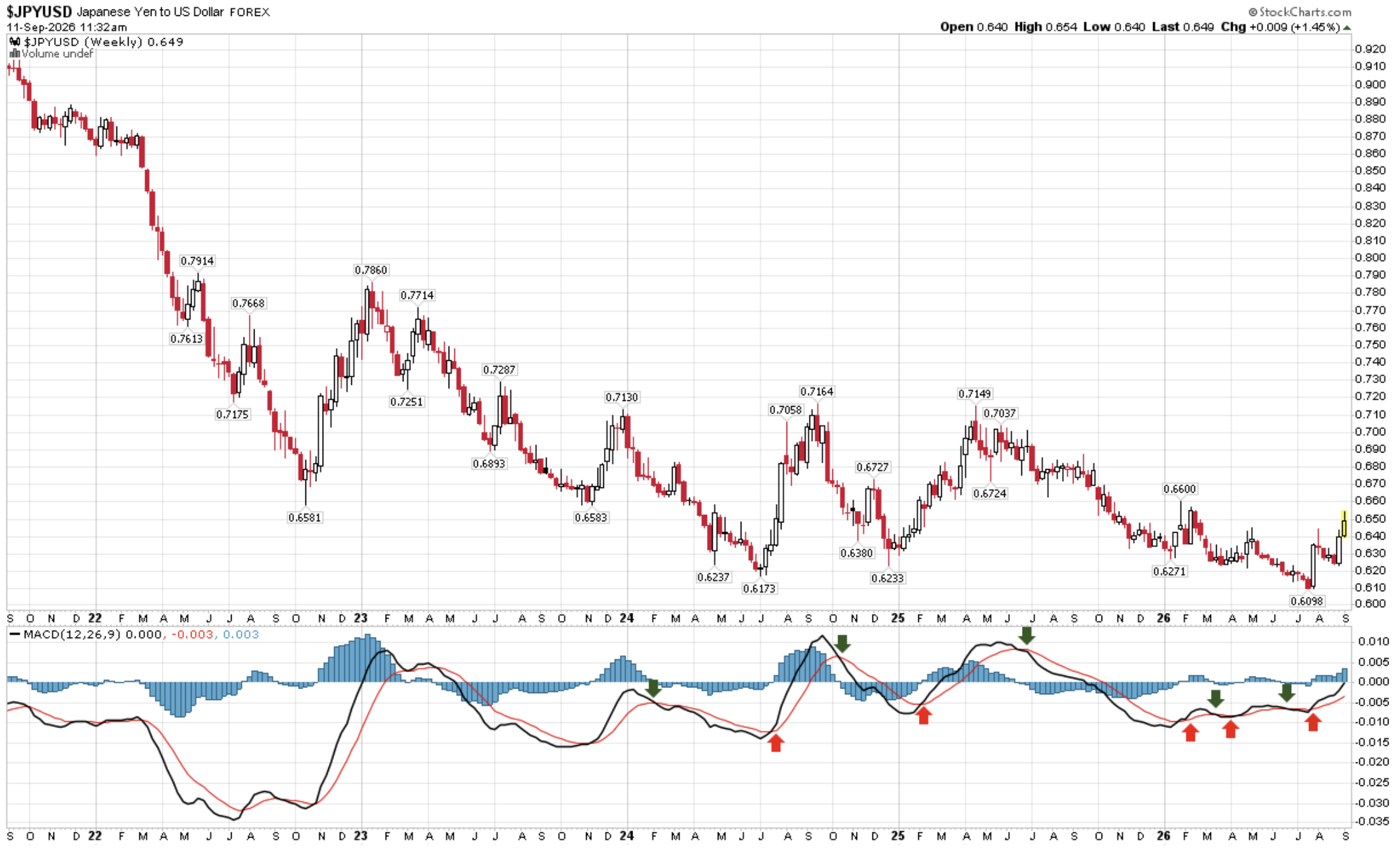
The Japanese Yen to US Dollar: The yen continued to press higher this week. Bottom right-hand side of the chart. This is bearish for global liquidity.
Source: StockCharts.com
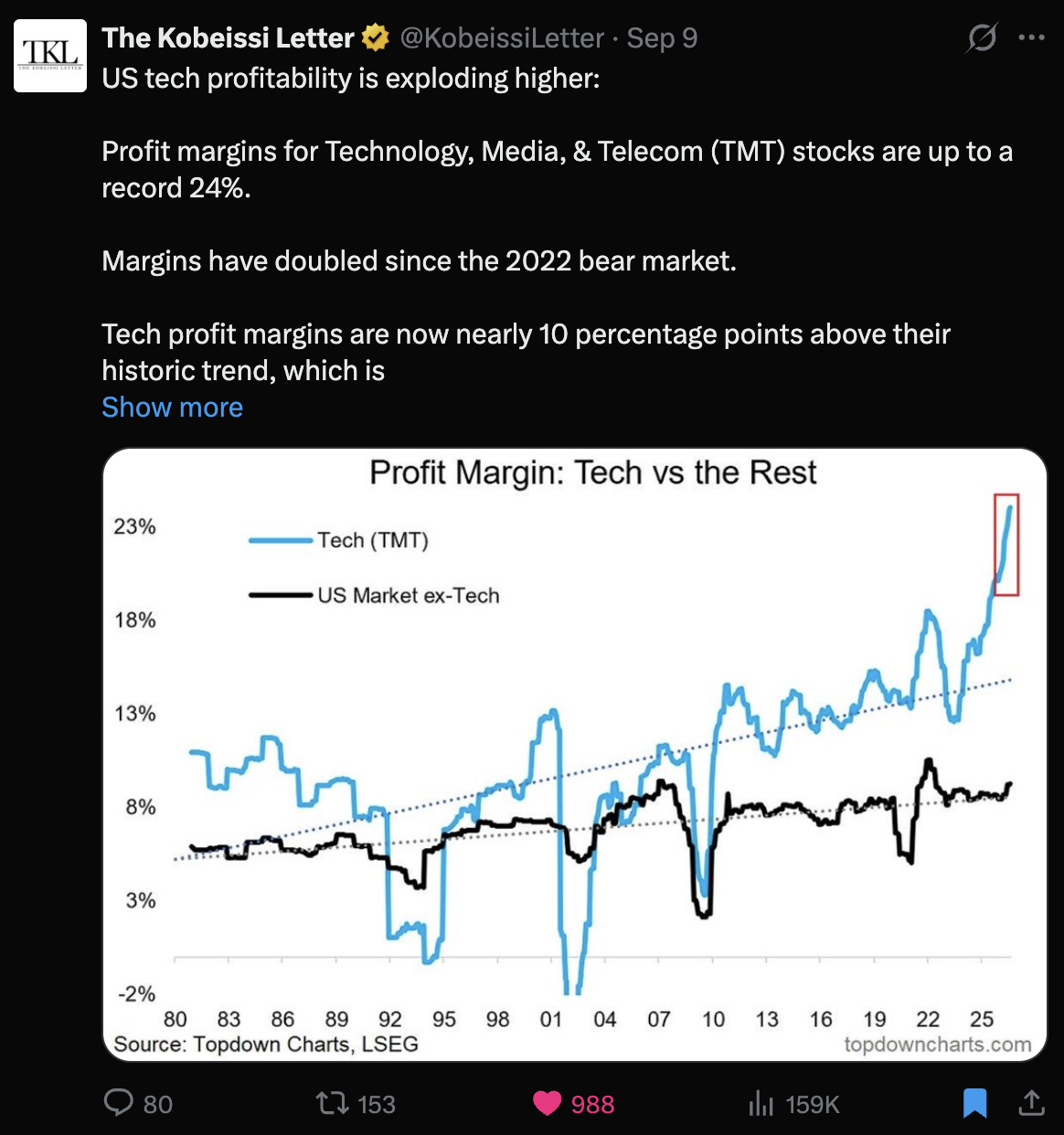
This is quite remarkable… Just keep in mind that profit margins do mean-revert over time, as noted in the blue line. And a portion of the gain is due to tech companies’ ownership in private companies that have been marked up significantly. Remarkable non the less.
Source: X, Topdown Charts, LSEG, @KobeissiLetter
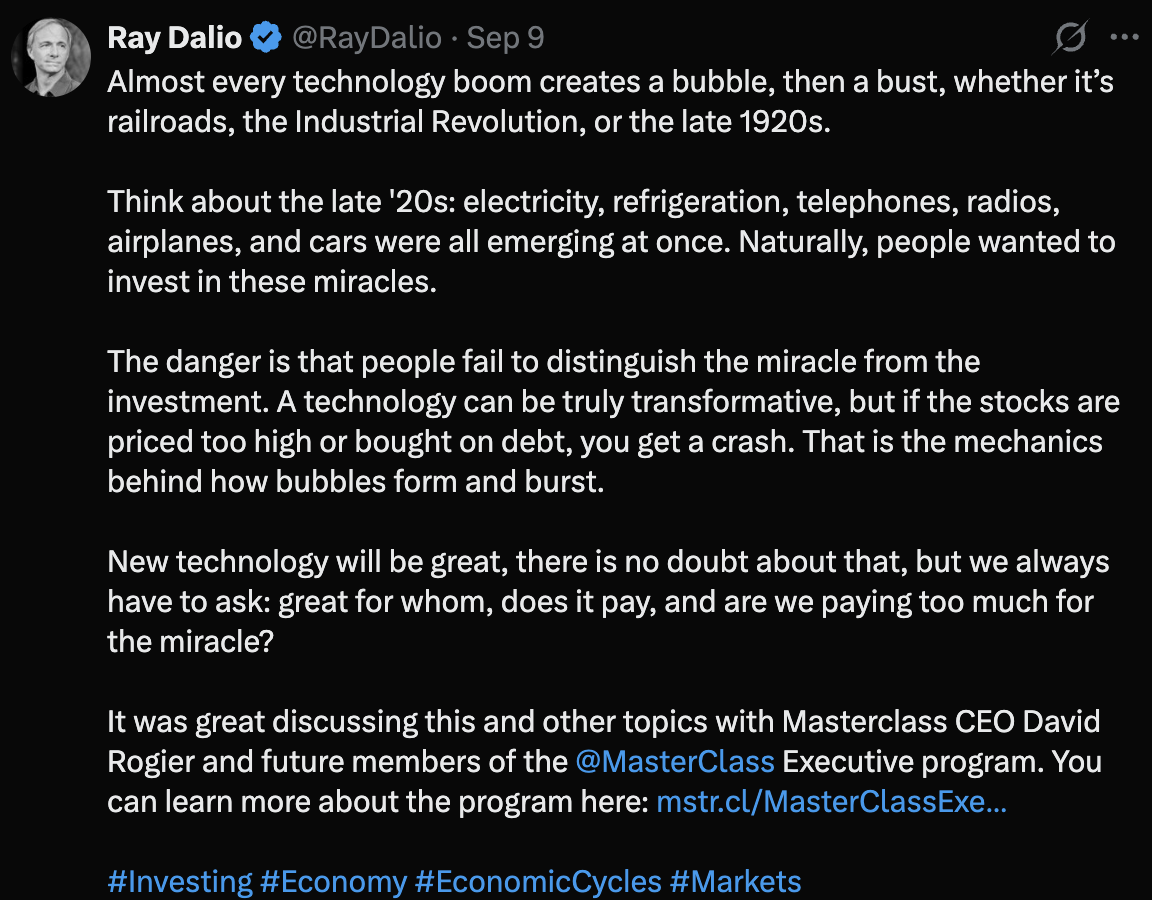
Source: X, @RayDalio
Got commodities?
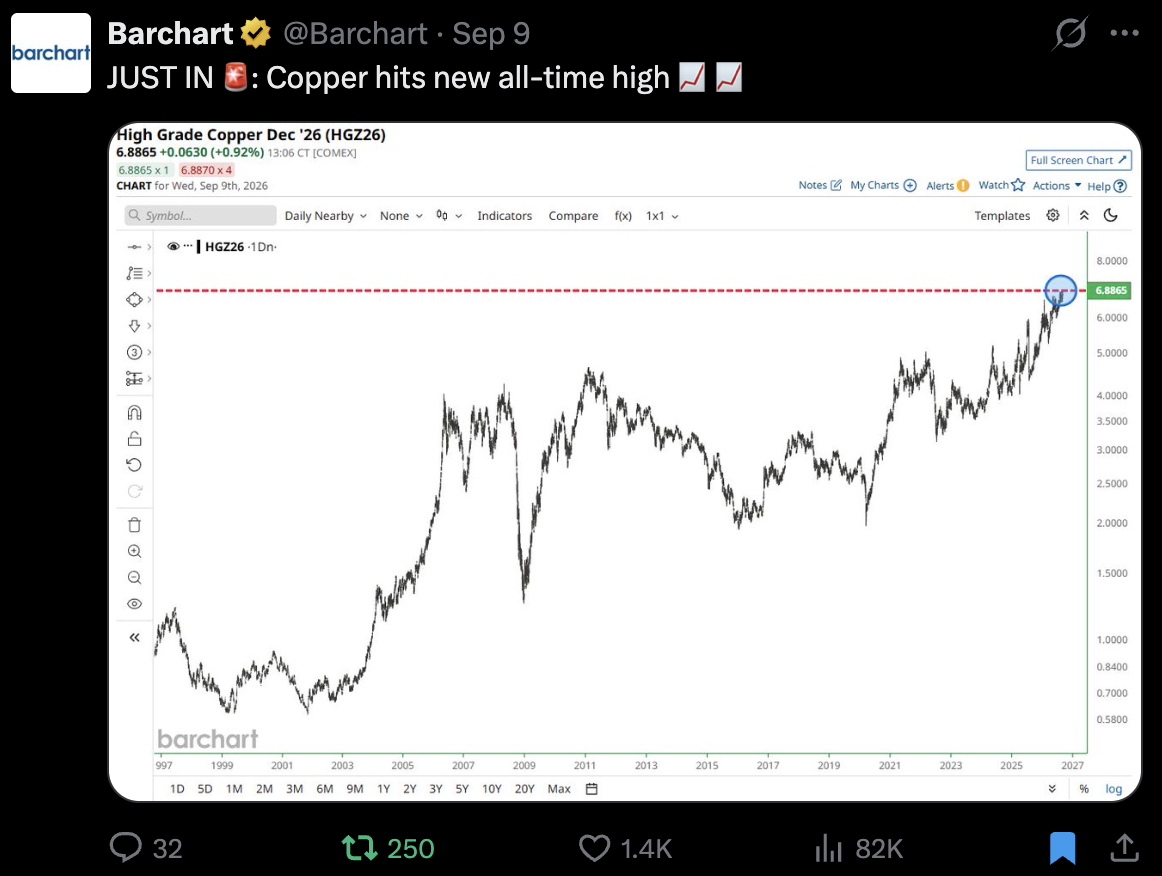
Source: X, @barchart
Opinions are subject to change. Not a recommendation to buy or sell any security. Provided for discussion and educational purposes only.
If you like what you are reading, click on the link and share it with a friend (it’s free).
CLICK HERE TO SUBSCRIBE TO ON MY RADAR
Trade Signals: September 10, 2026 Update
I’m in Chicago attending Matt Suhey’s funeral today, Friday, September 11. Trade Signals will post tomorrow, Saturday morning.
Trade Signals
The Indicators Dashboard - Stocks, Investor Sentiment, Bonds, Commodities, Currencies, and Gold
Valuations and Subsequent 10-year Returns
Supporting Charts with Explanations

TRADE SIGNALS SUBSCRIPTION ACKNOWLEDGEMENT / IMPORTANT DISCLOSURES
About Trade Signals - Trade Signals is a paid subscription service that posts daily, weekly, and monthly market trends (and more). Free for CMG clients. Not a recommendation to buy or sell any security. For discussion purposes only.
The views expressed herein are solely those of Steve Blumenthal as of the date of this report and are subject to change without notice. Please note that the information provided is not recommended for buying or selling any security and is provided for discussion purposes only.
Personal Note: #26 Matt Suhey
Matt Suhey passed peacefully in his sleep last Sunday. It was unexpected. Hero. He was one of my heroes. He was everyone’s hero. Not because of his Super Bowl ring, but because of who he was as a human being. Today, let me tell you a short story about a giant of a man who quietly lifted so many.
His seven grandchildren called him “Higgies.” A perfect nod to Matt’s mother's maiden name, Higgins, and it carried a lot more than a nickname usually does. It carried four generations of Penn State football, a Super Bowl ring, and one of the finest men I've known and fortunate to call family.
Let me back up, because the "Higgins" in Higgies is really where this story starts.
Bob Higgins played for Penn State, coached Penn State from 1930 to 1948, and is in the College Football Hall of Fame. His daughter, Ginger, married one of his own players, a guard named Steve Suhey. Steve captained Higgins's 1947 team to an undefeated season. A season that included a Cotton Bowl appearance that almost wasn’t. The opponent, SMU, asked Penn State to leave their two black players home. Steve's answer became part of Penn State lore: "We Are Penn State. There will be no meetings,” he said. We all play, or none of us play. A firm insistence on doing the right thing. If you are a college football fan, get to a Penn State game and listen as the cheerleaders lead half of the 110,000 people in the stadium to shout, "We Are” and the other half to shout “Penn State.”
Steve and Ginger raised seven children in State College. Ginger outlived her husband by nearly four decades, ran his business after he passed, and ran a tight ship at home with the warmth and kindness of an angel.
Three of her sons played football for Penn State. The youngest was Matt.
Matt carried his mother's traits the way his own grandchildren would later carry his nickname — without much ceremony, just by living them. Kindness. Integrity. A refusal to make things about himself. He rushed for nearly 2,800 yards at Penn State before the Chicago Bears drafted him in 1980, and for ten seasons he lined up in the same backfield as Walter Payton — arguably the greatest running back who ever played the game. In 1985, they became the best team in football. Some argue the best team in NFL history.
Matt's job on most Sundays was to take the hit so Walter didn't have to. Jarrett Payton put it best years later: "Matt watched my dad's back, kind of like being a bodyguard or protector. He blocked for him. He took a lot of hits, making sure that my dad would get the glory, and Matt kind of just sat back in the background, very unselfish." That was Matt's whole career in one sentence, and honestly, it was Matt's whole life in one sentence too.
The friendship went well beyond the field. Walter asked Matt to be godfather to his son, and Matt returned the favor, asking Walter to be godfather to his own youngest, Scotty. When Walter was dying of liver cancer in 1999, it was Matt who stayed at his side and stood between him and the cameras. Two guys from the same Bears backfield, watching out for each other to the very end.
Matt got his ring in Super Bowl XX, scoring the first touchdown of that 46–10 win over New England. He's ranked among the 100 greatest Bears ever to play. But teammates who called this week didn't want to talk about the stats. Mike Singletary said it plainly: "He was such a class guy... he really had the emotional intelligence to know how to deal with every kind of person." Then he added the line that's stayed with me: "I'm really, really going to miss that light."
That's the Matt his friends and family experienced every day. After football, he built a real business career on the same terms he played the game — grit, hard work, no shortcuts, and a handshake you could trust. And nothing came before his family: Donna, his wife of 38 years; his kids Joey, Allison, and Scotty; and those seven grandchildren who'll grow up and someday know "Higgies" as more than a name. To my children, Brianna, Matthew, and Kyle, he was simply Uncle Matt. The greatest championship he ever won wasn’t on the playing field; it was in the beautiful family who will forever love him.
I bet there was some pushing and shoving to be the first to greet Matt when he crossed to the other side. I can see his mother Ginger, wearing Matt’s #26 Bears jersey, stiff-arming Walter Payton out of the way. And Walter smiling and patiently waiting with a prank or two up his sleeve. That would be about right. Two friends, reunited, and still looking out for each other.
The world is a better place because this hero of a man was in it. Welcome home, Matt, welcome home.

Source: Chicago Bears, Click on the photo for the Bears tribute to Matt
By the time this email hits your inbox, I’ll be on a flight home from Chicago. The funeral was earlier today. His three children spoke beautifully about their father. It was sad, and it was a wonderful tribute to #26.
Ever forward!
Gratefully,
Steve
CLICK HERE TO SUBSCRIBE TO ON MY RADAR - IT’S FREE
You can share this letter on X by clicking here.
You can share this letter on LinkedIn by clicking here.
Subscribe to OMR for free by clicking the photo.
Stephen B. Blumenthal
Executive Chairman & CIO
CMG Capital Management Group, Inc.
75 Valley Stream Parkway, Suite 201,
Malvern, PA 19355
CMG Customer Relationship Summary (Form CRS)
Metric-Financial, LLC Customer Relationship Summary (Form CRS)

Stephen Blumenthal founded CMG Capital Management Group in 1992 and serves today as its Executive Chairman and CIO. Steve authors a free weekly e-letter entitled, “On My Radar.” Steve shares his views on macroeconomic research, valuations, portfolio construction, asset allocation and risk management. Author of Forbes Book: On My Radar, Navigating Stock Market Cycles.
Follow Steve on X @SBlumenthalCMG and LinkedIn.
IMPORTANT DISCLOSURE INFORMATION
This document is prepared by CMG Capital Management Group, Inc. (“CMG”) and is circulated for informational and educational purposes only. There is no consideration given to the specific investment needs, objectives, or tolerances of any of the recipients. Additionally, CMG’s actual investment positions may, and often will, vary from its conclusions discussed herein based on any number of factors, such as client investment restrictions, portfolio rebalancing, and transaction costs, among others. Recipients should consult their own advisors, including tax advisors, before making any investment decision. This material is for informational and educational purposes only and is not an offer to sell or the solicitation of an offer to buy the securities or other instruments mentioned. This material does not constitute a personal recommendation or take into account the particular investment objectives, financial situations, or needs of individual investors which are necessary considerations before making any investment decision. Investors should consider whether any advice or recommendation in this research is suitable for their particular circumstances and, where appropriate, seek professional advice, including legal, tax, accounting, investment, or other advice. The views expressed herein are solely those of Steve Blumenthal as of the date of this report and are subject to change without notice.
Investing involves risk.
This letter may contain forward-looking statements relating to the objectives, opportunities, and future performance of the various investment markets, indices, and investments. Forward-looking statements may be identified by the use of such words as; “believe,” anticipate,” “planned,” “potential,” and other similar terms. Examples of forward-looking statements include, but are not limited to, estimates with respect to financial condition, results of operations, and success or lack of success of any particular market, index, investment, or investment strategy. All are subject to various factors, including, but not limited to, general and local economic conditions, changing levels of competition within certain industries and markets, changes in legislation or regulation, Federal Reserve policy, and other economic, competitive, governmental, regulatory, and technological factors affecting markets, indices, investments, investment strategy and portfolio positioning that could cause actual results to differ materially from projected results. Such statements are forward-looking in nature and involve a number of known and unknown risks, uncertainties, and other factors, and accordingly, actual results may differ materially from those reflected or contemplated in such forward-looking statements. Investors are cautioned not to place undue reliance on any forward-looking statements or examples. All statements made herein speak only as of the date that they were made. Investing is inherently risky and all investing involves the potential risk of loss.
Past performance does not guarantee or indicate future results. Different types of investments involve varying degrees of risk, and there can be no assurance that the future performance of any specific investment, investment strategy, or product (including the investments and/or investment strategies recommended or undertaken by CMG), or any non-investment related content, made reference to directly or indirectly in this commentary will be profitable, equal any corresponding indicated historical performance level(s), be suitable for your portfolio or individual situation or prove successful. Due to various factors, including changing market conditions and/or applicable laws, the content may no longer be reflective of current opinions or positions. Moreover, you should not assume that any discussion or information contained in this commentary serves as the receipt of, or as a substitute for, personalized investment advice from CMG. Please remember to contact CMG, in writing, if there are any changes in your personal/financial situation or investment objectives for the purpose of reviewing/evaluating/revising our previous recommendations and/or services, or if you would like to impose, add, or to modify any reasonable restrictions to our investment advisory services. Unless, and until, you notify us, in writing, to the contrary, we shall continue to provide services as we do currently. CMG is neither a law firm, nor a certified public accounting firm, and no portion of the commentary content should be construed as legal or accounting advice.
No portion of the content should be construed as an offer or solicitation for the purchase or sale of any security. References to specific securities, investment programs or funds are for illustrative purposes only and are not intended to be, and should not be interpreted as recommendations to purchase or sell such securities.
This presentation does not discuss, directly or indirectly, the amount of the profits or losses realized or unrealized, by any CMG client from any specific funds or securities. Please note: In the event that CMG references performance results for an actual CMG portfolio, the results are reported net of advisory fees and inclusive of dividends. The performance referenced is that as determined and/or provided directly by the referenced funds and/or publishers, has not been independently verified, and does not reflect the performance of any specific CMG client. CMG clients may have experienced materially different performance based upon various factors during the corresponding time periods. See in links provided citing limitations of hypothetical back-tested information. Past performance cannot predict or guarantee future performance. Not a recommendation to buy or sell. Please talk to your advisor.
Information herein has been obtained from sources believed to be reliable, but we do not warrant its accuracy. This document is general communication and is provided for informational and/or educational purposes only. None of the content should be viewed as a suggestion that you take or refrain from taking any action nor as a recommendation for any specific investment product, strategy, or other such purposes.
In a rising interest rate environment, the value of fixed-income securities generally declines, and conversely, in a falling interest rate environment, the value of fixed-income securities generally increases. High-yield securities may be subject to heightened market, interest rate, or credit risk and should not be purchased solely because of the stated yield. Ratings are measured on a scale that ranges from AAA or Aaa (highest) to D or C (lowest). Investment-grade investments are those rated from highest down to BBB- or Baa3.
NOT FDIC INSURED. MAY LOSE VALUE. NO BANK GUARANTEE.
Certain information contained herein has been obtained from third-party sources believed to be reliable, but we cannot guarantee its accuracy or completeness.
In the event that there has been a change in an individual’s investment objective or financial situation, he/she is encouraged to consult with his/her investment professional.
Written Disclosure Statement. CMG is an SEC-registered investment adviser located in Malvern, Pennsylvania. Stephen B. Blumenthal is CMG’s founder and CEO. Please note: The above views are those of CMG and its CEO, Stephen Blumenthal, and do not reflect those of any sub-advisor that CMG may engage to manage any CMG strategy, or exclusively determines any internal strategy employed by CMG. A copy of CMG’s current written disclosure statement discussing advisory services and fees is available upon request or via CMG’s internet web site at www.cmgwealth.com/disclosures. CMG is committed to protecting your personal information. Click here to review CMG’s privacy policies.
See CMG Disclosures at the bottom of this page.
For more information about NDR, please visit at www.ndr.com.
NDR, Inc. (NDR), d.b.a. Ned Davis Research Group (NDRG), any NDRG affiliates or employees, or any third-party data provider, shall not have any liability for any loss sustained by anyone who has relied on the information contained in any NDRG publication. The data and analysis contained herein are provided "as is." NDRG disclaims any and all express or implied warranties, including, but not limited to, any warranties of merchantability, suitability or fitness for a particular purpose or use. NDRG's past recommendations and model results are not a guarantee of future results. This communication reflects our analysts' opinions as of the date of this communication and will not necessarily be updated as views or information change. All opinions expressed herein are subject to change without notice. NDRG or its affiliated companies or their respective shareholders, directors, officers and/or employees, may have long or short positions in the securities discussed herein and may purchase or sell such securities without notice. For NDRG's important additional disclaimers, refer to www.ndr.com/invest/public/copyright.html. Further distribution prohibited without prior permission. Copyright 2025 © NDR, Inc. All rights reserved.