On My Radar: A Game of Reward vs. Risk

October 9, 2026
By Steve Blumenthal
“The first rule of compounding is to never interrupt it unnecessarily.”
— Charlie Munger
Picture a church carnival on a crisp October Saturday. Next to the pie table, there's a folding table with a big glass fishbowl stuffed with raffle tickets. A hand-lettered sign says $10 a ticket. Grand prize: a weekend at the Shore.
You can't know which ticket gets pulled. Nobody can. But you can ask a few smart questions. How many tickets are in the bowl? What's the prize worth? What does a ticket cost? And if you lose, can you live with it?
That, in a nutshell, is investing.
Howard Marks put it better than anyone in his memo Risk Revisited Again:
"Investment performance (like life in general) is a lot like choosing a lottery winner by pulling one ticket from a bowlful… Superior investors have a better sense for what's in the bowl, and thus for whether it's worth buying a ticket in a lottery. But even they don't know for sure which one will be chosen."
Marks calls this "key point number one": the future "should be viewed not as a fixed outcome that's destined to happen and capable of being predicted, but as a range of possibilities." He borrows a line from London Business School professor Elroy Dimson that I've never forgotten: "Risk means more things can happen than will happen."
I first heard Marks use the fishbowl idea in person at the 2019 Mauldin Economics Strategic Investment Conference, and I wrote about it here in June 2021. His advice that day was simple: there is no sure thing; there's a bowl full of tickets. Invest when there are more winning tickets in your favor, and less when there are fewer.
“Now if all performance, if all the future, is one ticket drawn from a bowl full of tickets, does that mean we can’t know anything about the future as investors? The answer is no, it doesn’t mean that because sometimes there are more winning tickets in the bowl than losing tickets, sometimes they’re more losing tickets in the bowl than winners, and an exceptional investor is someone who has an above average awareness of the tickets in the bowl––even if he doesn’t know what the outcome is going to be.
But the great investors that I know, know when they have a bowl full of winning tickets and not losers. You have one stock and you know that if there’s a 90% chance it will go up but a 10% chance it will go down and if it goes up, it could go up five times, but if goes down, it could go down 30%. That’s a great investment opportunity.
You should invest more when the tickets in the bowl are in your favor. You should invest less when they are against your favor and what determines the mix of the tickets in the bowl is largely where we stand in the cycle.” Source
What’s important to understand is that the bowl changes. Valuations, interest rates, credit conditions, liquidity, and the Fed all add or remove winning tickets in the bowl. When stock prices are low and fear is high, the bowl tends to hold more winners and the tickets cost less. When markets are priced to perfection (think of "the four O's": overvalued, overconcentrated, overowned, overleveraged), and inflation and interest rates are rising, there are fewer winning tickets in the bowl. You can still win. The odds just aren't as good.
The great investors all play some version of this game and do so knowing a strategy can win most of the time and still sink you if the losing ticket is one you can't recover from.
Jason Zweig interviewed Peter Bernstein in 2004, the author of Against the Gods. Bernstein said, “In general, survival is the only road to riches. Let me say that again: Survival is the only road to riches.” Source
Grab your coffee and find your favorite chair. This week, you’ll find some thoughts on how we at CMG view reward vs. risk, with a few select investments as examples. Starting with how to hedge your key equity positions. Survival indeed.
Also, my dear friend Peter Boockvar was on CNBC this morning. I immediately texted him: “You’re a stud.” I provide a replay link below.
On My Radar: A Game of Reward vs. Risk
Reward vs. Risk - Things To Consider
Peter Boockvar - CNBC Interview
The Yen Carry Trade
Trade Signals: October 8, 2026
Personal Note: Friendships
OMR is for informational and educational purposes only. No consideration is given to your specific investment needs, objectives, or tolerances.
Please see the Important Disclosures at the bottom of this page. Reminder: This is not a recommendation to buy or sell any security. My views may change at any time. The information is for discussion and educational purposes only.
If you like what you are reading, you can subscribe for free.

Reward vs. Risk – Things To Consider
Below are a few examples of how we at my firm think through reward and risk. The aim is to help you build a process, not to tell you what to buy. That process matters most when you're investing for a lifetime, or for multi-generational wealth. General examples only. Not specific investment recommendations.
Let’s start with Peter Bernstein: "Survival is the only road to riches."
Step One: Protect What You Already Own
The stock market is near a record high, and a handful of stocks are doing most of the lifting. I remain long-term bullish on Nvidia, Google, Tesla (for robotics), and several other names you likely own. But I'm concerned we could see a market event that knocks share prices down 30%, 50%, or more.
The problem isn't the business models. The problem is leverage: how many other investors have margined up their brokerage accounts, plus the borrowed money tied to the Yen Carry Trade that I keep monitoring. When leverage unwinds, good companies get sold right along with the bad ones. Forced sellers don't get to choose.
One sensible approach is to use options on the stocks you already own. You sell an out-of-the-money call option, which generates income for you. You use that income to help buy an out-of-the-money put option, which gains value if the stock falls. Professionals call this a "collar."
A simple example (illustrative only): You own a stock trading at $100. You sell a call at $115 and buy a put at $85. You keep the gains up to $115. Below $85, the put protects you. It is important to note that the strategy needs to be actively managed so your favorite stocks aren’t called away. In effect, you want to create an inexpensive way to hedge against downside risk.
Think of it like insuring your home or car. Protection has a cost, but you decide how much coverage to buy and how big a deductible to keep. Depending on how it's structured, the yearly cost can run from roughly zero to a percent or so. Ask yourself a simple question: am I okay losing 15%, but not 25%, 50%, or more? Your answer sets your deductible.
In my experience, most people panic out at the bottom of a market crisis. I'm 65 years old. I'm not interested in waiting five, ten, or fifteen years to get back to even after a 50% loss. What most people lose sight of is how merciless the math can be.
Losses and gains aren't symmetrical. The deeper the hole, the harder the climb back:
Loss Gain needed to get back to even. Following is some approximate math:
Years to recover at 7% a year:
–10% requires a gain of +11% to get back to even. Years to recover ~1.6
–20% requires a gain of +25%, ~3.3 years to recover.
–33% requires a gain of +50%, ~6.0 years to recover.
–50% requires a gain of +100%, ~10.2 years to recover.
Option specialists can help you put a plan in place and manage it over time. You don't have to sell your stocks. When the strategy is managed well, the risk of having shares called away can be kept small, although it can't be eliminated entirely. There are also tax considerations, so bring your CPA into the conversation.
Key things to know:
How much downside are you willing to accept?
What will it cost each year to protect against that downside?
Work with an expert.
If you'd like some ideas, please reach out to amy@cmgwealth.com.
Step Two: Score Every Ticket in the Bowl
Next, let's look at a few examples. My hope is that they give you a feel for how to think about every investment you make. First and foremost, think in probabilities, and use a simple scoring system:
Reward: Score it from 1 to 10. A 1 means the lowest return potential and a 10 means the highest.
Risk: The scale flips. A 10 means high risk and a 1 means low risk.
The goal: You want high reward scores paired with low risk scores. You're trying to draw from the fishbowl with the most winning tickets and steer clear of the one stuffed with losers.
The "Safe" Choice: a 10-Year Treasury Note at 5.20%
Most investors, probably the majority, hold traditional bonds. The 60% stock / 40% bond portfolio is the plain-vanilla approach. For the past decade, bonds have been a poor bet. The nominal returns were barely positive, and after inflation they were a lost decade. Long-time readers know we saw this coming. Interest rates were near historic lows, and as I've written many times in OMR, rising inflation and higher rates were likely and would be a headwind for bonds. Bad fishbowl then.
So what about now, with the 10-year yielding above 5%?
Here are the questions I'd ask:
What's the probability rates go higher from here? Lower?
What's the probability that a 5.20% yield will beat inflation over the next ten years?
What happens to the price if rates move? Roughly speaking, a 1% drop in rates lifts the note's value about 8%. A 1% rise cuts it about 7%. A 2% rise cuts it about 14%. That's the interest-rate risk most bond investors don't think about until it shows up on their statement.
The odds on bonds have improved as yields have risen. In my view, though, the bet isn't worth the risk yet.
Risk Score: 7.5. Inflation and rising rates remain likely. Washington keeps spending far beyond its means: deficits remain near $2 trillion a year, Medicare and Social Security costs are climbing, and the interest bill on the national debt continues to grow. Without fiscal restraint, more debt and more money printing lead to higher inflation. Treasury Secretary Bessent's 3-3-3 plan (3% growth, a 3% deficit, and 3 million more barrels of oil per day) is nowhere near working.
Reward Score: 3. At 5.20%, the yield isn't yet high enough to pay you for the risk.
The Alternatives
What we're after here is a steady return that does the job the traditional 40% bond allocation used to do. That means a higher return, without the interest-rate risk.
Direct Lending - There are professionally managed funds that make short-term loans to companies, secured by their receivables, inventory, equipment, and other assets. The loans are priced at SOFR (roughly 3.90% today) plus a 7% to 8% spread. The goal is a return in the low double digits. Think alternative banking, first-lien, senior-secured loans.
Risk Score: 5.5. The risk with these types of funds here isn't interest rates. The risk is that a borrower doesn't repay and the collateral is insufficient to cover the loss. Our assessment is mostly qualitative: the character of the people, the firm's experience and culture, its underwriting skill, the quality of the collateral, and its ability to collect when a loan goes sideways. We like short-term loans, and that the rate floats, so the yield rises if interest rates rise. Our goal is to meaningfully beat inflation and preserve wealth. We also want to understand how the manager sizes each loan, so that no single default can do serious damage. Nothing is risk-free. Fishbowl mindset.
Reward Score: 7.5. In a high and rising rate environment, we like the current yield and the potential to keep pace with rising rates and inflation, without the price losses a rate spike would inflict on Treasury and bond fund investors.
Multi-Strategy Absolute Return Funds - Find talented management teams with an investment objective of delivering high-single-digit to low-double-digit returns and aligned strong downside risk management objectives. For accredited investors, there are LPs to consider, and for all investors, there are mutual funds and ETFs that may be worth researching.
Risk Score: 5.5. If an experienced team, diversification across multiple long-short strategies, and a strong record of protecting the downside. The trade-off may be liquidity: some funds require a 1-year minimum hold, with quarterly liquidity thereafter. Others may be quarterly; ETFs are daily.
Reward Score: 7.
BDCs and Structured ETFs. These are niche strategies. Think specialty lending funds that make senior secured, first-lien loans to private middle-market companies. Return objective in the high single-digit to low double-digit. Best to own a diversified basket of different funds.
Risk Score: 6.5
Reward Score: 7.5. The return objective is in the 12% range. There is no guarantee it will be met, and that applies to every investment above and to all investing in general.
As a general guideline, a ratio above 1 means you're being paid more than you're risking, at least by our estimate. The higher the number, the better the fishbowl.
Pulling It Together
These are just a few examples of how we think about reward and risk for the families we serve, with an eye on the period ahead. Our views may be wrong, and no outcome is guaranteed. That's true of all investing.
Three final points:
Liquidity: Know when you might need the money. Funds have different rules for withdrawing your money. We generally favor a hold of one year or less, with quarterly exits.
Diversification: No single investment should be able to sink the ship. Spreading capital across different sources of return can meaningfully lower the risk score of your total portfolio.
Position size: We typically don't allocate more than 10% of a client's net worth to any one manager.
Remember the bowl. You can't control which ticket gets drawn. You can control which bowl you reach into, how many tickets you buy, and whether a losing draw is one you can survive.
Absolutely NOT A RECOMMENDATION FOR YOU TO BUY OR SELL ANYTHING. CAREFULLY REVIEW ALL PROSPECTUSES BEFORE INVESTING. Speak with your advisor.
Opinions are subject to change. Not a recommendation to buy or sell any security. Provided for discussion and educational purposes only. Past performance is not indicative of future results.
Peter Boockvar - CNBC Interview
Peter Boockvar on the impact of data center buildout on the stock market: It works until it doesn’t. I enjoyed him educating Joe Kernan and Andrew Ross Sorkin. Well worth the short watch.
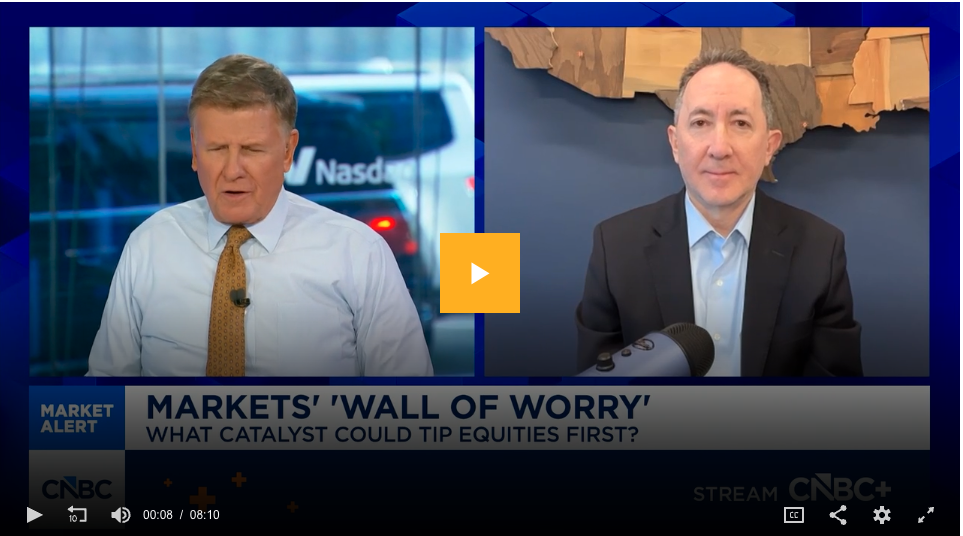
Source: CNBC
Opinions are subject to change. Not a recommendation to buy or sell any security. Provided for discussion and educational purposes only.
Key Data to Watch: The 10-Year Yield, the Yen Carry Trade, the High Yield Market and EM Credit
Interest rates are the cost of money. Everything macro is tied to the cost of money. The match that lights the fuse to the global leverage indebtedness problem is rising rates. We should all be on high alert.
Tracking the potential unwinding of the yen carry trade, here is the bottom line:
Across each of the key risk assets, we are seeing red flags. Signs risk is unwinding. Risk of a disruptive event is high.
Since we are at a critical point in terms of rising yields at a time of extreme system wide leverage (the Yen Carry Trade, Government Debt, global developed market debt, and US margin debt), I’m going to update the following charts each week going forward as we may be near a critical inflection point.
Updated charts with brief notes follow:
The 10-year:
Challenging 2007 yield high at 5.32%.
Yields declined on the jobs report today to 5.20%. They are already back up to 5.28% at the time of this chart post.
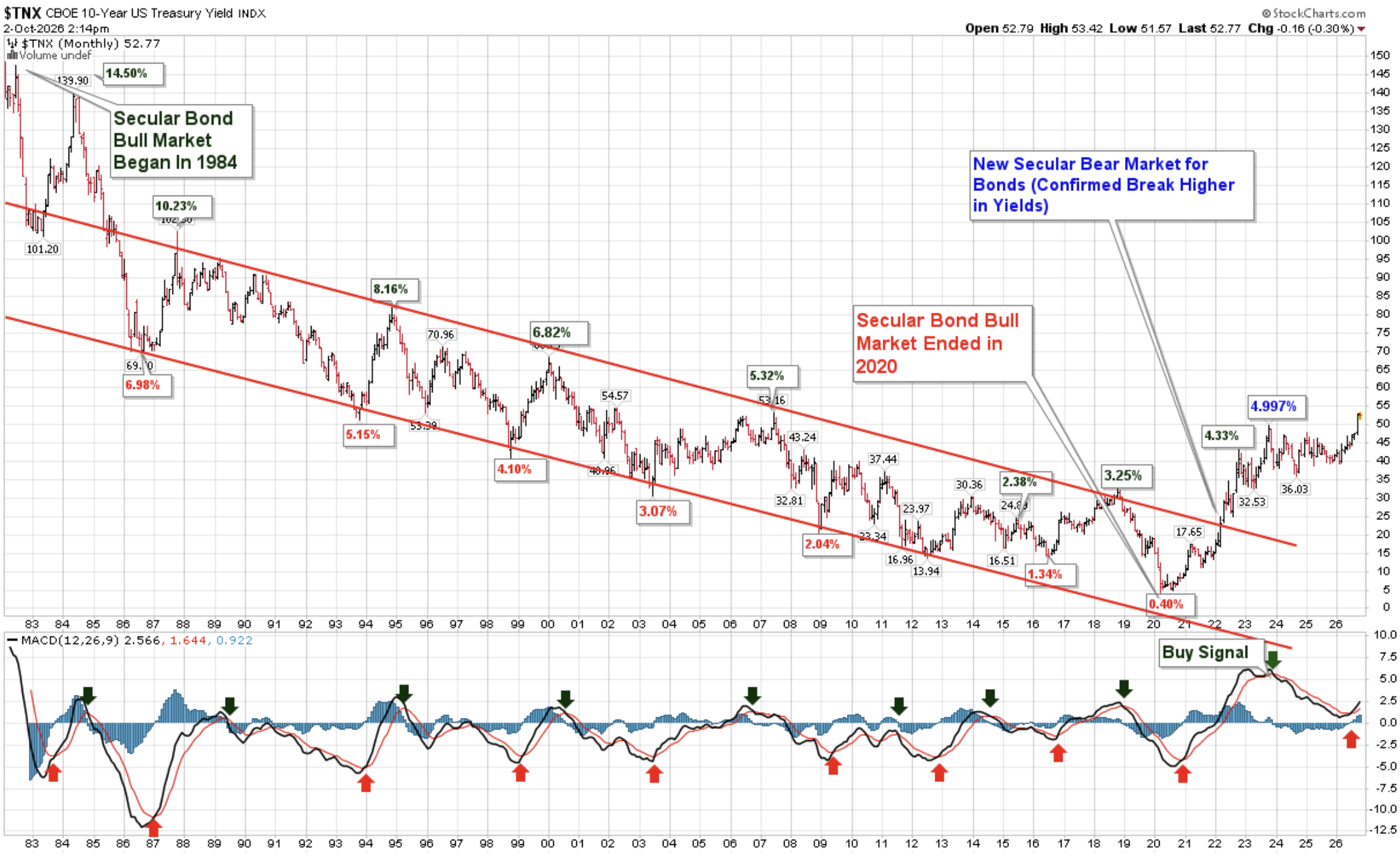
Source: StockCharts.com, CMG annotations (arrows)
The Yen:
The Bank of Japan needs the yen higher to fight off inflation.
They would prefer not to raise their interest rates which increases the interest costs they pay on their debt and risks unwinding the leveraged yen carry trade (borrow near 0% and invest in higher yielding assets elsewhere).
When the borrow for free spread goes away, the leverage likely unwinds. That is the problem that risks selling in the system.
The current trend as measured by the weekly MACD is pointing to a higher yen but the recent intervention to push the yen higher seems to be stalling.
Each bar equals the price activity for one week. A lower yen means higher inflation for Japanese citizens. The risk to US interest rates is that they sell their large US Treasury holdings and repatriate the proceeds (sell US bonds, sell dollars, buy yen). That may be what we are beginning to see in the higher 5-year, 10-year, and 30-year US Treasury yields these past few weeks.
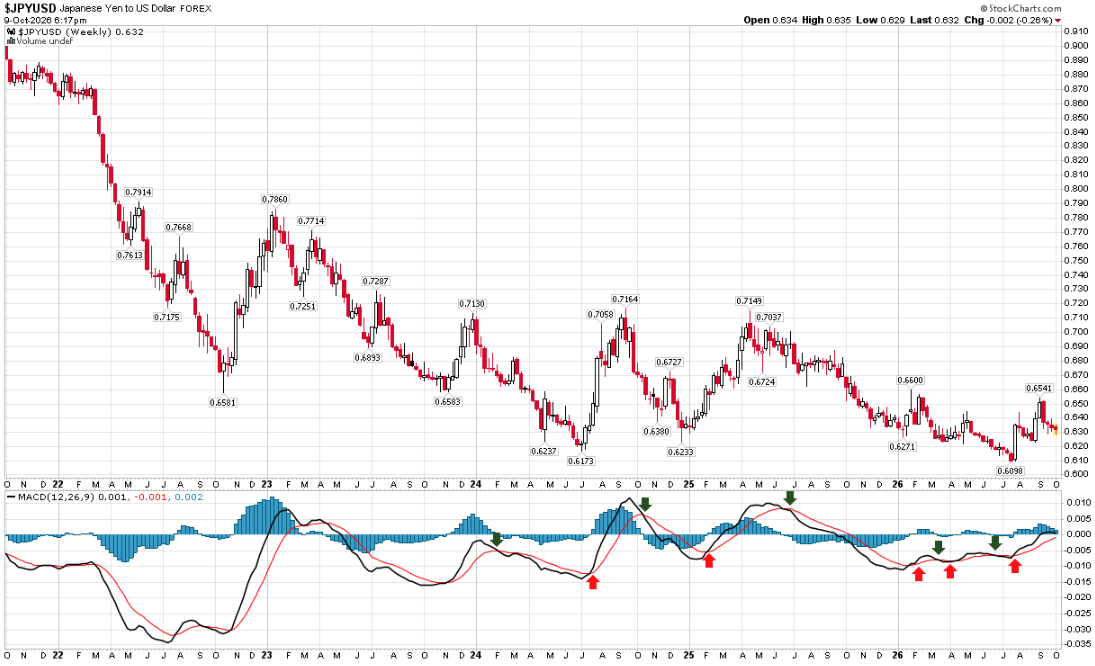
Source: StockCharts.com, CMG annotations
The Dollar:
Note the sharp price move higher over the last three weeks.
The Weekly MACD trend signal is pointing to a higher dollar.
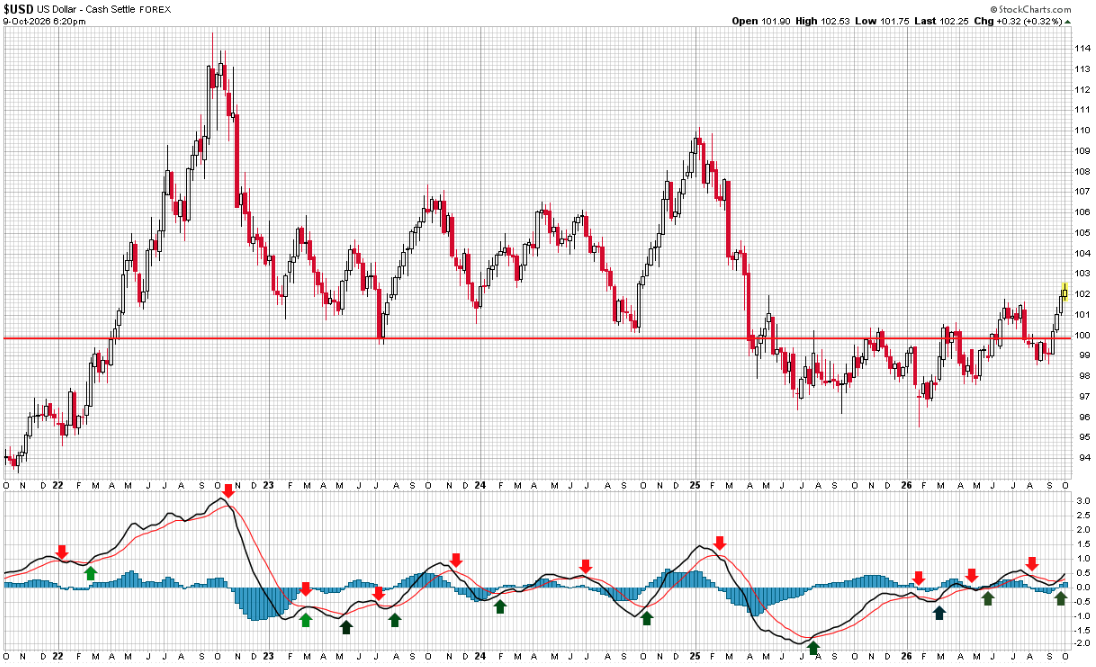
Source: StockCharts.com, CMG Investment Research
High-yield bonds:
The “canary in the coal mine” indicator. I’ve been using it since 1992.
HY is in a sharp sell-off. Next is a look at the long-term monthly chart (note the long-term MACD sell signal). Monthly MACD is the dominant trend:
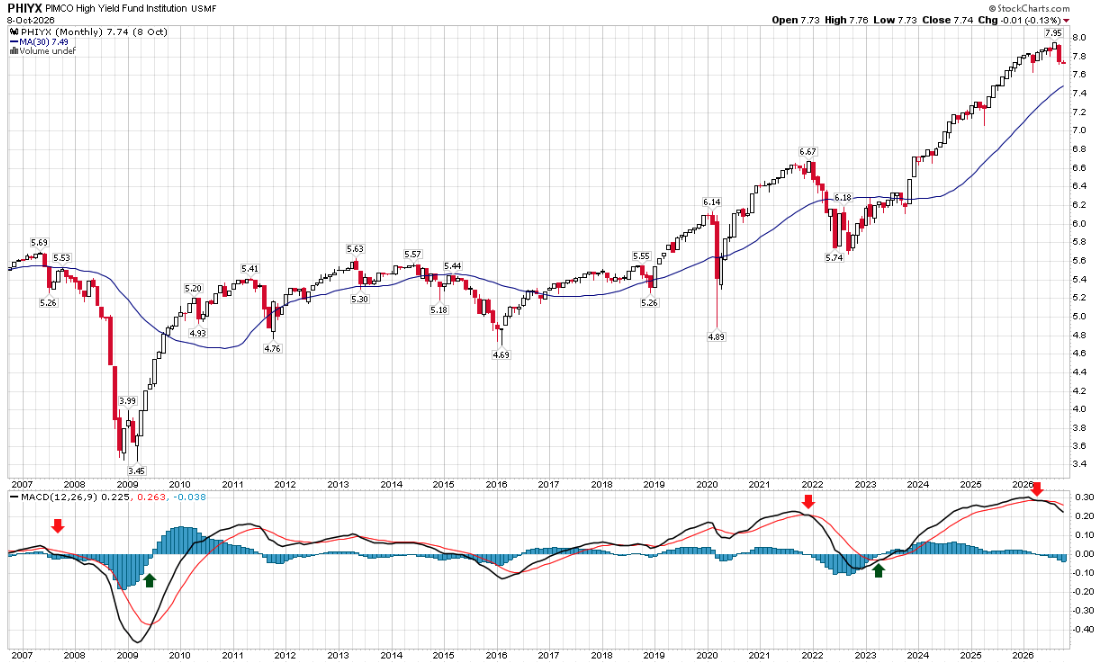
Source: StockCharts.com, CMG arrows
I favor the weekly MACD for intermediate term trend following.
Price is plotted in the upper section.
The weekly MACD signal is in the lower section.
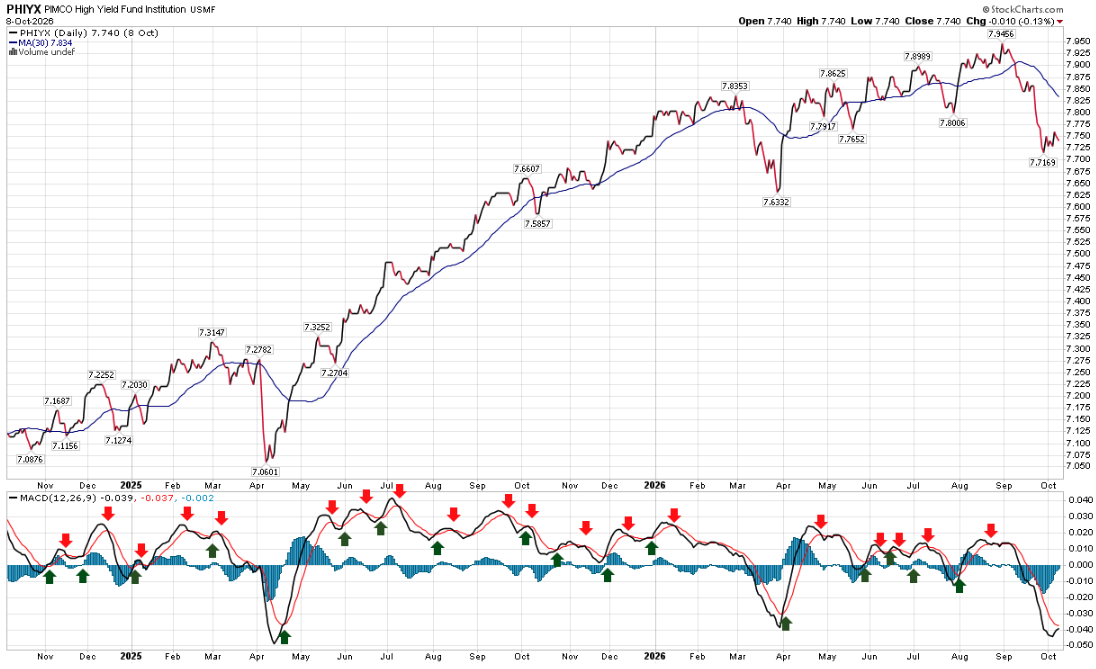
Source: StockCharts.com w CMG trend arrows
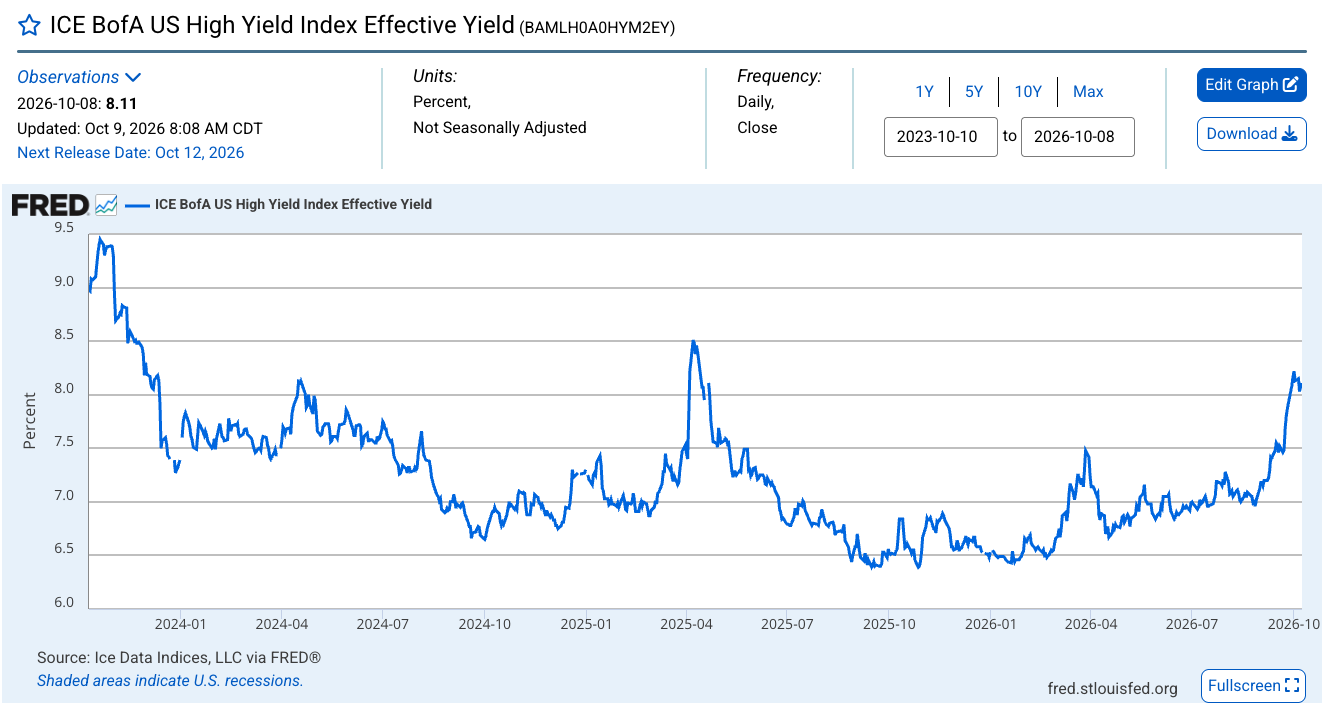
High yield bond yields are spiking higher.
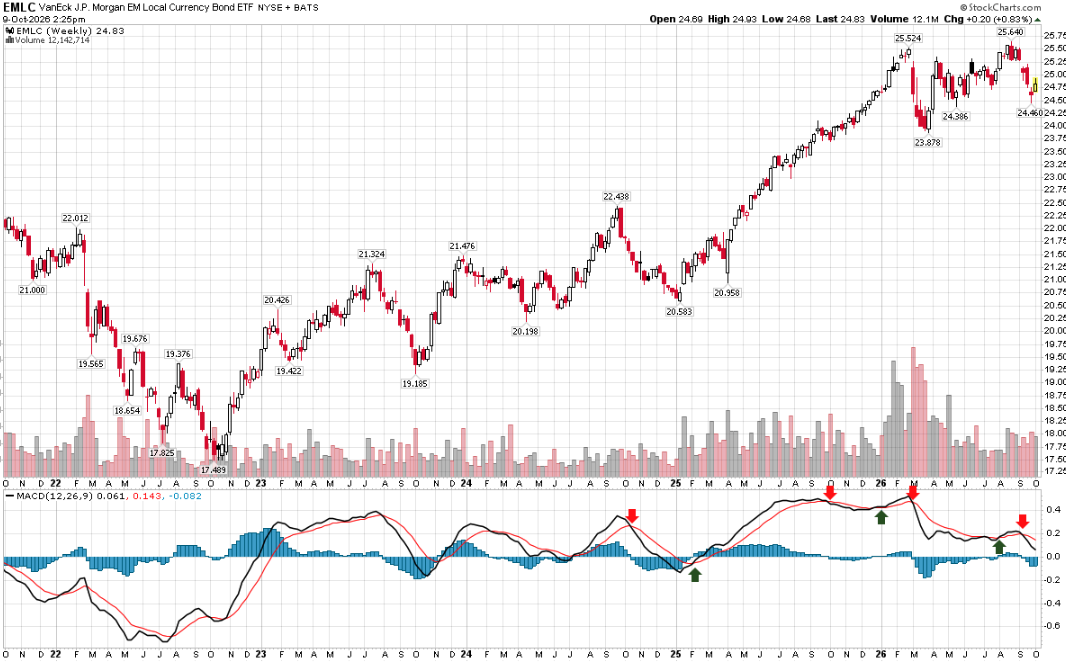
Emerging Market Local Currency Bond ETF:
Another risk signal to watch for the Yen Carry Trade unwinding of EM debt as this is where some of the leverage sits (borrow low in yen, invest in higher yielding EM debt).
How to read the chart:
Calm and steady is good; a sharp decline in price is a warning. Prices down mean yields are up.
I put a weekly MACD trend signal in the lower section. Currently in a down trend.
We are looking for evidence of the leveraged yen carry trade unwinding.
Source: StockCharts.com, CMG Investment Research
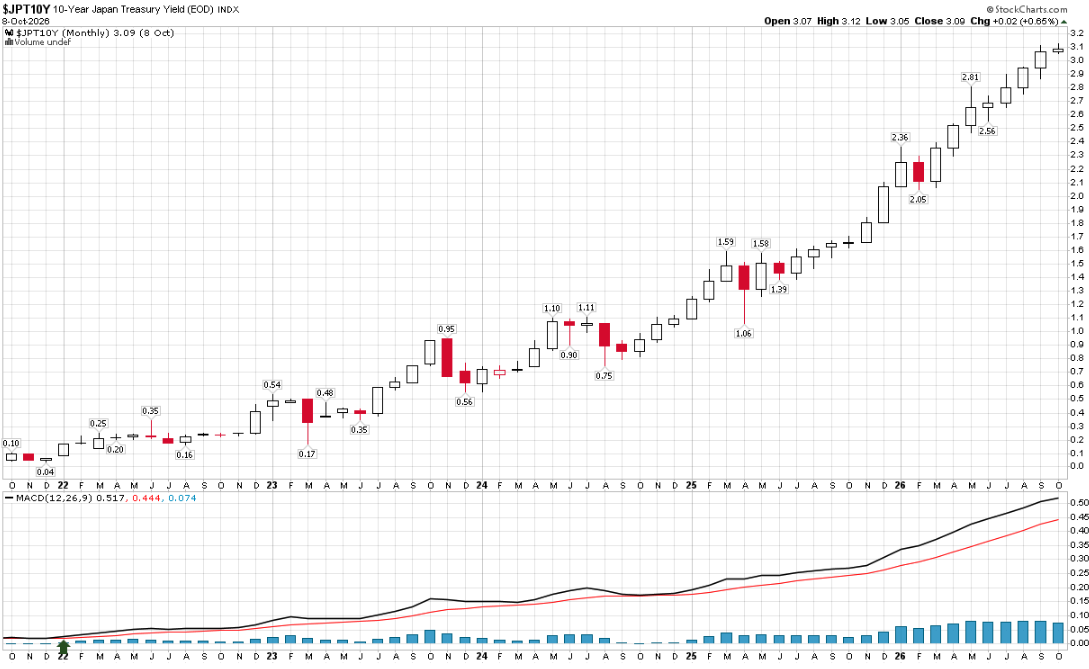
The Japan 10-year JGB yield:
Current yield is 3.10% today, the highest level since September 1996.
What is important about this is that high JGB yield makes the benefit of the yen carry trade go away.
Bottom line: Flashing yellow.
Source: StockCharts.com
Opinions are subject to change. Not a recommendation to buy or sell any security. Provided for discussion and educational purposes only.
If you like what you are reading, click on the link and share it with a friend (it’s free).
CLICK HERE TO SUBSCRIBE TO ON MY RADAR
Trade Signals: October 8, 2026 Update
Trade Signals
The Indicators Dashboard - Stocks, Investor Sentiment, Bonds, Commodities, Currencies, and Gold
Valuations and Subsequent 10-year Returns
Supporting Charts with Explanations

TRADE SIGNALS SUBSCRIPTION ACKNOWLEDGEMENT / IMPORTANT DISCLOSURES
About Trade Signals - Trade Signals is a paid subscription service that posts daily, weekly, and monthly market trends (and more). Free for CMG clients. Not a recommendation to buy or sell any security. For discussion purposes only.
The views expressed herein are solely those of Steve Blumenthal as of the date of this report and are subject to change without notice. Please note that the information provided is not recommended for buying or selling any security and is provided for discussion purposes only.
Personal Note: Friendship
I had a wonderful time last Friday night getting together with about 30 former teammates representing the 1979 to 1983 teams. Joining me on the field was the 1979 Final Four team. We came in third.
Let’s just say there are a few hip and knee replacements now needed. Ugh. I said to the guys, “Do you realize that for the current boys on the team on the field today, they are doing the math and it was 47 years ago. For us in 1979, that was if we were looking at the 1932 team.” That didn’t go over so well.
I sure do enjoy our friendships.

Bill, Billy Mac, Dan, Duncan, Lou, Scott and Steve - 1979 PSU Soccer Final Four
A quick Friars update: The boys have gone 1-2-1 over the last four games and sit at 6-2-2. By the time this hits your inbox, I’ll be on the field with Coach Sue with a notebook in hand. The Penn Charter game starts at 4 pm, so I’m going to call my edit team and race to it.
Wishing you a wonderful weekend!
Kind regards,
Steve
CLICK HERE TO SUBSCRIBE TO ON MY RADAR - IT’S FREE
You can share this letter on X by clicking here.
You can share this letter on LinkedIn by clicking here.
Subscribe to OMR for free by clicking the photo.
Stephen B. Blumenthal
Executive Chairman & CIO
CMG Capital Management Group, Inc.
75 Valley Stream Parkway, Suite 201,
Malvern, PA 19355
CMG Customer Relationship Summary (Form CRS)
Metric-Financial, LLC Customer Relationship Summary (Form CRS)

Stephen Blumenthal founded CMG Capital Management Group in 1992 and serves today as its Executive Chairman and CIO. Steve authors a free weekly e-letter entitled, “On My Radar.” Steve shares his views on macroeconomic research, valuations, portfolio construction, asset allocation and risk management. Author of Forbes Book: On My Radar, Navigating Stock Market Cycles.
Follow Steve on X @SBlumenthalCMG and LinkedIn.
IMPORTANT DISCLOSURE INFORMATION
This document is prepared by CMG Capital Management Group, Inc. (“CMG”) and is circulated for informational and educational purposes only. There is no consideration given to the specific investment needs, objectives, or tolerances of any of the recipients. Additionally, CMG’s actual investment positions may, and often will, vary from its conclusions discussed herein based on any number of factors, such as client investment restrictions, portfolio rebalancing, and transaction costs, among others. Recipients should consult their own advisors, including tax advisors, before making any investment decision. This material is for informational and educational purposes only and is not an offer to sell or the solicitation of an offer to buy the securities or other instruments mentioned. This material does not constitute a personal recommendation or take into account the particular investment objectives, financial situations, or needs of individual investors which are necessary considerations before making any investment decision. Investors should consider whether any advice or recommendation in this research is suitable for their particular circumstances and, where appropriate, seek professional advice, including legal, tax, accounting, investment, or other advice. The views expressed herein are solely those of Steve Blumenthal as of the date of this report and are subject to change without notice.
Investing involves risk.
This letter may contain forward-looking statements relating to the objectives, opportunities, and future performance of the various investment markets, indices, and investments. Forward-looking statements may be identified by the use of such words as; “believe,” anticipate,” “planned,” “potential,” and other similar terms. Examples of forward-looking statements include, but are not limited to, estimates with respect to financial condition, results of operations, and success or lack of success of any particular market, index, investment, or investment strategy. All are subject to various factors, including, but not limited to, general and local economic conditions, changing levels of competition within certain industries and markets, changes in legislation or regulation, Federal Reserve policy, and other economic, competitive, governmental, regulatory, and technological factors affecting markets, indices, investments, investment strategy and portfolio positioning that could cause actual results to differ materially from projected results. Such statements are forward-looking in nature and involve a number of known and unknown risks, uncertainties, and other factors, and accordingly, actual results may differ materially from those reflected or contemplated in such forward-looking statements. Investors are cautioned not to place undue reliance on any forward-looking statements or examples. All statements made herein speak only as of the date that they were made. Investing is inherently risky and all investing involves the potential risk of loss.
Past performance does not guarantee or indicate future results. Different types of investments involve varying degrees of risk, and there can be no assurance that the future performance of any specific investment, investment strategy, or product (including the investments and/or investment strategies recommended or undertaken by CMG), or any non-investment related content, made reference to directly or indirectly in this commentary will be profitable, equal any corresponding indicated historical performance level(s), be suitable for your portfolio or individual situation or prove successful. Due to various factors, including changing market conditions and/or applicable laws, the content may no longer be reflective of current opinions or positions. Moreover, you should not assume that any discussion or information contained in this commentary serves as the receipt of, or as a substitute for, personalized investment advice from CMG. Please remember to contact CMG, in writing, if there are any changes in your personal/financial situation or investment objectives for the purpose of reviewing/evaluating/revising our previous recommendations and/or services, or if you would like to impose, add, or to modify any reasonable restrictions to our investment advisory services. Unless, and until, you notify us, in writing, to the contrary, we shall continue to provide services as we do currently. CMG is neither a law firm, nor a certified public accounting firm, and no portion of the commentary content should be construed as legal or accounting advice.
No portion of the content should be construed as an offer or solicitation for the purchase or sale of any security. References to specific securities, investment programs or funds are for illustrative purposes only and are not intended to be, and should not be interpreted as recommendations to purchase or sell such securities.
This presentation does not discuss, directly or indirectly, the amount of the profits or losses realized or unrealized, by any CMG client from any specific funds or securities. Please note: In the event that CMG references performance results for an actual CMG portfolio, the results are reported net of advisory fees and inclusive of dividends. The performance referenced is that as determined and/or provided directly by the referenced funds and/or publishers, has not been independently verified, and does not reflect the performance of any specific CMG client. CMG clients may have experienced materially different performance based upon various factors during the corresponding time periods. See in links provided citing limitations of hypothetical back-tested information. Past performance cannot predict or guarantee future performance. Not a recommendation to buy or sell. Please talk to your advisor.
Information herein has been obtained from sources believed to be reliable, but we do not warrant its accuracy. This document is general communication and is provided for informational and/or educational purposes only. None of the content should be viewed as a suggestion that you take or refrain from taking any action nor as a recommendation for any specific investment product, strategy, or other such purposes.
In a rising interest rate environment, the value of fixed-income securities generally declines, and conversely, in a falling interest rate environment, the value of fixed-income securities generally increases. High-yield securities may be subject to heightened market, interest rate, or credit risk and should not be purchased solely because of the stated yield. Ratings are measured on a scale that ranges from AAA or Aaa (highest) to D or C (lowest). Investment-grade investments are those rated from highest down to BBB- or Baa3.
NOT FDIC INSURED. MAY LOSE VALUE. NO BANK GUARANTEE.
Certain information contained herein has been obtained from third-party sources believed to be reliable, but we cannot guarantee its accuracy or completeness.
In the event that there has been a change in an individual’s investment objective or financial situation, he/she is encouraged to consult with his/her investment professional.
Written Disclosure Statement. CMG is an SEC-registered investment adviser located in Malvern, Pennsylvania. Stephen B. Blumenthal is CMG’s founder and CEO. Please note: The above views are those of CMG and its CEO, Stephen Blumenthal, and do not reflect those of any sub-advisor that CMG may engage to manage any CMG strategy, or exclusively determines any internal strategy employed by CMG. A copy of CMG’s current written disclosure statement discussing advisory services and fees is available upon request or via CMG’s internet web site at www.cmgwealth.com/disclosures. CMG is committed to protecting your personal information. Click here to review CMG’s privacy policies.
See CMG Disclosures at the bottom of this page.
For more information about NDR, please visit at www.ndr.com.
NDR, Inc. (NDR), d.b.a. Ned Davis Research Group (NDRG), any NDRG affiliates or employees, or any third-party data provider, shall not have any liability for any loss sustained by anyone who has relied on the information contained in any NDRG publication. The data and analysis contained herein are provided "as is." NDRG disclaims any and all express or implied warranties, including, but not limited to, any warranties of merchantability, suitability or fitness for a particular purpose or use. NDRG's past recommendations and model results are not a guarantee of future results. This communication reflects our analysts' opinions as of the date of this communication and will not necessarily be updated as views or information change. All opinions expressed herein are subject to change without notice. NDRG or its affiliated companies or their respective shareholders, directors, officers and/or employees, may have long or short positions in the securities discussed herein and may purchase or sell such securities without notice. For NDRG's important additional disclaimers, refer to www.ndr.com/invest/public/copyright.html. Further distribution prohibited without prior permission. Copyright 2025 © NDR, Inc. All rights reserved.
The opinions are mine. Please know that there are no guarantees the above will prove correct, and that views are subject to change. See essential disclosures further below.