On My Radar: No Clear Off-Ramp

October 2, 2026
By Steve Blumenthal
“There is no instance of a nation benefiting from prolonged warfare.”
— Sun Tzu, The Art of War
In 1961, MIT meteorologist Edward Lorenz wanted to rerun a weather simulation. To save time, he typed in 0.506 instead of the full 0.506127 and went down the hall for a cup of coffee. When he came back an hour later, the forecast was completely different. That tiny change became the seed of chaos theory and what we now call the 'butterfly effect': small changes in a complex system can lead to very different outcomes.
Back in April, I shared my notes from a conversation with my good friend Steve M., former Chairman, President, and CEO of a major oil company and a student of chaos theory (OMR, April 24, 2026 – I Hear The Train A-Coming). His read then was blunt: "There is no clear off-ramp."
I spoke with Steve again this week and asked what has changed since April.
"Things have not materially changed," he said. Then he paused. "Well, I'll take that back. The exception is the engagement now of the Houthis."
One small change in the system, and that exception matters a lot.
Grab your coffee and find your favorite chair. You'll find my notes from our conversation. There are certain people who possess a combination of balance and intelligence that, when they speak, you want to take in what they have to say. Oh, and real-life experience too. That’s where wisdom comes from. We’ll also look at this morning's jobs report and an update on the yen carry-trade watch charts we’ve been highlighting.
On My Radar: No Clear Off-Ramp
Steve M: Five Months Later
September Jobs: Cooling, Not Collapsing
The 10-year - The Yen - And Watch Out For -2
Trade Signals: October 1, 2026
Personal Note: Penn State, Stonewall, Boston and NYC
OMR is for informational and educational purposes only. No consideration is given to your specific investment needs, objectives, or tolerances.
Please see the Important Disclosures at the bottom of this page. Reminder: This is not a recommendation to buy or sell any security. My views may change at any time. The information is for discussion and educational purposes only.
If you like what you are reading, you can subscribe for free.

Steve M: Five Months Later
Where we are
Steve believes the U.S. is "about in the same position" as it was in the spring. He thinks there was "a very good off-ramp" to declare victory around the time of the June Versailles truce, and it wasn't taken. The truce fell apart within about 10 days.
The Houthis were the wildcard back then. They aren't anymore. They have attacked Saudi Arabia, the Saudis asked Washington for help, and the U.S. declined. (Reuters and CNN reported in mid-September that the Crown Prince called the President twice to request strikes on the Houthis, and Washington said its focus remained on Iran.)
His concern is the lesson our allies are taking from this: "We're teaching a lot of bad lessons." Saudi Arabia, the UAE, and Kuwait now see themselves as "almost on their own," with Iran right next door.
Why Iran isn't breaking
He repeated his point from April. The Revolutionary Guard runs like a chaos-theory organization: "I've got the battle plan, I know my role, I carry it out. I don't need help from higher up." Taking out the top leadership in February didn't stop it.
Add near-religious zeal ("defenders of the Iranian Revolution of 1979") to that decentralized structure, and you get something that is "pretty hard to crack."
On sanctions, he asked how many countries over time have fallen to economic pressure alone. "The answer is zero." In his view, regimes fall when military force on the ground comes together with sanctions, and the U.S. has neither the appetite nor the forces in place for a ground war in a country the size of Iran.
Squeezing a country tends to pull its people together. He pointed to South Africa under sanctions and to Ukraine today: "Even though I may not like you as a government, it's still my country."
His conclusion: "So I think we're stuck."
The new lesson: chokepoints over bombs
In April, Steve said Iran had learned that controlling the Strait of Hormuz may be worth more than a nuclear weapon. Now that the Houthis threaten the Red Sea, he thinks that lesson has doubled. If you can pressure both chokepoints, "maybe a nuclear bomb can wait." That approach hurts the U.S. and also "a whole lot of other people."
China and Russia: "I can assure you they're not helping us here." He suspects they are helping Iran with everything from targeting to outlets for its oil. "The enemy of my enemy is my friend." Trade can still cross the line between us, "but the line still remains."
The bigger risks
Munitions. He believes the U.S. now has "a significant munitions problem." His worry is the message that sends to China about Taiwan.
Alliances. We've strained ties with Europe, Canada, and others at the moment we most need them.
The home front. He wants the focus back on "the people on the street that have to buy groceries, pay for gas." He also flagged immigration effects already reaching higher education. Small colleges are closing and others are cutting tuition, because the demographic decline is now compounded by fewer international students.
How it ends
Steve sees no white flag coming from Tehran. The war's goals kept growing (no nuclear capability, regime change, Hormuz tolling, and more), and "not all of them are going to happen."
The exit will take political will to "spin and walk away from some of them." The nuclear program has been set back, and that can be presented as a win, perhaps as an improvement on the earlier Obama-era agreement.
In April he said the U.S. would need to "climb down." That view hasn't changed. The only open question is how the climb-down gets framed.
A timing note: The day after we spoke, news broke that a third carrier strike group, the USS Theodore Roosevelt, plus an amphibious group carrying roughly 2,000 Marines, is heading to the region, bringing U.S. forces there to more than 60,000. Does that contradict Steve's view that there's no appetite for boots on the ground? I don't think so. Carriers are air and sea power, and 2,000 Marines is a raid force, not an invasion force. This looks like leverage, and possibly preparation for strikes, after the President rejected Iran's latest ceasefire proposal. The one risk to watch is a limited operation, like seizing Kharg Island, which Steve warned back in April would leave U.S. forces as "sitting ducks." Source
Oil, diesel, and markets
Steve thinks the President is right that oil prices will come down. He's less sure when. "It may not be instantaneous." Every hint of a resolution has pushed prices lower, and every sign that the conflict will drag on, especially with the Red Sea now at risk, has pushed them "up significantly."
Inventories are thin. "We've lived off the inventories, we've lived off what was in the supply chain." That affects when prices fall, not whether they fall: "The decline will happen."
His political-economy read: an exit from the Middle East that looks workable before the midterms "would be huge." Lower tariffs would be the next lever. Neither would work in a week, but both could help over "the next several quarters." He added, "You can never underestimate the power of a sitting president."
SB here, in plain English:
When we spoke in April, Brent had just pushed above $120 (OMR, May 1 – The Invisible Energy Tax). As of last week it was near $100. The improvement is real: Saudi Arabia restarted its East-West pipeline, Iraqi exports topped 3 million barrels a day, and there's talk Hormuz could reopen under certain conditions. But diesel is a different story.
European diesel margins hit a record of roughly $95 a barrel over crude. Source
Diesel moves trucks, tractors, and ships, so it is the "invisible energy tax" in its purest form. Crude is easing while the products the economy actually runs on stay tight.
Opinions are subject to change. Not a recommendation to buy or sell any security. Provided for discussion and educational purposes only.
September Jobs: Cooling, Not Collapsing
Two weeks ago, the Fed raised rates a quarter point to 3.75%–4.00%, its first hike since 2023. I called it round nine of a twelve-round fight (OMR, Sept 18 – The Fed's Fight, Round Nine).
Last week, gravity showed up. The 30-year Treasury yield hit its highest level since 2004, and the 5-year moved above 5% (OMR, Sept 25 – Gravity Returns). The question since then has been whether the Fed throws another rate hike punch in October.
This morning's jobs report may have answered it.
My friend Peter Boockvar was out early with his take. Mauldin Economics also shared it with subscribers to Over My Shoulder, an inexpensive newsletter and worth putting on your radar.
Here's the headline: the economy added just 29,000 jobs in September. The estimate was 90,000. The prior two months were also revised down by a combined 60,000.
My quick bullet point notes follow. Peter's quotes are in quotation marks, and the rest is my summary.
Private sector: Private payrolls added 46,000, down from 89,000 the month before. That 89,000 was itself revised down from 127,000. Government jobs fell.
Household survey: This separate survey showed 406,000 new jobs, but it's a very volatile number. The labor force grew even faster, by 485,000, so unemployment ticked up to 4.2% from 4.1%.
Paychecks: Average hourly earnings rose just 0.1% for the month and 3% from a year ago.
Participation: More people came back into the labor force, and the participation rate rose to 61.8%. The rate for prime-age workers (25–54) held at 83.4%.
Who's hiring: Healthcare and social services (+23,000), trade, transport, and warehousing (+24,000), leisure and hospitality (+10,000), construction (+11,000), and manufacturing (+9,000). Manufacturing got a lift from building equipment for data centers.
Who's cutting: Information, financial services, and business services. These are the white-collar jobs most exposed to AI. That's worth watching.
The trend: Averaging out the monthly noise, job gains are 51,000 a month over the last three months, 66,000 over six months, and 41,000 over twelve months. In 2019, the average was 165,000. Data source: Boockvar, Substack, BLS
SB here, in plain English: How many new jobs does the economy need each month to keep unemployment steady? Economists call it the "breakeven" number. It used to be well above 100,000. With slower population growth and less immigration, it's much lower today. Peter has seen estimates "everywhere from zero to north of 50k," which puts the recent three-month average of 51,000 "kind of in the range." So the job market isn't collapsing. It's slowing to match a smaller pool of new workers.
Why it matters for rates: Back in July, I said to watch the 4.50% level on the 10-year Treasury as a tell. As long as it holds above that level, the bond market, not the Fed, may end up setting policy (OMR, July 17 – The Match, the Fuse, and 4.50%). Peter made a similar point last month: the bond market priced in the September hike before the Fed acted.
This morning, the bond market moved again. Treasury yields fell after the release from 5.34% to 5.20% at the time of this writing.
Slow job growth and modest wage gains mean less fuel for inflation, and that takes some pressure off long-term rates for now. Peter was direct: "We won't get an October rate increase and not even worth guessing about December as it's too far away."
Bottom line: The job market is cooling, not cracking. That's good news for bonds and likely means no hike in October. Call it a breather between rounds, not the end of the fight. Monthly numbers keep getting revised lower, and job losses are showing up in information and finance. Slow is fine. Shrinking would be a different story. We'll see.
Opinions are subject to change. Not a recommendation to buy or sell any security. Provided for discussion and educational purposes only.
Key Data to Watch: The 10-Year Yield, the Yen Carry Trade, the High Yield Market and EM Credit
Interest rates are the cost of money. Everything macro is tied to the cost of money. The match that lights the fuse to the global leverage indebtedness problem is rising rates. We should all be on high alert.
Tracking the potential unwinding of the yen carry trade, here is the bottom line:
Across each of the key risk assets, we are seeing red flags. Signs risk is unwinding. Risk of a disruptive event is high.
Since we are at a critical point in terms of rising yields at a time of extreme system wide leverage (the Yen Carry Trade, Government Debt, global developed market debt, and US margin debt), I’m going to update the following charts each week going forward as we may be near a critical inflection point.
Updated charts with brief notes follow:
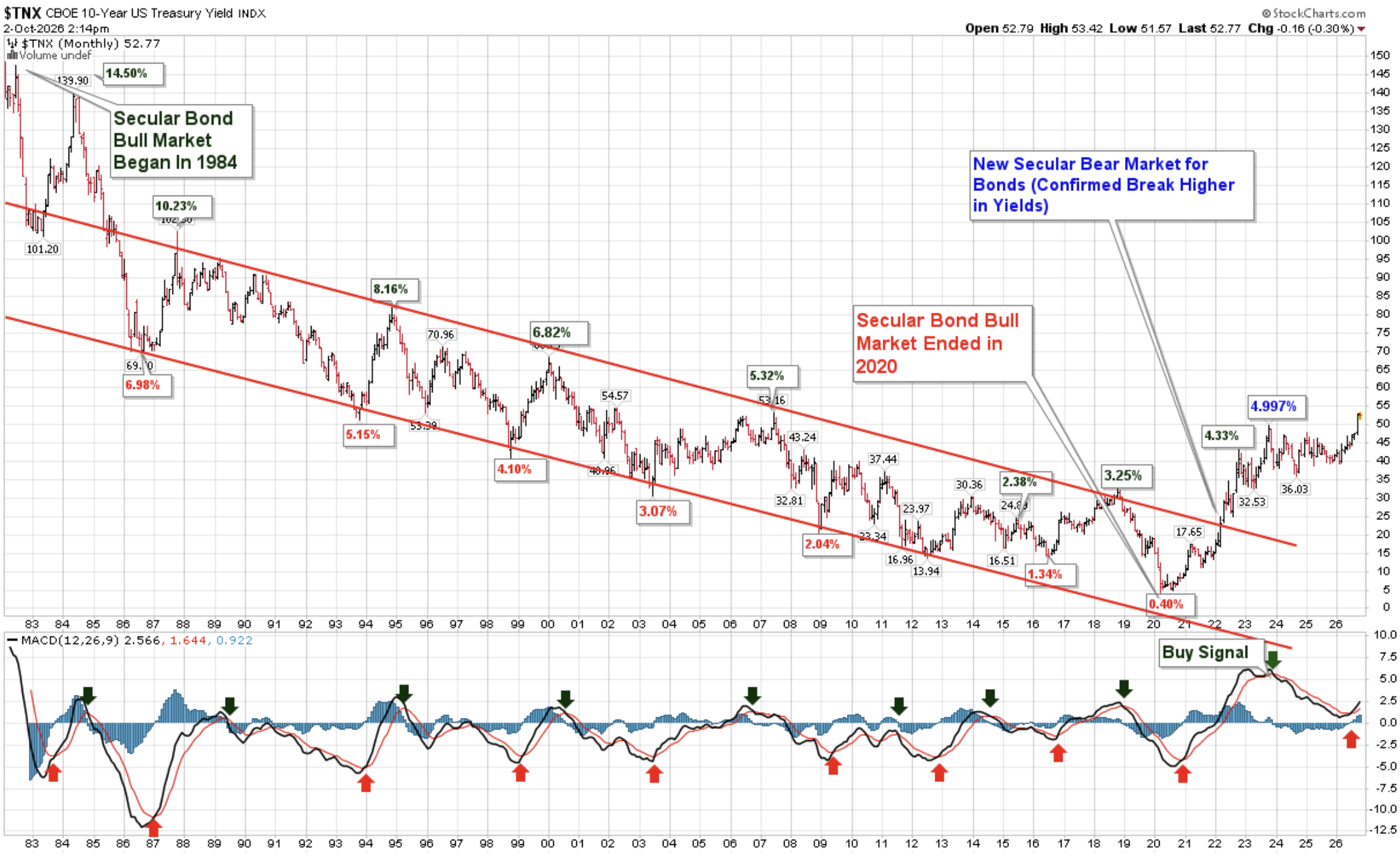
The 10-year:
Challenging 2007 yield high at 5.32%.
Yields declined on the jobs report today to 5.20%. They are already back up to 5.28% at the time of this chart post.
Source: StockCharts.com, CMG annotations (arrows)
The Yen:
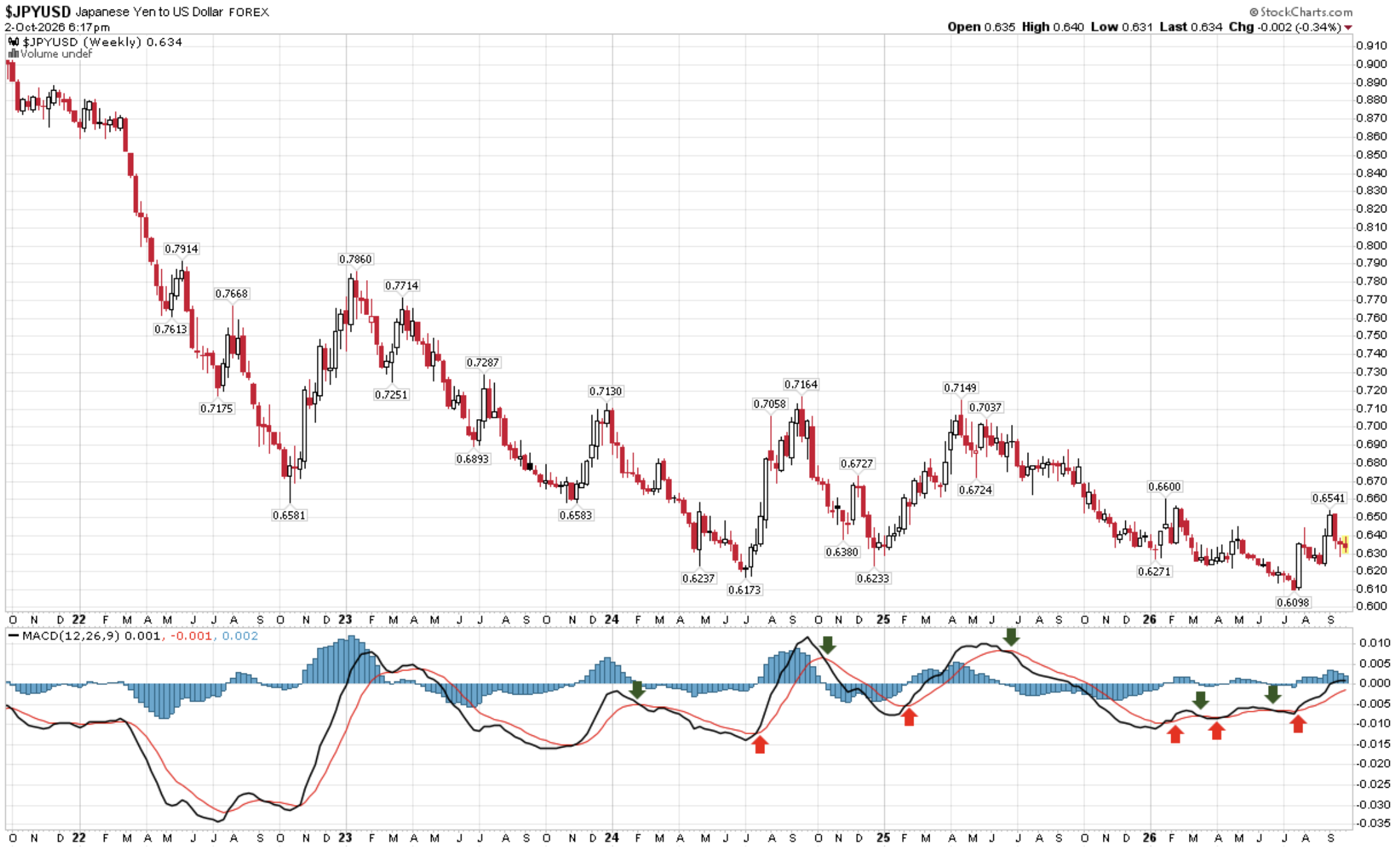
The Bank of Japan needs the yen higher to fight off inflation.
They would prefer not to raise their interest rates which increases the interest costs they pay on their debt and risks unwinding the leveraged yen carry trade (borrow near 0% and invest in higher yielding assets elsewhere).
When the borrow for free spread goes away, the leverage likely unwinds. That is the problem that risks selling in the system.
The current trend as measured by the weekly MACD is pointing to a higher yen but the recent intervention to push the yen higher seems to be stalling.
Each bar equals the price activity for one week. A lower yen means higher inflation for Japanese citizens. The risk to US interest rates is that they sell their large US Treasury holdings and repatriate the proceeds (sell US bonds, sell dollars, buy yen). That may be what we are beginning to see in the higher 5-year, 10-year, and 30-year US Treasury yields these past few weeks.
Source: StockCharts.com, CMG annotations
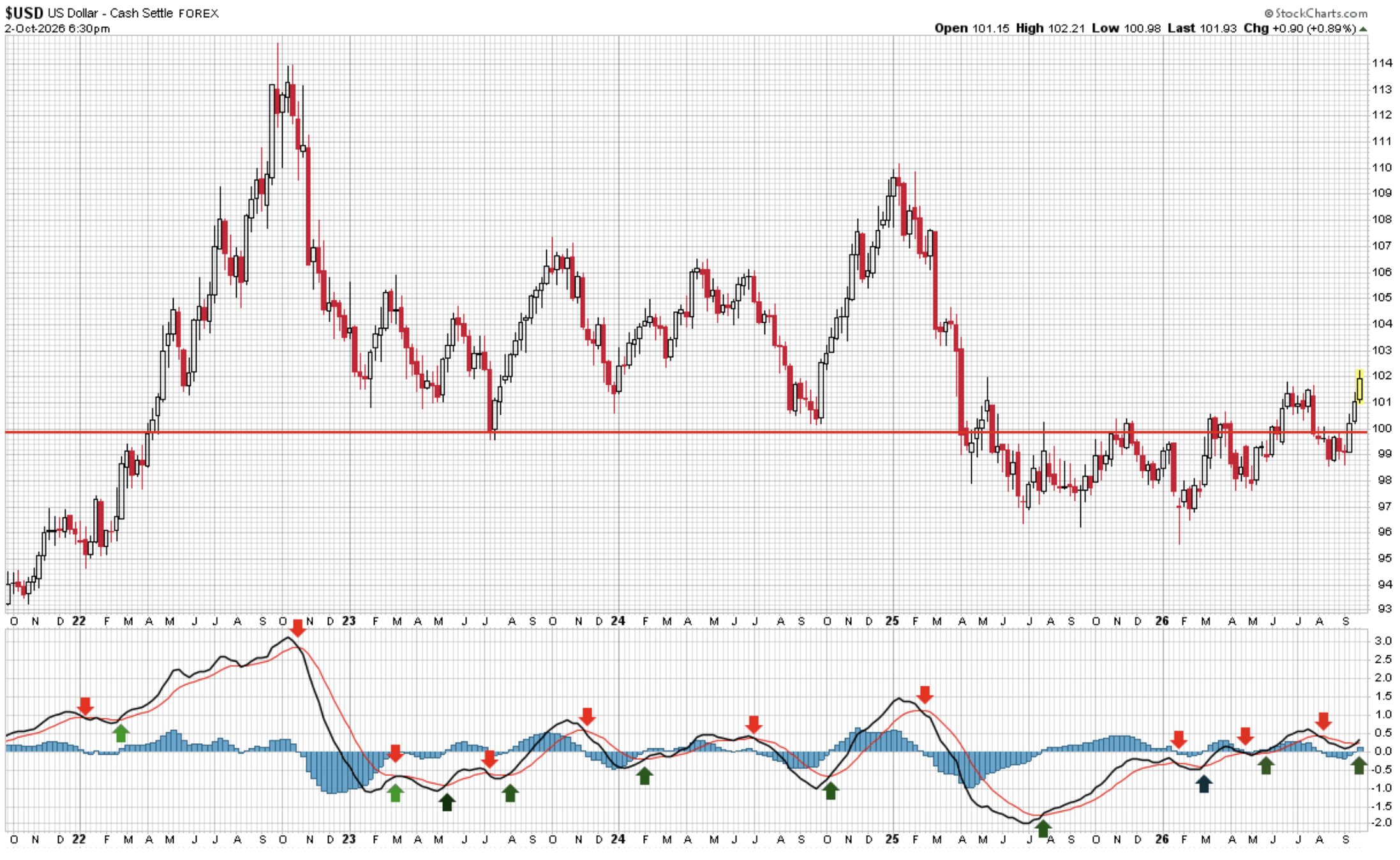
The Dollar:
Note the sharp price move higher over the last three weeks.
The Weekly MACD trend signal is pointing to a higher dollar.
Source: StockCharts.com, CMG Investment Research
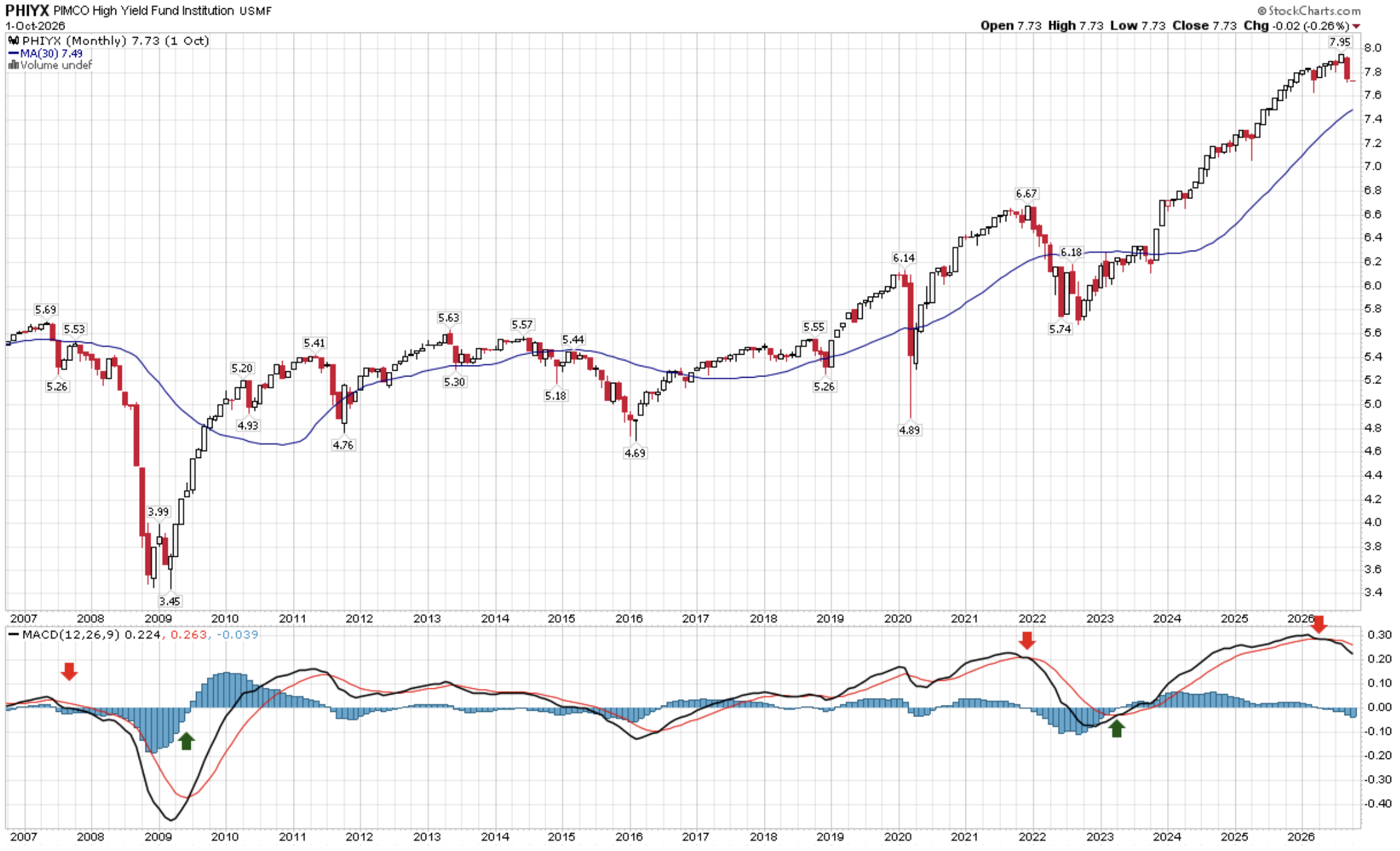
High-yield bonds:
The “canary in the coal mine” indicator. I’ve been using it since 1992.
HY is in a sharp sell-off. Next is a look at the long-term monthly chart (note the long-term MACD sell signal). Monthly MACD is the dominant trend:
Source: StockCharts.com, CMG arrows
I favor the weekly MACD for intermediate term trend following.
Price is plotted in the upper section.
The weekly MACD signal is in the lower section.
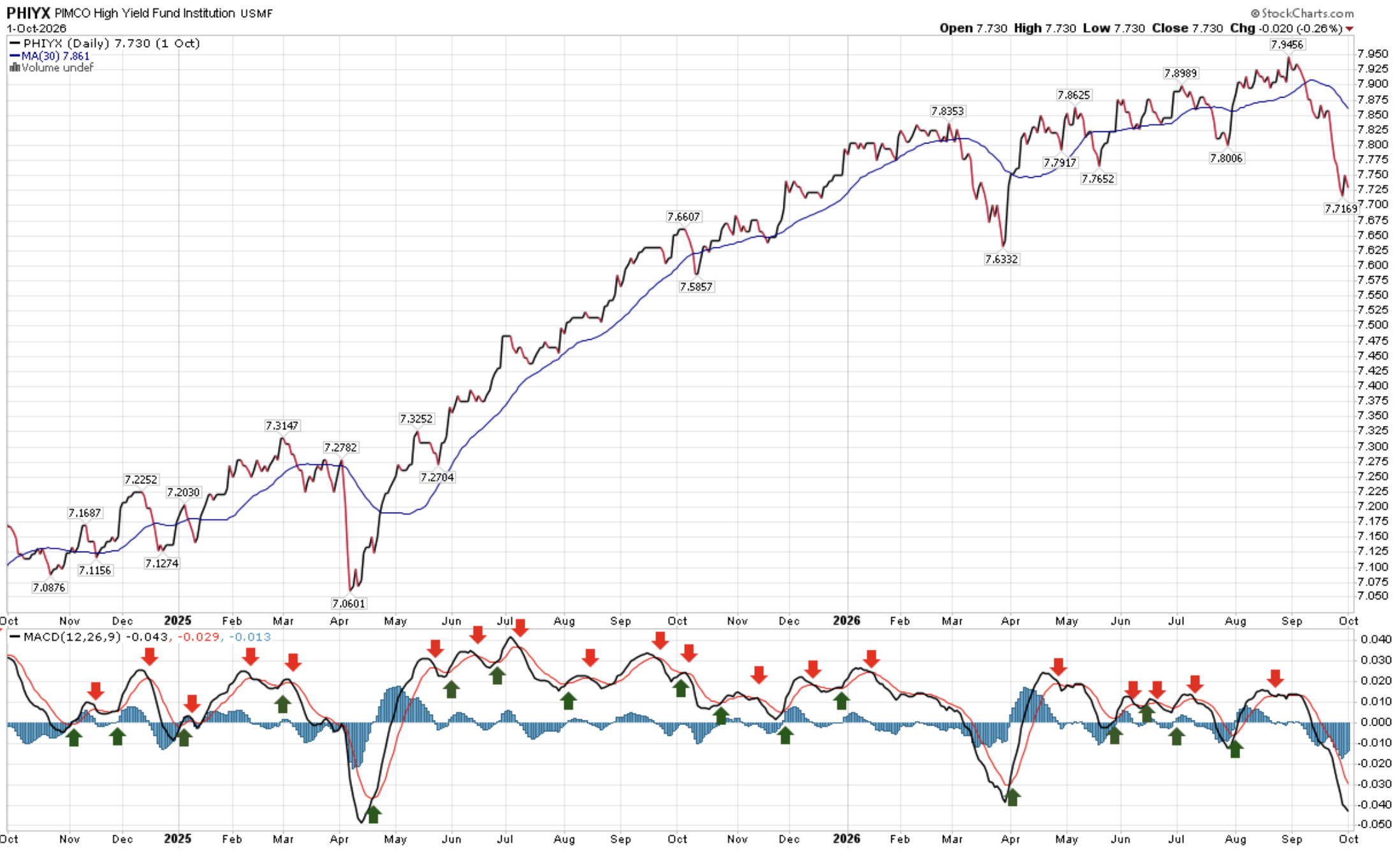
Source: StockCharts.com w CMG trend arrows
High yield bond yields are spiking higher.
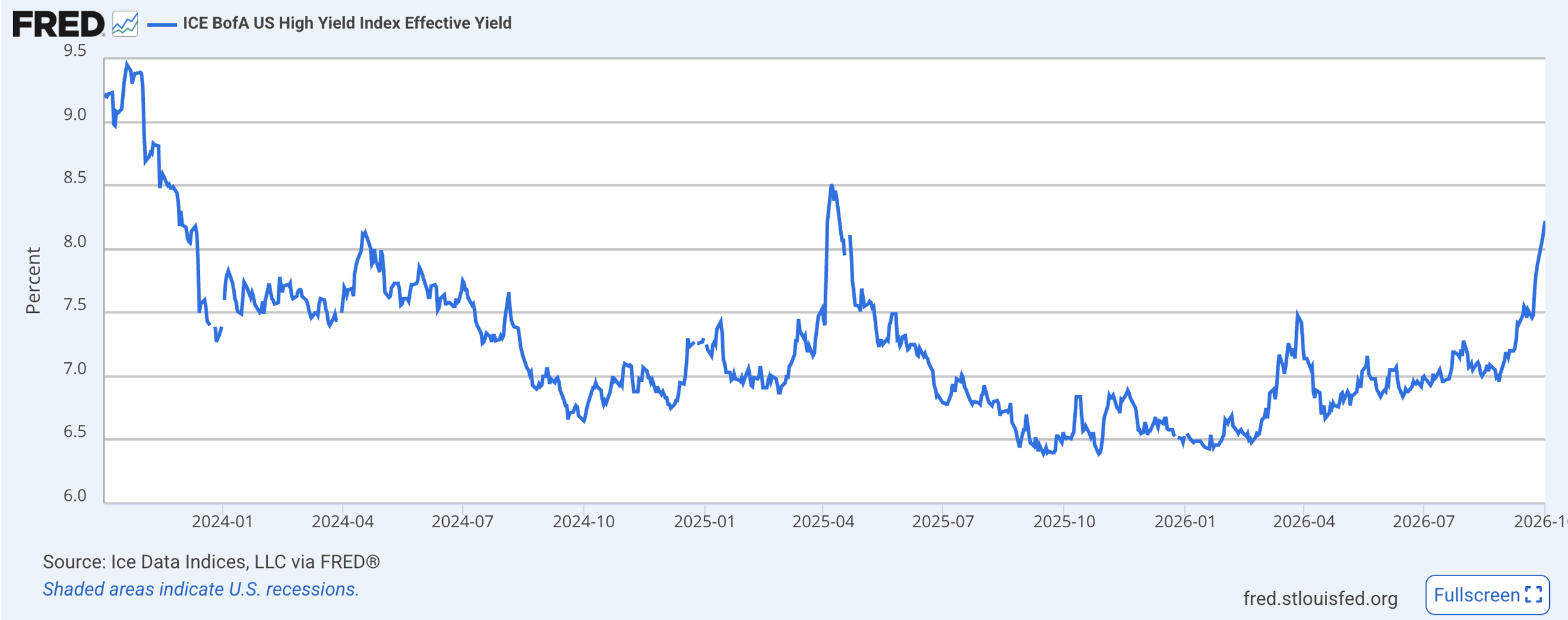
Emerging Market Local Currency Bond ETF:
Another risk signal to watch for the Yen Carry Trade unwinding of EM debt as this is where some of the leverage sits (borrow low in yen, invest in higher yielding EM debt).
How to read the chart:
Calm and steady is good; a sharp decline in price is a warning. Prices down mean yields are up.
I put a weekly MACD trend signal in the lower section. Currently in a down trend.
We are looking for evidence of the leveraged yen carry trade unwinding.

Source: StockCharts.com, CMG Investment Research
The Japan 10-year JGB yield:
Current yield is 3.10% today, the highest level since September 1996.
What is important about this is that high JGB yield makes the benefit of the yen carry trade go away.
Bottom line: Flashing yellow.
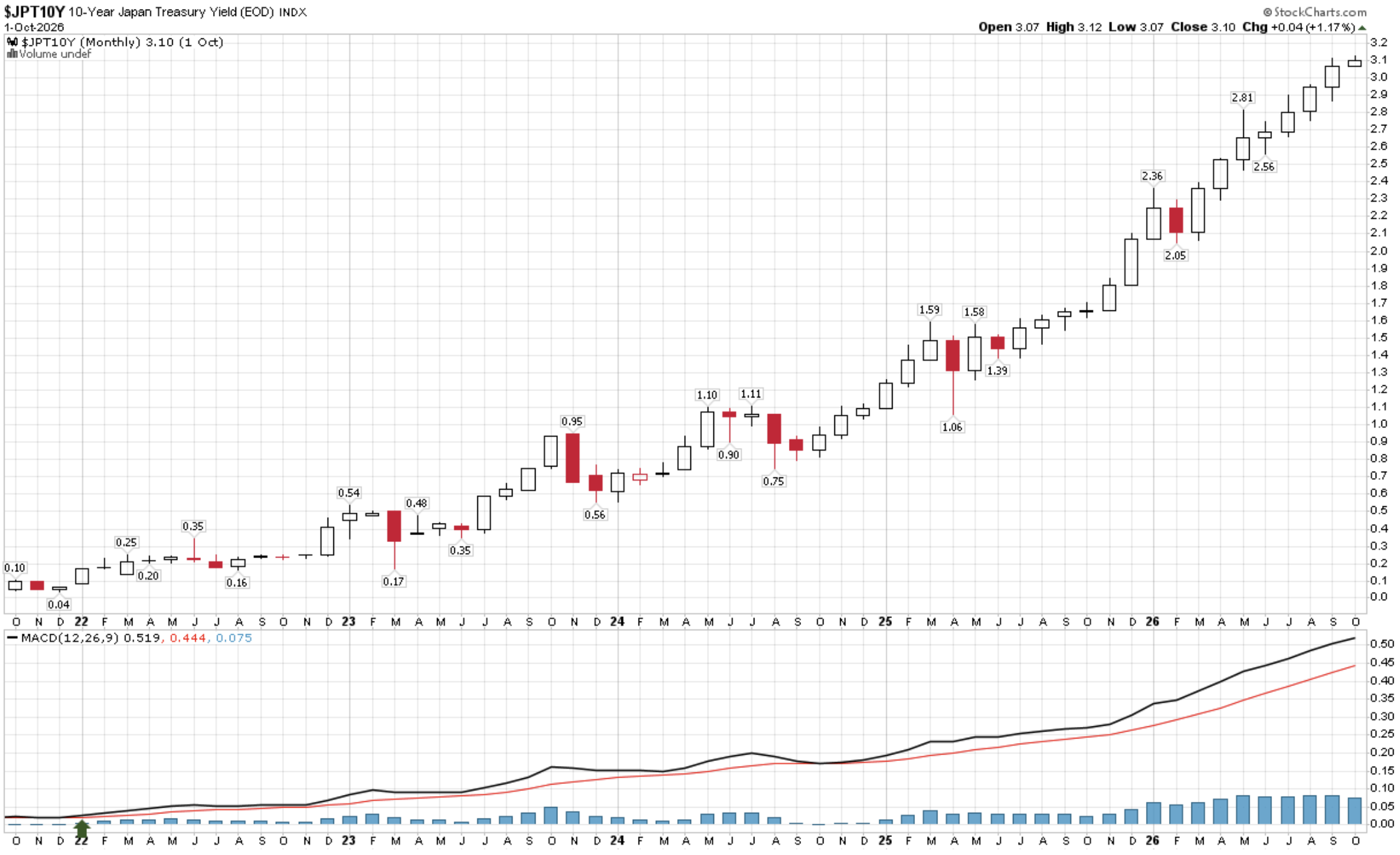
Source: StockCharts.com
Opinions are subject to change. Not a recommendation to buy or sell any security. Provided for discussion and educational purposes only.
Other Interesting Charts
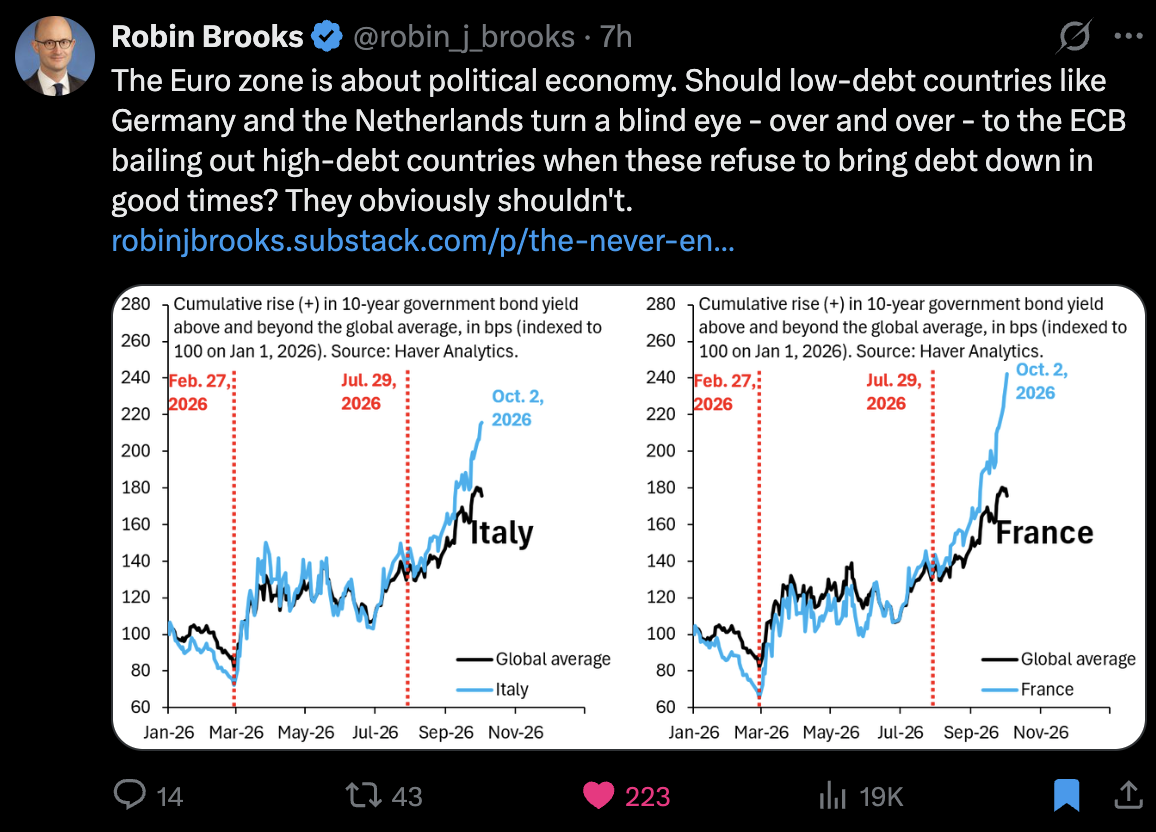
Source: @robin_j_brooks
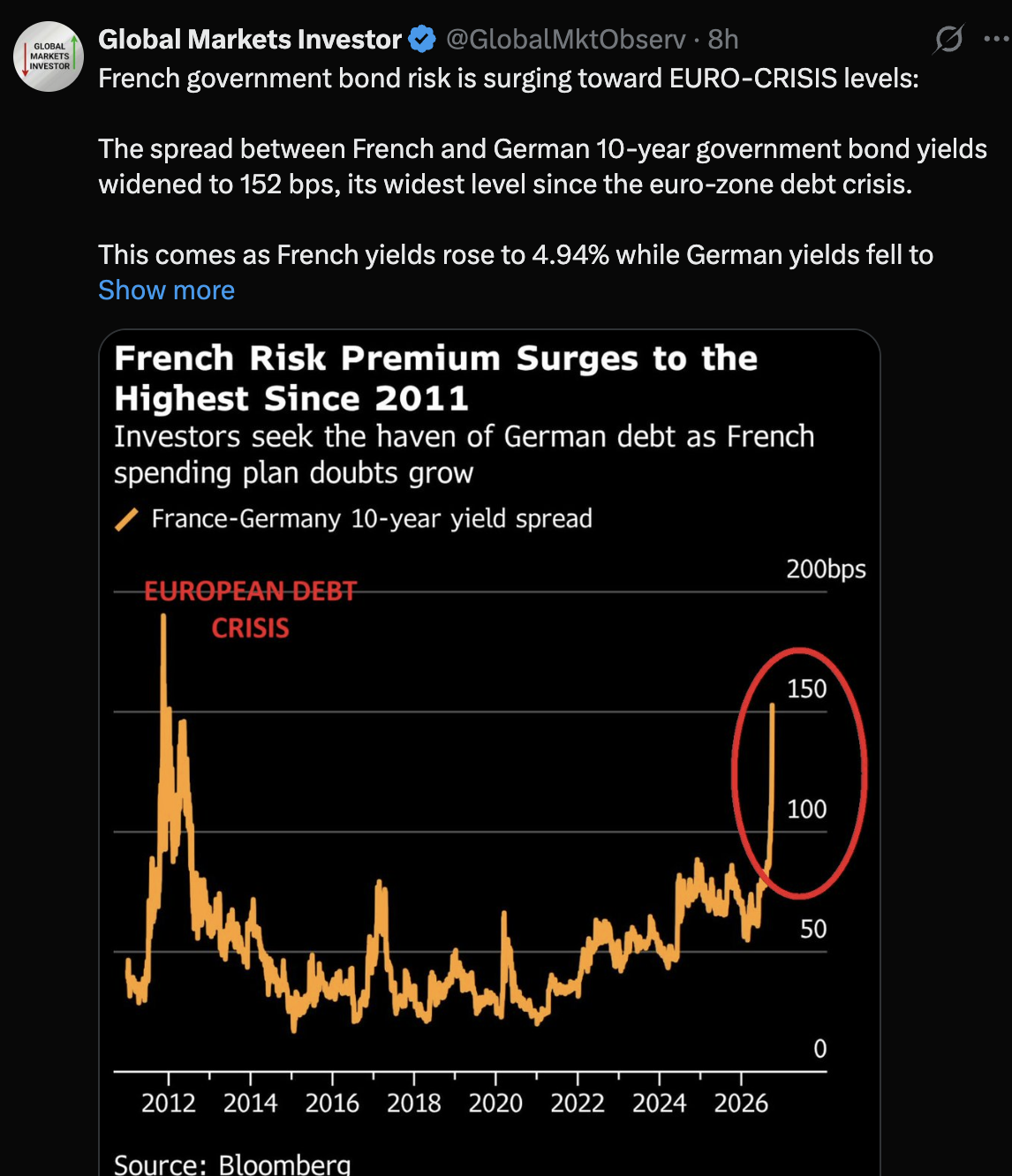
Source: @GlobalMktObserv

Source: @Barchart
I found this next post interesting - I smell a whiff of panic:

Source: @elerianm
Opinions are subject to change. Not a recommendation to buy or sell any security. Provided for discussion and educational purposes only.
If you like what you are reading, click on the link and share it with a friend (it’s free).
CLICK HERE TO SUBSCRIBE TO ON MY RADAR
Trade Signals: October 1, 2026 Update
Trade Signals
The Indicators Dashboard - Stocks, Investor Sentiment, Bonds, Commodities, Currencies, and Gold
Valuations and Subsequent 10-year Returns
Supporting Charts with Explanations

TRADE SIGNALS SUBSCRIPTION ACKNOWLEDGEMENT / IMPORTANT DISCLOSURES
About Trade Signals - Trade Signals is a paid subscription service that posts daily, weekly, and monthly market trends (and more). Free for CMG clients. Not a recommendation to buy or sell any security. For discussion purposes only.
The views expressed herein are solely those of Steve Blumenthal as of the date of this report and are subject to change without notice. Please note that the information provided is not recommended for buying or selling any security and is provided for discussion purposes only.
Personal Note: Penn State, Stonewall, NYC and Boston
By the time this OMR hits your inbox, I'll be on the PA Turnpike, heading for Route 322 West and on to Penn State. Once you cross the Susquehanna, the drive along the Juniata and up over Seven Mountains is about as beautiful as Pennsylvania gets, especially this time of year. Former teammates from the late '70s and early '80s are gathering to watch the Nittany Lions take on Ohio State. I looked down the list of attendees and smiled. Can't wait to see him, and him, and him… not a single one I'd skip. I'm super excited.
We'll visit with the coaches, players, and their parents after the game. Then it's off to the Phyrst, my favorite State College bar, for an ice-cold IPA. Many friendships to catch up on.
There are more events planned for Saturday, but I'll need to leave before the evening banquet for a family surprise party. More on that later, or I'll blow the surprise.
Next week, we host an advisor client event at Stonewall, starting Tuesday afternoon and running through early afternoon Wednesday. Two days of golf and networking. One of our guests is an equity option hedging expert. With valuations where they are, if not now, when? I'll share a few more pictures next week.
If you are a golfer, please reach out to me, it’d be my pleasure to host you at Stonewall.

Stonewall Golf Club. Photos by Michael Gale

Stonewall. A big hat tip to Michael Gale
NYC and Boston follow.
Friars update: The boys tied 0–0 on Monday and sit at 5–0–2. I won't make this afternoon's game against The Haverford School, but I've been strategizing with Coach Sue all week. The plan is to mark their defensive midfielder out of the game and put our best defender on their right midfielder. Then we're counting on our non-soccer athletes ("the athletes," as Coach calls them) to create havoc with a dog-like, out-work-'em mentality. Man for man, Haverford is stronger, but there is no "I" in this year's Malvern Prep team. Underdogs are hungry dogs, and hungry dogs run faster. I'm hoping we come out hungry. Go Friars!
If you're curious and reading this after October 2nd, you can find the result here.
Congratulations to the Atlanta Braves. They ended an improbable Phillies World Series dream last night. The Dodgers have an Avengers-like lineup and the Brewers look strong. I do like the Yankees and will be watching with interest. Fun stuff. Good luck to your favorite team(s).
Fall is here. Enjoy the magic of the changing colors.
Kind regards,
Steve
CLICK HERE TO SUBSCRIBE TO ON MY RADAR - IT’S FREE
You can share this letter on X by clicking here.
You can share this letter on LinkedIn by clicking here.
Subscribe to OMR for free by clicking the photo.
Stephen B. Blumenthal
Executive Chairman & CIO
CMG Capital Management Group, Inc.
75 Valley Stream Parkway, Suite 201,
Malvern, PA 19355
CMG Customer Relationship Summary (Form CRS)
Metric-Financial, LLC Customer Relationship Summary (Form CRS)

Stephen Blumenthal founded CMG Capital Management Group in 1992 and serves today as its Executive Chairman and CIO. Steve authors a free weekly e-letter entitled, “On My Radar.” Steve shares his views on macroeconomic research, valuations, portfolio construction, asset allocation and risk management. Author of Forbes Book: On My Radar, Navigating Stock Market Cycles.
Follow Steve on X @SBlumenthalCMG and LinkedIn.
IMPORTANT DISCLOSURE INFORMATION
This document is prepared by CMG Capital Management Group, Inc. (“CMG”) and is circulated for informational and educational purposes only. There is no consideration given to the specific investment needs, objectives, or tolerances of any of the recipients. Additionally, CMG’s actual investment positions may, and often will, vary from its conclusions discussed herein based on any number of factors, such as client investment restrictions, portfolio rebalancing, and transaction costs, among others. Recipients should consult their own advisors, including tax advisors, before making any investment decision. This material is for informational and educational purposes only and is not an offer to sell or the solicitation of an offer to buy the securities or other instruments mentioned. This material does not constitute a personal recommendation or take into account the particular investment objectives, financial situations, or needs of individual investors which are necessary considerations before making any investment decision. Investors should consider whether any advice or recommendation in this research is suitable for their particular circumstances and, where appropriate, seek professional advice, including legal, tax, accounting, investment, or other advice. The views expressed herein are solely those of Steve Blumenthal as of the date of this report and are subject to change without notice.
Investing involves risk.
This letter may contain forward-looking statements relating to the objectives, opportunities, and future performance of the various investment markets, indices, and investments. Forward-looking statements may be identified by the use of such words as; “believe,” anticipate,” “planned,” “potential,” and other similar terms. Examples of forward-looking statements include, but are not limited to, estimates with respect to financial condition, results of operations, and success or lack of success of any particular market, index, investment, or investment strategy. All are subject to various factors, including, but not limited to, general and local economic conditions, changing levels of competition within certain industries and markets, changes in legislation or regulation, Federal Reserve policy, and other economic, competitive, governmental, regulatory, and technological factors affecting markets, indices, investments, investment strategy and portfolio positioning that could cause actual results to differ materially from projected results. Such statements are forward-looking in nature and involve a number of known and unknown risks, uncertainties, and other factors, and accordingly, actual results may differ materially from those reflected or contemplated in such forward-looking statements. Investors are cautioned not to place undue reliance on any forward-looking statements or examples. All statements made herein speak only as of the date that they were made. Investing is inherently risky and all investing involves the potential risk of loss.
Past performance does not guarantee or indicate future results. Different types of investments involve varying degrees of risk, and there can be no assurance that the future performance of any specific investment, investment strategy, or product (including the investments and/or investment strategies recommended or undertaken by CMG), or any non-investment related content, made reference to directly or indirectly in this commentary will be profitable, equal any corresponding indicated historical performance level(s), be suitable for your portfolio or individual situation or prove successful. Due to various factors, including changing market conditions and/or applicable laws, the content may no longer be reflective of current opinions or positions. Moreover, you should not assume that any discussion or information contained in this commentary serves as the receipt of, or as a substitute for, personalized investment advice from CMG. Please remember to contact CMG, in writing, if there are any changes in your personal/financial situation or investment objectives for the purpose of reviewing/evaluating/revising our previous recommendations and/or services, or if you would like to impose, add, or to modify any reasonable restrictions to our investment advisory services. Unless, and until, you notify us, in writing, to the contrary, we shall continue to provide services as we do currently. CMG is neither a law firm, nor a certified public accounting firm, and no portion of the commentary content should be construed as legal or accounting advice.
No portion of the content should be construed as an offer or solicitation for the purchase or sale of any security. References to specific securities, investment programs or funds are for illustrative purposes only and are not intended to be, and should not be interpreted as recommendations to purchase or sell such securities.
This presentation does not discuss, directly or indirectly, the amount of the profits or losses realized or unrealized, by any CMG client from any specific funds or securities. Please note: In the event that CMG references performance results for an actual CMG portfolio, the results are reported net of advisory fees and inclusive of dividends. The performance referenced is that as determined and/or provided directly by the referenced funds and/or publishers, has not been independently verified, and does not reflect the performance of any specific CMG client. CMG clients may have experienced materially different performance based upon various factors during the corresponding time periods. See in links provided citing limitations of hypothetical back-tested information. Past performance cannot predict or guarantee future performance. Not a recommendation to buy or sell. Please talk to your advisor.
Information herein has been obtained from sources believed to be reliable, but we do not warrant its accuracy. This document is general communication and is provided for informational and/or educational purposes only. None of the content should be viewed as a suggestion that you take or refrain from taking any action nor as a recommendation for any specific investment product, strategy, or other such purposes.
In a rising interest rate environment, the value of fixed-income securities generally declines, and conversely, in a falling interest rate environment, the value of fixed-income securities generally increases. High-yield securities may be subject to heightened market, interest rate, or credit risk and should not be purchased solely because of the stated yield. Ratings are measured on a scale that ranges from AAA or Aaa (highest) to D or C (lowest). Investment-grade investments are those rated from highest down to BBB- or Baa3.
NOT FDIC INSURED. MAY LOSE VALUE. NO BANK GUARANTEE.
Certain information contained herein has been obtained from third-party sources believed to be reliable, but we cannot guarantee its accuracy or completeness.
In the event that there has been a change in an individual’s investment objective or financial situation, he/she is encouraged to consult with his/her investment professional.
Written Disclosure Statement. CMG is an SEC-registered investment adviser located in Malvern, Pennsylvania. Stephen B. Blumenthal is CMG’s founder and CEO. Please note: The above views are those of CMG and its CEO, Stephen Blumenthal, and do not reflect those of any sub-advisor that CMG may engage to manage any CMG strategy, or exclusively determines any internal strategy employed by CMG. A copy of CMG’s current written disclosure statement discussing advisory services and fees is available upon request or via CMG’s internet web site at www.cmgwealth.com/disclosures. CMG is committed to protecting your personal information. Click here to review CMG’s privacy policies.
See CMG Disclosures at the bottom of this page.
For more information about NDR, please visit at www.ndr.com.
NDR, Inc. (NDR), d.b.a. Ned Davis Research Group (NDRG), any NDRG affiliates or employees, or any third-party data provider, shall not have any liability for any loss sustained by anyone who has relied on the information contained in any NDRG publication. The data and analysis contained herein are provided "as is." NDRG disclaims any and all express or implied warranties, including, but not limited to, any warranties of merchantability, suitability or fitness for a particular purpose or use. NDRG's past recommendations and model results are not a guarantee of future results. This communication reflects our analysts' opinions as of the date of this communication and will not necessarily be updated as views or information change. All opinions expressed herein are subject to change without notice. NDRG or its affiliated companies or their respective shareholders, directors, officers and/or employees, may have long or short positions in the securities discussed herein and may purchase or sell such securities without notice. For NDRG's important additional disclaimers, refer to www.ndr.com/invest/public/copyright.html. Further distribution prohibited without prior permission. Copyright 2025 © NDR, Inc. All rights reserved.
The opinions are mine. Please know that there are no guarantees the above will prove correct, and that views are subject to change. See essential disclosures further below.